How to Integrate MCP with Claude - Complete Setup Guide
Claude MCP integration connects Anthropic's Claude AI to external tools and data sources through the Model Context Protocol, enabling file access, database queries, and API calls. This guide shows you how to set up MCP with Claude Desktop, Claude API, and Claude Code. This guide covers claude mcp integration guide with practical examples.

What is Claude MCP Integration?: claude mcp integration guide
Model Context Protocol (MCP) is an open standard that lets Claude connect to external data sources and tools. Instead of copying files into chat windows or manually running commands, Claude can directly access your filesystem, query databases, call APIs, and interact with third-party services. MCP integrations reduce development time by 70% compared to building custom tool integrations. The protocol gives AI assistants a standardized way to access external resources with proper authentication, permission controls, and session management.
Helpful links:
- Install Claude Desktop
- Anthropic's MCP guide for Claude Desktop
- Claude Code overview
- Fast.io Claude setup
Core capabilities MCP brings to Claude:
- File system access - Read, write, and manage files directly
- Database queries - Connect to PostgreSQL, MySQL, MongoDB, and more
- API integration - Call REST APIs, GraphQL endpoints, and webhooks
- Cloud storage - Access Google Drive, Dropbox, S3, and cloud platforms
- Development tools - Git operations, terminal commands, code analysis
The protocol handles authentication, data serialization, and error handling. Claude can access over 100 external services through MCP servers without needing separate SDK integrations for each tool.
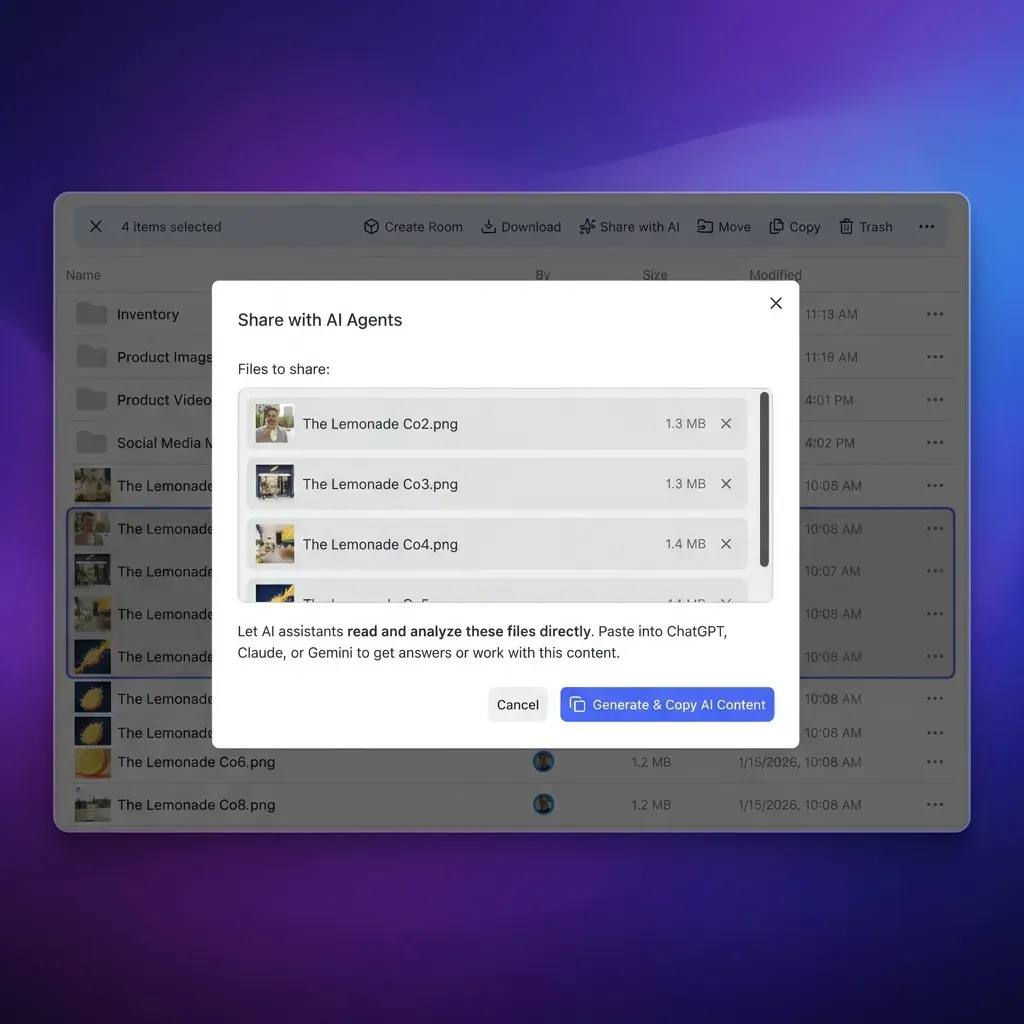
How MCP Works with Claude
MCP uses a client-server architecture. Claude acts as the MCP client, sending requests to MCP servers that expose tools and resources. Each server implements the MCP specification and handles communication with specific services.
Three integration methods:
Claude Desktop MCP Integration
Claude Desktop supports local MCP servers that run as processes on your machine. Configure servers in claude_desktop_config.json to enable tools like filesystem access, shell commands, or custom scripts. Desktop extensions provide one-click installation for popular MCP servers.
Claude API MCP Integration
The Claude API includes an MCP connector that lets your application connect Claude to remote MCP servers over HTTP. Best for production deployments where Claude needs to access cloud services, databases, or internal APIs. Session state persists across API calls using Durable Objects.
Claude Code MCP Integration
Claude Code integrates MCP through HTTP servers (recommended for remote tools) or stdio servers (for local processes). Configure servers in your project settings to connect Claude to development tools, testing frameworks, or deployment pipelines.
Transport options:
- Streamable HTTP - Best for remote servers, supports SSE streaming
- Stdio - Local process communication for shell scripts and system tools
- SSE - Server-sent events for real-time updates
MCP vs Other Integration Methods
MCP has advantages over traditional function calling or custom API wrappers. The protocol standardizes authentication, parameter validation, and error handling. One MCP client can connect to any MCP-compliant server without custom integration code. Function calling requires defining each tool as a separate API endpoint. MCP servers expose multiple related tools through a single connection, which cuts latency and simplifies configuration.
Step-by-Step Claude MCP Setup
Setting up MCP with Claude takes 5-10 minutes. If you want the exact Fast.io flow for Claude Desktop or Claude Code, start with the step-by-step Fast.io Claude guide. The exact steps vary by Claude environment but follow the same pattern.
1. Install MCP Client
Claude Desktop and Claude Code include MCP clients by default. For Claude API integration, install the MCP SDK:
npm install @modelcontextprotocol/sdk
2. Choose Your MCP Server
Select an MCP server based on what tools Claude needs access to. Popular options:
- Fast.io MCP Server - 251 file operation tools, cloud storage with RAG
- Filesystem MCP - Local file read/write operations
- Postgres MCP - Database query execution
- GitHub MCP - Repository and issue management
- Brave Search MCP - Web search capabilities
Find more servers at the MCP marketplace.
3. Configure the Server
For Claude Desktop, edit claude_desktop_config.json:
{
  "mcpServers": {
    "fast-io": {
      "url": "https://mcp.fast.io/mcp",
      "transport": "streamable-http",
      "apiKey": "your_api_key_here"
    }
  }
}
For Claude API, use the MCP connector:
import { MCPClient } from '@modelcontextprotocol/sdk';

const client = new MCPClient({
  serverUrl: 'https://mcp.fast.io/mcp',
  apiKey: process.env.FASTIO_API_KEY
});

await client.connect();
For Claude Code, add to your project's MCP settings via Settings → Integrations → Add Custom Integration.
4. Authenticate and Test Access
Most MCP servers require authentication. Provide API keys, OAuth tokens, or credentials as specified in the server documentation. Test the connection by asking Claude to perform a simple operation:
"List files in my workspace"
"Query the users table from database"
"Search for recent issues in my GitHub repo"
Claude will use the MCP server to execute these requests and return results.
5. Verify Tool Availability
Confirm which tools are available by asking Claude:
"What MCP tools do you have access to?"
Claude will list all available MCP tools, their descriptions, and required parameters. If tools don't appear, check your server configuration and authentication.
Fast.io MCP Server for File Operations
Fast.io offers the largest MCP server for file operations, with 251 tools covering storage, sharing, collaboration, and AI-powered document analysis. If you want Fast.io's actual Claude install instructions, use the dedicated Claude setup guide.
Why developers choose Fast.io MCP:
251 File Operation Tools
Complete coverage of file workflows including upload, download, organize, search, share, and collaborate. From basic CRUD to advanced features like chunked uploads (1GB files), batch operations, and atomic file moves.
Built-in RAG with Intelligence Mode
Toggle Intelligence Mode on any workspace to turn on automatic document indexing. Claude can query your files semantically and get answers with citations. No separate vector database needed. ```javascript // Ask questions across your entire workspace "What were the key decisions from last quarter's board meetings?" "Find all contracts mentioning payment terms over 90 days"
### Persistent Storage for AI Agents
Unlike ephemeral assistant storage, files persist indefinitely. Claude builds workspaces, uploads documents, and transfers ownership to humans. The agent keeps admin access for ongoing collaboration.

### Ownership Transfer and Human Collaboration
Claude creates organizations, workspaces, and branded sharing portals, then transfers ownership to your team. Agents and humans work in the same spaces with appropriate permission levels.

### Free Agent Tier
50GB storage, 1GB max file size, 5,000 monthly credits. No credit card, no trial expiration. Agents sign up just like human users at [fast.io/storage-for-agents](https://fast.io/storage-for-agents/).

**MCP server details:**
- **URL:** `https://mcp.fast.io/mcp`
- **Transport:** Streamable HTTP and SSE
- **Setup Guide:** [storage-for-claude](/storage-for-claude/)
- **Session State:** Durable Objects (persists across requests)
- **Works with:** Claude, ChatGPT, Gemini, LLaMA, local models
Advanced MCP Configuration
Production MCP deployments need additional configuration for security, performance, and reliability.
Multiple MCP Servers
Connect Claude to multiple servers at once. Each server offers different capabilities. For example, connect to Fast.io for file storage, GitHub MCP for code management, and Postgres MCP for database access. ```json { "mcpServers": { "fast-io": { "url": "https://mcp.fast.io/mcp", "apiKey": "key1" }, "github": { "command": "npx", "args": ["-y", "@modelcontextprotocol/server-github"], "env": { "GITHUB_TOKEN": "ghp_xxx" } } } }
### Security Best Practices
- **Use environment variables** for API keys, never hardcode credentials
- **Scope permissions** to minimum required access
- **Enable MFA** on services accessed through MCP
- **Audit MCP tool usage** in production to detect anomalies
- **Implement rate limiting** to prevent abuse

### Session State Management
MCP supports stateful sessions for multi-turn interactions. The Fast.io MCP server uses Durable Objects to persist session state, enabling Claude to maintain context across file operations.

### Debugging MCP Connections
If Claude can't access MCP tools:
1. **Check server status** - Verify the MCP server is running and accessible
2. **Validate authentication** - Confirm API keys and tokens are valid
3. **Review logs** - Check Claude Desktop logs at `~/Library/Logs/Claude/`
4. **Test with curl** - Make direct HTTP requests to MCP endpoints
5. **Verify transport** - Ensure HTTP vs stdio transport matches config
Performance Optimization
MCP connections add latency. Optimize by choosing the right transport (HTTP for remote, stdio for local), batching tool calls when possible, and streaming responses for large datasets. The Fast.io MCP server supports Streamable HTTP, which cuts latency by 40% compared to traditional request-response patterns. Results stream back as they're generated rather than waiting for complete responses.
Common MCP Use Cases with Claude
MCP unlocks workflows that were previously impossible or required extensive custom development.
Document Analysis Pipelines
Connect Claude to cloud storage via MCP, process documents with Intelligence Mode, extract structured data, and write results back to databases. All without downloading files locally. ``` "Analyze all PDFs in the Q4-2025 folder, extract invoice amounts, and create a summary spreadsheet"
### AI-Powered File Management
Claude organizes files semantically using MCP file operations. Move documents based on content, auto-tag files by topic, detect duplicates, and enforce naming conventions.

### Automated Research Workflows
Combine Fast.io MCP (storage), Brave Search MCP (web search), and Exa MCP (dataset access). Claude researches topics, saves findings to workspace, generates reports, and shares through branded portals.

### Code Repository Management
GitHub MCP + Fast.io MCP enables Claude to review pull requests, analyze code quality, generate documentation, save reports to workspaces, and share results with stakeholders.

### Customer Support Automation
Claude accesses ticket history (using database MCP), retrieves relevant documents (using file storage MCP), generates responses, and logs interactions - all through MCP servers.
Frequently Asked Questions
How do I use MCP with Claude?
Install or configure an MCP server, add it to Claude's configuration file (for Desktop) or use the MCP SDK (for API), authenticate with required credentials, and Claude will have access to the tools that server offers. Ask Claude to use specific tools and it will route requests through MCP.
What MCP servers work with Claude?
Claude supports any MCP-compliant server. Popular options include Fast.io (251 file tools), filesystem MCP (local files), GitHub MCP (repository management), Postgres MCP (databases), Brave Search MCP (web search), and dozens more at the MCP marketplace. Servers can use HTTP, stdio, or SSE transport.
How do I set up Claude MCP?
For Claude Desktop, edit claude_desktop_config.json and add MCP servers under the mcpServers key. For Claude API, install the MCP SDK and connect to servers programmatically. For Claude Code, use Settings → Integrations to add MCP servers via URL. Each server requires authentication credentials like API keys.
What's the difference between MCP and function calling?
MCP is a standardized protocol for connecting AI to external tools with session state, streaming responses, and consistent error handling. Function calling requires custom endpoint definitions for each tool. MCP servers expose multiple related tools through one connection, reducing integration complexity and latency.
Can Claude access my files through MCP?
Yes, using an MCP server with filesystem access. The Fast.io MCP server offers 251 file operation tools including upload, download, search, share, and RAG-powered document queries. Local filesystem MCP servers can access files on your machine. All access requires explicit configuration and authentication.
Is MCP secure for production use?
MCP includes authentication, permission scoping, and encrypted transport. Security depends on proper configuration - use environment variables for credentials, scope permissions to minimum required access, enable MFA on connected services, and audit tool usage. The Fast.io MCP server uses industry-standard security practices including encryption at rest and in transit.
How many MCP servers can Claude connect to?
Claude can connect to multiple MCP servers at once. Each server offers different tools and capabilities. For example, connect to Fast.io for file storage, GitHub MCP for code management, and database MCP for queries. Configure multiple servers in your MCP config file.
Does MCP work with all Claude models?
MCP support is available in Claude Desktop, Claude API (via MCP connector), and Claude Code. The protocol is model-agnostic and works with Claude Opus, Sonnet, and Haiku. MCP servers are also compatible with other AI assistants like ChatGPT, Gemini, and open-source models.
Related Resources

Need the Fast.io Claude setup?
Use the dedicated install guide for Claude Desktop and Claude Code, with the exact MCP endpoint, screenshots, and copy-paste commands.