Fastio MCP Server Integration Guide for Developers
The Fastio MCP server is a remote server. Your client connects to it over a URL, which means there is no package to install and no process to spawn. This guide covers the three endpoints, how to choose between them, how scoped API keys and OAuth work, what the tool surface reaches, and how the same integration looks from Claude Code, Cursor, Cline, and a custom agent framework. Endpoints and behavior checked on October 5, 2026.


What the Fastio MCP server is
The Fastio MCP server is a remote Model Context Protocol server, hosted by Fastio, that exposes workspaces, shares, files, and the built-in AI layer to any MCP-capable client. It is reached at one of three addresses, depending on the client, listed below.
The word remote is the whole design, and it is the detail most integration guides get wrong. There is no npm package to install, no binary to download, and no subprocess for your client to spawn. Your client opens an HTTP connection to a URL that Fastio operates. In practice that means a client configuration block for Fastio carries a url field, never a command and args pair. If you are copying a config that starts with npx, it is not configuring this server.
That single fact removes most of the work. You are not running infrastructure, you are not versioning a local server against the protocol, and you do not have to redeploy anything when the tool surface changes. You point a client at a URL and authenticate.
Fastio exposes a consolidated MCP toolset rather than a sprawl of single-purpose endpoints. The tools cover the same ground a person covers in the web interface: creating and organizing workspaces, moving files, building shares, importing from other clouds, running semantic search and citation-backed chat, reading structured data out of documents, following activity, and transferring ownership of an organization to a human.
New to the protocol itself? Start with the Model Context Protocol explainer. If you are choosing a client, see the MCP client comparison.
Related guides
- Fastio MCP Server Docker Compose Setup GuideUsing Docker Compose to set up agent environments that connect to the remote Fastio MCP server provides a stable...
- How to Implement Fastio SSE Streaming for MCP ToolsSSE (Server-Sent Events) streaming over MCP allows Fastio to push real-time file updates, extraction progress, and tool...
- How to Implement Fastio MCP with LangGraphIntegrating Fastio's MCP server with LangGraph lets your stateful agent workflows read, write, and share files across...
- How to Implement OpenTelemetry Tracing for Fastio MCP ServersLearn how to implement OpenTelemetry tracing for Fastio MCP servers to see how your AI agents actually work. This guide...
- Top 7 MCP Servers for Databases: Connecting Agents to Data (2026)MCP servers for databases connect AI agents to structured data storage. This guide ranks the top 7 servers for...
- What Is Model Context Protocol (MCP)?Model Context Protocol (MCP) is an open standard that lets AI agents connect to external data sources and tools through...
More on this subject: MCP and Model Context Protocol (244 guides)
The three endpoints, and which one to use
Fastio publishes three endpoints. All three reach the same account; they differ in the shape in which they present the tools, so pick the one for your client.
Streamable HTTP is the current transport and the one to build against. The older /mcp and /sse addresses keep working for existing setups, but new setups should use the address for their client. There is no option in which the server runs on your machine, because this server does not run on your machine.
There is one genuine local path, and it belongs to a different product. The Fastio CLI ships its own MCP server, started with fastio mcp, for clients that can only spawn a local stdio process. That is the CLI's server, not this one. Reach for it when a client gives you no way to enter a URL, and treat the two as separate integrations rather than two modes of the same thing. A longer treatment of the transport choice lives in Streamable HTTP versus SSE.
How to authenticate
Two credential paths reach the same tools, and the right one depends on whether a human is present at setup time.
OAuth, for interactive clients. Browser-based login means an agent never handles your password. The client sends you to Fastio, you approve, and the client receives a token. On the Review Permissions screen you choose Read Only or Read & Write, and which organizations and workspaces the connection can reach. This is the path to use in a desktop client or an editor, and it is what a client gets when it connects without an Authorization header.
Scoped API keys, for everything unattended. A human creates a key and grants it to the agent. Keys are scoped, so a key can be limited to specific organizations, workspaces, or shares rather than everything the creating user can see. Point the client at https://mcp.fast.io/mcp/tools or https://mcp.fast.io/mcp/code, depending on the tools it calls, and send the key as an Authorization: Bearer header on the connection. Two-factor authentication can be required for API-key management itself, which keeps key creation behind a second factor even when key use is automated.
Scope keys narrowly. An agent that writes weekly reports into one workspace needs a key for one workspace. If that agent misbehaves, the blast radius is the workspace you gave it and nothing else. This is the single highest-leverage decision in an agent integration and it costs nothing to get right at setup. There is more on the threat model in MCP server security.
If you are scripting key creation, fastio auth api-key create --name "CI pipeline" does it from the CLI. The CLI reads FASTIO_API_KEY or FASTIO_TOKEN from the environment and keeps profiles under ~/.fastio/.
Configuring a client
Every MCP client wants the same three things: a name, a URL, and a way to attach credentials. The syntax differs, the shape does not.
For a client that handles OAuth, the entry is close to minimal. This is the Cursor form, with the coding-agent address:
{
  "mcpServers": {
    "fastio": {
      "url": "https://mcp.fast.io/mcp/code"
    }
  }
}
For an unattended client using a scoped key, send a bearer header on the connection. This example uses the named tools at /mcp/tools:
{
  "mcpServers": {
    "fastio": {
      "url": "https://mcp.fast.io/mcp/tools",
      "headers": {
        "Authorization": "Bearer ${FASTIO_API_KEY}"
      }
    }
  }
}
Read the key from the environment rather than pasting it into a file you will later commit. Restart the client after saving, and it will negotiate the connection and list the available tools to the model.
Clients vary in where that JSON lives and in whether they support remote servers at all, which is the practical constraint worth checking first. If a client can only spawn a local process, use the CLI's fastio mcp server described above rather than trying to force a URL into a command field.


Point your agent at a workspace it can keep
Connect the remote MCP server, give your agent a scoped key, and hand the finished workspace to a human when the job is done. Monthly plans start with a trial of up to 14 days (credit card required); annual plans have no trial.
What the tools actually reach
The toolset is consolidated, so a small number of tools cover a lot of surface. It is more useful to think in terms of what an agent can accomplish than to count tool names.
Workspaces and files. Agents create workspaces, organize folders, move and copy files, and read file metadata. Uploads use chunked sessions, so large files do not need to fit in a single request. Maximum file size depends on the active plan.
Shares. Send, Receive, and Exchange shares are distinct types rather than one link with flags. An agent can build a Send share for delivering work, a Receive share to collect files from someone with no account, or an Exchange share for two-way work. Shares support branding, guest access, download controls, and passwords where the share type and access mode allow. Single-file shares can be durable or set to expire, carry per-recipient grants you can revoke individually, and are versioned so recipients see the current file with history available.
Import from elsewhere. Rather than pulling a file down and pushing it back up, an agent can have Fastio fetch it directly from Google Drive, Dropbox, OneDrive, or Box over OAuth, with folder structure preserved, or from any public URL. The bytes never round-trip through the agent's host.
The AI layer. When Intelligence is enabled, files are indexed for semantic search, summarization, and citation-backed chat. Search combines exact full-text matching with meaning-based retrieval and returns the matching passages, not just the matching files. Metadata Views go a step further and turn documents into a queryable table: describe the columns you want in plain language, and extraction populates a typed, filterable grid you can sort and click through to the source document. Agents can drive Views programmatically, which is the difference between an agent that can read a folder of contracts and one that can answer questions across them.
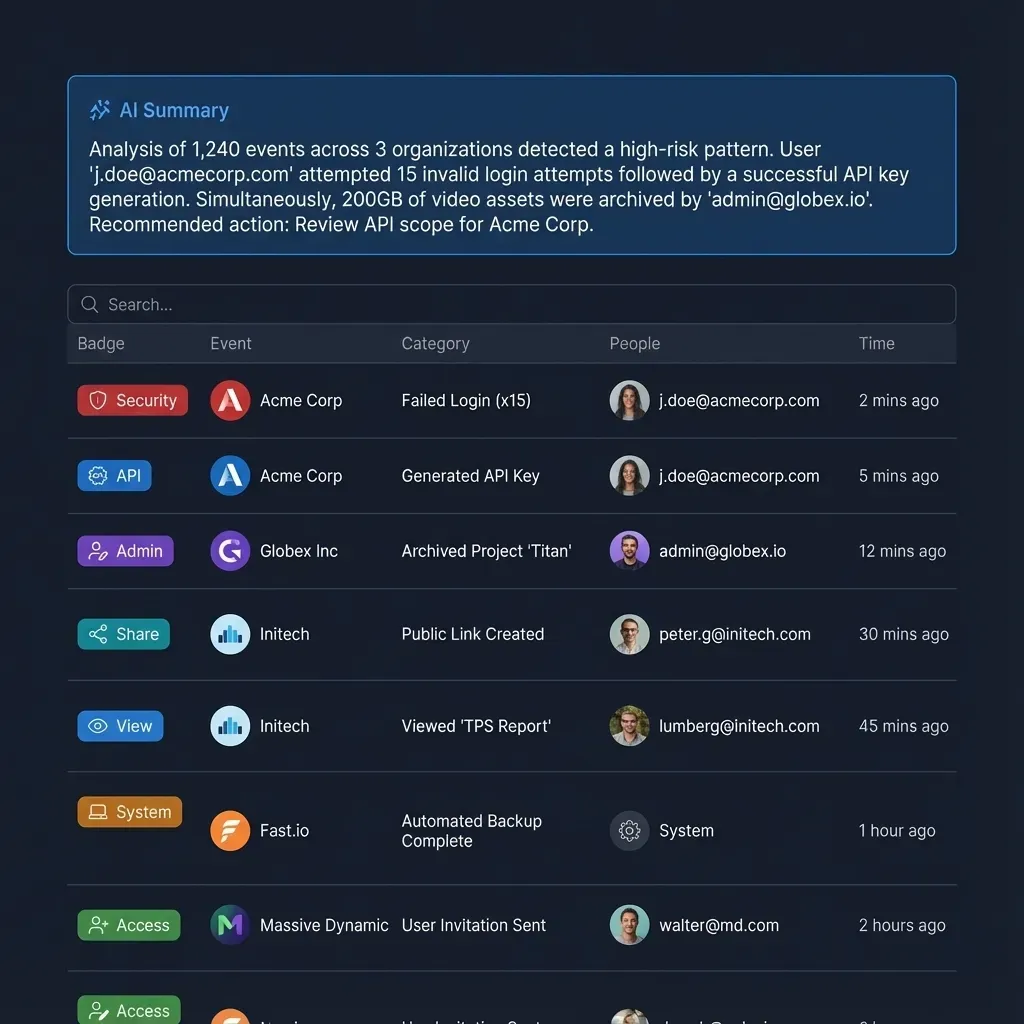
Activity. Agents can poll or subscribe to workspace and share activity instead of walking every resource looking for changes. Activity can also be searched and summarized into a natural-language account of what happened.
One default worth knowing: agent-created workspaces have Intelligence enabled from the start, and Intelligence cannot be re-enabled once it has been disabled. Decide deliberately before turning it off.
Connecting from an agent framework
Framework integrations differ less than their documentation suggests, because they are all solving the same problem: hand the model a set of tools and a way to call them.
If the framework has first-class MCP support, the work is configuration. Register a remote server with the URL and credentials above, and the framework handles discovery and tool-calling. Nothing Fastio-specific is required.
If the framework has no MCP support, do not wait for it and do not go looking for a Fastio client library, because there is not one in any language. Call the REST API directly with whatever HTTP library the language already has: requests in Python, fetch in JavaScript, reqwest in Rust. The API is the same surface the MCP server sits on top of, and a plain HTTP call is less code than an adapter. Any tutorial offering you a Fastio SDK to install is describing a package that does not exist.
If the framework runs somewhere you cannot easily hold a browser session, send a scoped API key as a bearer token to /mcp/tools or /mcp/code. This is the common shape for scheduled jobs, CI, and long-running services.
The pattern that makes agent work durable is the handoff. An agent can build an organization, populate it, and then transfer ownership to a human through a claim link. The human ends up owning a workspace they can log into and keep, and the agent can retain access to continue maintaining it. That is what separates an agent that produced some files from an agent that delivered something.
Keeping an agent integration accountable
Autonomy is only comfortable when it is reviewable, and three mechanisms carry that here.
The audit log records activity by people and agents, including file operations, membership changes, comments, AI activity, and billing events, and is retained according to your plan. When an agent does something surprising at 3am, use the audit log and activity feed to review what happened and when.
Permissions are granular at every level. Organizations, workspaces, shares, folders, and files each carry their own controls, so read-only access to one folder is expressible rather than approximated.
Version history is complete. Every file keeps its versions and prior ones can be restored, which is the practical answer to an agent that overwrites something it should not have. Recipients of a share always see the current version, with history available.
Fastio runs on certified infrastructure partners including Google Cloud and Cloudflare. Fastio itself does not hold SOC 2, ISO 27001, or HIPAA certification, so if your procurement process requires a certificate in Fastio's own name, raise it early rather than late.
What it costs to build against
Plans include seats, storage and a monthly allowance of usage-based credits, with per-plan limits, which lets teams match capacity to both agent workloads and human collaborators.
Monthly plans can start with a 14-day Business Trial (credit card required) that ends early if the trial credits run out; annual plans have no trial. The Starter plan is $9.99/mo for 3 seats, 250 GB of storage, and 100,000 credits per month; current Business and Enterprise details are on the pricing page.
Bandwidth, and storage beyond the plan, are billed per gigabyte, while credits meter AI work such as chat, document ingestion and agent runs. For an agent integration ingestion is usually the meter to model first, because indexing a large document set is a one-time cost that dwarfs the steady state.
There is a signup path worth knowing for agent-first products: an agent can sign up on its own, do the work, and then hand the organization to a human who creates or joins it and starts the trial.
Sources
References used to verify factual claims in this guide.
-
The Fastio MCP server is remote, with Streamable HTTP at /mcp/tools and /mcp/code, and its earlier /mcp and /sse addresses keep working
-
The Fastio CLI is published on npm as @vividengine/fastio-cli and installs a binary named fastio
-
Monthly plans start with a trial of up to 14 days that requires a credit card, with plans from $9.99/mo
Frequently Asked Questions
Do I need to install anything to use the Fastio MCP server?
No. The server is remote and hosted by Fastio, and clients reach it at a URL such as https://mcp.fast.io/mcp/tools. There is no package to install and no process for your client to spawn, so a client configuration entry carries a url field rather than a command and args pair. If a config you are copying starts with npx, it is not configuring this server.
Which endpoint should I use?
Use https://mcp.fast.io/mcp/tools for Claude and most MCP clients, and https://mcp.fast.io/mcp/code for coding agents such as Claude Code, Cursor, and Cline. ChatGPT and Codex connect through the Fastio plugin, with https://mcp.fast.io/mcp/operations as the alternative for a custom MCP server. Interactive clients sign in with a browser-based OAuth login; CI and unattended agents send a scoped API key as an Authorization Bearer header to /mcp/tools or /mcp/code. The older /mcp and /sse addresses keep working for existing setups.
Is there a Fastio SDK for Python or JavaScript?
No. Fastio ships no language SDK. The three interfaces are the remote MCP server, the REST API at https://api.fast.io/current/, and the Fastio CLI, published on npm as @vividengine/fastio-cli. When you need code in a specific language, make a plain HTTP request against the REST API using that language's ordinary HTTP library.
How do I connect a client that only supports local stdio servers?
Use the Fastio CLI, which ships its own local MCP server started with fastio mcp. That is a separate product from the remote server at mcp.fast.io, so treat it as its own integration rather than a local mode of the hosted server.
How should an agent's credentials be scoped?
Have a human create a scoped API key limited to the specific organizations, workspaces, or shares the agent needs, rather than granting access to everything the creating user can see. Two-factor authentication can be required for API-key management, so key creation stays behind a second factor even when key use is automated.
How much does Fastio cost for developers building an integration?
Monthly plans start with a trial of up to 14 days (credit card required); annual plans have no trial. Creating an account is free, but the work happens inside an organization on a paid subscription. Starter costs $9.99 per month and includes 3 seats, 250 GB of storage, and 100,000 credits per month.
Do I need a separate vector database for semantic search?
No. When Intelligence is enabled on a workspace, files are indexed automatically for semantic search, summarization, and citation-backed chat, and agents reach that through the MCP tools. Note that agent-created workspaces start with Intelligence enabled and it cannot be re-enabled once disabled.
How do agents move large files in from another cloud?
Have Fastio fetch the file directly rather than downloading and re-uploading it. Cloud import covers Google Drive, Dropbox, OneDrive, and Box over OAuth with folder structure preserved, plus import from any public URL. Uploads from the agent's own disk use chunked sessions, and maximum file size depends on the plan.
Related Resources

Point your agent at a workspace it can keep
Connect the remote MCP server, give your agent a scoped key, and hand the finished workspace to a human when the job is done. Monthly plans start with a trial of up to 14 days (credit card required); annual plans have no trial.