Storage Integration for AI Agent Builder Platforms
AI agent builder platforms need storage integration to persist data, access documents, and deliver outputs. This guide covers how top platforms handle storage, what to look for when evaluating options, and how to implement reliable file access for your agents.


Why AI Agent Builders Need Storage Integration
AI agent builder platforms let you create agents through visual interfaces or configuration files. These agents need somewhere to store data between sessions, access input documents, and save outputs. Without storage, agents are stateless, meaning they forget everything when they stop running. Storage integration connects your agent builder to external file systems. This enables several workflows:
- Persistent memory: Agents can save conversation history, learned preferences, or intermediate results across sessions
- Document processing: RAG (retrieval-augmented generation) systems need to ingest PDFs, spreadsheets, and other documents
- Output delivery: Generated reports, images, or datasets need a place to live beyond the agent runtime
- Multi-agent coordination: When multiple agents work together, shared storage acts as their communication layer
Leading platforms now support multiple storage integrations including cloud storage (Google Drive, Dropbox), databases (PostgreSQL, MongoDB), and vector stores (Pinecone, Weaviate). Storage integration quality varies. Some platforms treat storage as an afterthought with basic API wrappers. Others provide native RAG pipelines and built-in indexing. For a comparison of leading frameworks, see our guide on AI agent framework comparison.
Related guides
- 10 Best Storage Solutions for RAG Pipelines in 2026RAG pipelines need two storage layers: document stores for raw files before ingestion, and vector databases for...
- How to Set Up Agentic AI Storage for Persistent Agent MemoryAgentic AI storage provides persistent file and data access that autonomous agents need to complete multi-step tasks...
- Best File Storage for Multi-Agent SystemsFile storage for multi-agent systems gives AI agents a shared file layer with concurrent access controls. Agents can...
- How to Use Supabase Storage for AI AgentsSupabase provides an open-source backend that combines a Postgres database, file storage, and real-time updates into a...
- How to Add File Storage to Vercel AI SDK ApplicationsThe Vercel AI SDK gives you React hooks and server utilities for building AI-powered applications, but file storage for...
- Fastio vs Amazon S3: Best Storage for AI Agent WorkspacesAmazon S3 provides raw object storage, while Fastio gives AI agents an MCP-ready workspace. S3 requires developers to...
More on this subject: Agent Memory and Storage (263 guides)
How Agent Builder Platforms Handle Storage
Different platforms take different approaches to storage integration.
Visual Builder Platforms (No-Code)
Tools like n8n, Flowise, and Dify provide drag-and-drop nodes for storage operations. You add a "Google Drive" node to your workflow, authenticate via OAuth, and connect it to your agent logic.
Strengths: Fast to set up, visual debugging, pre-built connectors.
Weaknesses: Limited to what the platform supports, harder to version control.
Framework-Based Platforms (Code)
LangChain, LlamaIndex, and CrewAI require you to write integration code. You install packages, configure credentials, and call storage APIs programmatically.
Strengths: Unlimited flexibility, works with any API, testable code.
Weaknesses: Steeper learning curve, more maintenance.
Cloud-Native Platforms (Managed)
Google's Vertex AI Agent Builder and similar managed services provide built-in storage. Vertex AI includes Cloud Storage buckets, Firestore for state, and Vector Search for embeddings without separate configuration.
Strengths: Integrated experience, automatic scaling, less infrastructure to manage.
Weaknesses: Vendor lock-in, limited to the platform's ecosystem.
Key Features to Evaluate
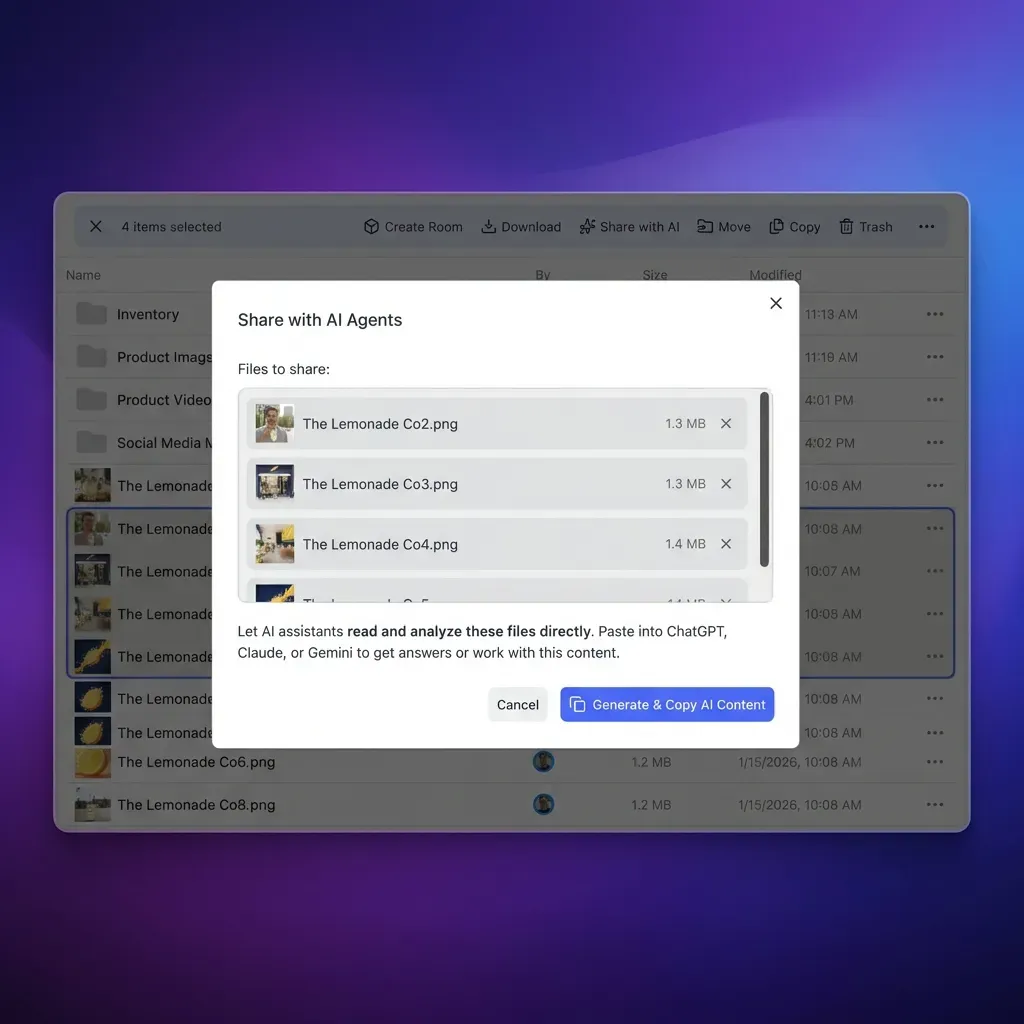
When choosing an agent builder platform, assess storage capabilities across these dimensions:
File Operations
Can agents upload, download, list, and delete files? Most platforms support basic CRUD, but check file size limits. Some cap uploads at 10MB while others handle multi-GB datasets.
Authentication Methods
OAuth is ideal for connecting to services like Google Drive or Dropbox. API keys work for S3-compatible storage. The best platforms support multiple auth methods and let you store credentials securely.
RAG Pipeline Support
If you're building document Q&A agents, look for built-in document loaders and embedding generators. Platforms like LlamaIndex and LangChain have dedicated connectors for PDFs, Word docs, and CSVs that automatically chunk and embed content.
Vector Database Integration
RAG systems need vector storage for embeddings. Check whether the platform works alongside Pinecone, Weaviate, ChromaDB, or other vector databases. Some (like Vertex AI) include managed vector stores.
Persistence Options
Where does data live between agent runs? Options include:
- Ephemeral: Data disappears when the agent stops (OpenAI Assistants File API)
- Session-scoped: Data persists for hours or days, then expires
- Permanent: Data lives indefinitely until deleted
Production agents require permanent storage. For a deeper look at persistence options, see our guide on AI agent persistent storage.
Storage Integration Reduces Agent Failures
Reliable storage integration prevents common agent failure modes. Storage-related issues are a frequent cause of agent failures in production environments.
Race Conditions
When multiple agents access the same file simultaneously, race conditions can occur. Fastio provides advisory file locks that agents acquire before editing, heartbeat while working, and release when done. If concurrent writes do land, automatic file version history preserves every revision. For more on shared file access patterns, see multi-agent file sharing.
Data Loss
Ephemeral storage (like OpenAI's file API) deletes files after a timeout. If your agent needs to reference a document days later, it's gone. Persistent storage prevents this.
Context Limits
Loading entire documents into agent context burns tokens fast. Better to chunk documents into a vector database during ingestion, then retrieve only relevant sections at query time. Platforms with built-in RAG handle this automatically.
URL Import Issues
Many agents need to pull files from external sources (a Google Drive link shared by a user). Some platforms require downloading locally first, then re-uploading to your storage. Fastio's URL Import feature pulls files directly from Google Drive, OneDrive, Box, and Dropbox via OAuth, skipping the local download step.


Give Your AI Agents Persistent Storage
Fastio provides AI agents with their own cloud storage accounts, a consolidated MCP toolset, built-in RAG once Intelligence is enabled, and ownership transfer for client delivery. Works with any LLM or agent framework.
Comparison of Popular Agent Builder Platforms
Here's how leading platforms compare on storage integration:
n8n: Drag-and-drop workflow builder with 400+ integrations including Google Drive, Dropbox, S3, and SFTP. Stores agent state in PostgreSQL or SQLite. No built-in RAG, but you can chain LLM nodes with vector database nodes manually.
Flowise: Open-source LangChain UI with visual node editing. Works alongside Pinecone, ChromaDB, and Supabase for vector storage. Supports document loaders for PDFs and web pages. State persistence via PostgreSQL.
Dify: Full-stack agent platform with built-in vector database. Handles document ingestion, chunking, and embedding automatically. Works alongside external storage (S3, Azure Blob) for large files.
LangChain: Python/JS framework requiring code. Supports 100+ document loaders and vector stores. No opinions about where you store data, so bring your own S3 bucket or database.
LlamaIndex: Focused on RAG workflows. Excellent document loaders for complex formats (PDFs with tables, code repositories). Works alongside every major vector database.
Vertex AI Agent Builder: Google's managed platform. Includes Cloud Storage for files, Vector Search for embeddings, and Firestore for structured data. All managed and auto-scaling.
Fastio: Cloud storage built for AI agents. Agents connect through the remote MCP server (consolidated MCP toolset) or the REST API, persist files in workspaces, and query them with built-in RAG. Intelligence Mode auto-indexes workspace files for semantic search. Ripley, the built-in agent, returns answers with citations. Works with any LLM (Claude, GPT-4, Gemini, LLaMA) via MCP or REST.
Which Platform Has the Best Storage Integration?
It depends on your use case. For more on selecting the right platform, see our AI agent framework comparison.
- For visual builders: n8n or Flowise if you prefer no-code
- For RAG-heavy workloads: LlamaIndex or Dify (built-in pipelines)
- For maximum flexibility: LangChain (supports everything, requires code)
- For managed simplicity: Vertex AI (Google ecosystem only)
- For agent-first storage: Fastio (built specifically for AI agent workflows)
Implementing Storage in Your Agent
Here's a practical implementation guide for common scenarios.
Scenario 1: Document Q&A Agent
Goal: Agent answers questions about uploaded PDFs. Storage needs:
- Store original PDFs (permanent)
- Vector database for embeddings
- Cache for frequently accessed chunks
Implementation with Fastio:
- Agent creates a workspace for each project
- User uploads PDFs to the workspace
- Enable Intelligence Mode on the workspace (auto-indexes files for RAG)
- Agent asks Ripley through the MCP
ai_managetool (actionask) and gets a cited answer - Results include source file references
Scenario 2: Multi-Agent Research Team
Goal: Multiple agents collaborate on research tasks, sharing intermediate results. Storage needs:
- Shared workspace for raw research data
- Individual agent folders for work-in-progress
- Final report storage with version history
Implementation:
- Create a workspace with multiple agent members
- Each agent gets its own subfolder with write access
- Use version history and permissions when editing shared documents
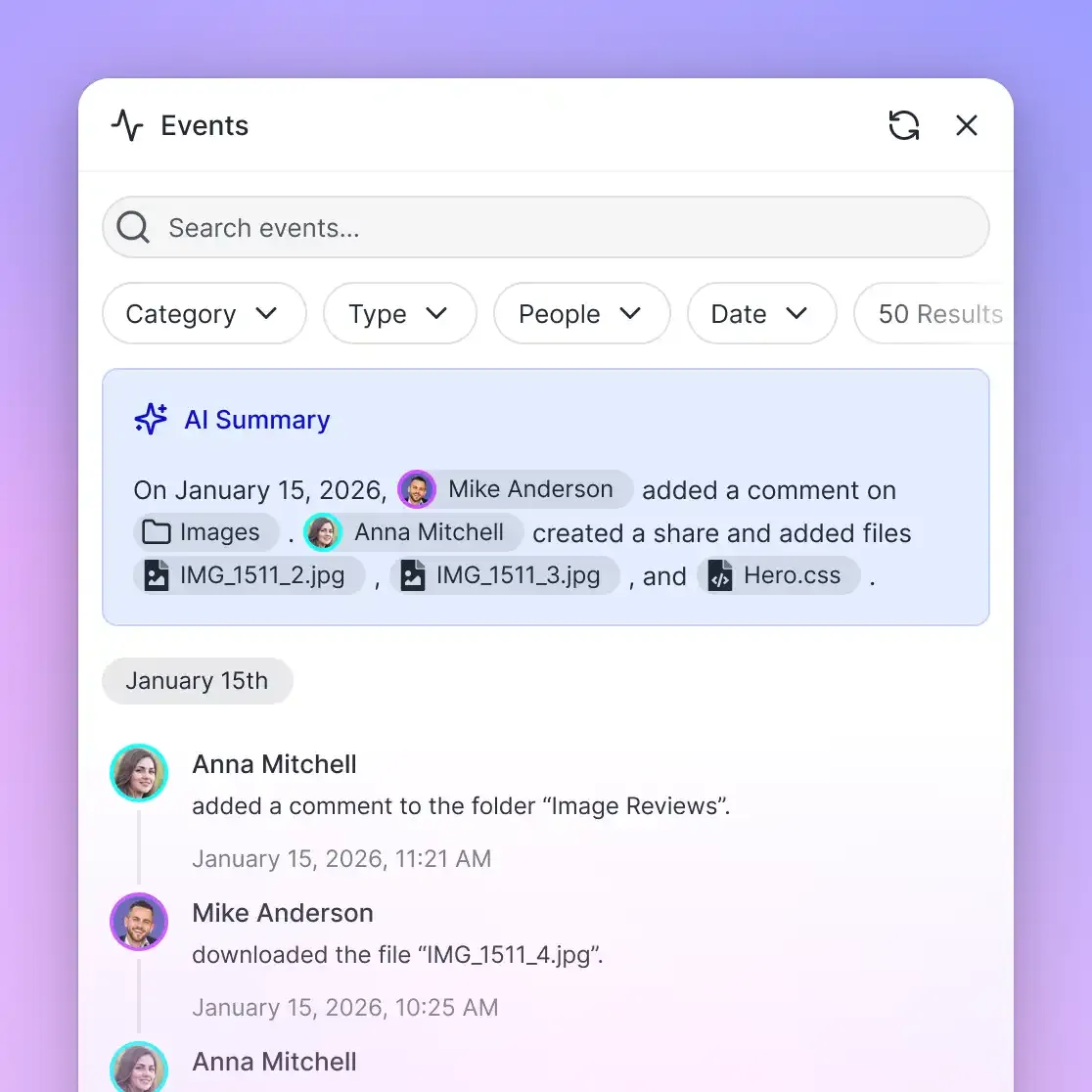
- Agents watch workspace activity (long-poll or event search) when new data arrives
- Transfer ownership to human user when research is complete
Scenario 3: Report Generation Agent
Goal: Agent generates PDF reports from data and delivers them to clients. Storage needs:
- Template storage (logos, formatting files)
- Data input folder (CSVs, JSON)
- Output folder for generated PDFs
- Branded portal for client download
Implementation:
- Agent workspace contains template assets
- Client uploads data files via upload portal
- Agent processes data, generates PDF using templates
- Agent creates a branded Send link with password protection
- Client receives download link with custom branding
Code Example: File Upload with Fastio
Point the agent at Streamable HTTP on https://mcp.fast.io/mcp/tools and send the API key as a Bearer token. A tools/call that imports a PDF into the workspace looks like this:
{"jsonrpc":"2.0","id":1,"method":"tools/call",
 "params":{"name":"upload_manage","arguments":{"action":"web-import","url":"https://example.com/report.pdf",
 "profile_type":"workspace","profile_id":"1234567890123456789"}}}
Get an API key in Settings > Devices & Agents > API Keys. After the import, enable Intelligence Mode on the workspace so Ripley can answer questions about the PDF with citations.
MCP Integration for Agent Builders
Model Context Protocol (MCP) standardizes how AI agents connect to external resources. Agent builders that support MCP can connect to any MCP server, including Fastio's.
What is MCP?
MCP defines a protocol for AI agents to discover and use tools (functions that interact with external systems). Fastio's MCP server exposes action-routed tools such as upload, storage, find, and ai. MCP clients (agent builders) discover available tools and call them on behalf of agents.
Why MCP Matters for Storage
Before MCP, every agent platform had custom integrations. Developers wrote separate connectors for LangChain, CrewAI, n8n, and Flowise. MCP provides one interface that works across all compatible platforms. Fastio provides an MCP server with a consolidated toolset over Streamable HTTP at https://mcp.fast.io/mcp/tools (a headless agent sends its API key as a Bearer header). This includes:
uploadandstoragefor file operationsworkspacefor notes and workspace updatesfindfor unified search across a workspace or shareai_manage(ask) for cited RAG answers from Ripleyshareandfilesharefor branded portals and durable linkseventfor the activity log
Each read tool has a _manage partner, such as upload_manage and storage_manage, that carries its create, update and delete actions.
MCP-Compatible Agent Builders
These platforms support MCP integration:
- Claude Desktop: Native MCP support for Claude agents
- Remote MCP Server: Connect agents directly to
https://mcp.fast.io/mcp/tools - Custom agents: Use the MCP Python SDK or TypeScript SDK to connect
MCP adoption is growing. As more agent builders implement MCP clients, storage integration becomes plug-and-play.

Best Practices for Agent Storage
Organize by Project, Not by Agent
Create one workspace per project, not per agent. Multiple agents can collaborate in the same workspace, making handoffs smoother.
Use Ownership Transfer for Client Delivery
When agents build deliverables for clients, create the workspace under the agent account, then transfer ownership to the client's human account. The agent retains admin access for future updates.
Enable RAG Selectively
Not every workspace needs AI indexing. Toggle Intelligence Mode only for workspaces that require semantic search. This saves processing credits and reduces indexing delays.
Watch Workspace Activity
Agents react to new or changed files by long-polling workspace activity (GET /current/activity/poll/{entityId}?wait=95&lastactivity={timestamp}) or searching the event log (GET /current/events/search/). The MCP event tool covers the same activity log.
Monitor Storage Usage
Track how much storage each agent uses so you can plan capacity as projects grow.
Version Important Files
Enable version history on critical documents. If an agent overwrites a file by mistake, you can restore previous versions.
Sources
References used to verify factual claims in this guide.
-
Consolidated MCP toolset MCP server with a consolidated toolset for file storage MCP Streamable HTTP at https://mcp.fast.io/mcp/tools MCP upload_manage tools/call with action web-import file activity via GET /current/activity/poll/{entityId} audit log via GET /current/events/search/ Ripley cited answers through MCP ai ask Remote MCP server exposes a consolidated toolset REST API or MCP server with a consolidated toolset to manage files chunked uploads through POST /current/upload/
-
n8n workflow builder with 400+ integrations including Google Drive and Dropbox
-
LangChain supports 100+ document loaders LangChain supports 100+ document loaders and vector stores
-
Google Drive supports up to 5TB per file
-
Dropbox supports up to 2TB file uploads
-
Some platforms cap uploads at 10MB file size limits Visual platforms cap uploads at 10-50MB
-
Fastio works with Claude, GPT-4, Gemini, and LLaMA via MCP or REST API
Frequently Asked Questions
Which AI agent builders support file storage integration?
Most major platforms support storage integration, including n8n, Flowise, Dify, LangChain, LlamaIndex, CrewAI, AutoGen, and Vertex AI Agent Builder. The integration method varies. Visual platforms use drag-and-drop nodes, code frameworks require SDK installation, and managed platforms provide built-in storage. Fastio works with any platform via REST API or MCP protocol.
How do I add storage to my AI agent?
The method depends on your platform. For visual builders (n8n, Flowise), add a storage node to your workflow and authenticate. For code frameworks (LangChain, CrewAI), configure credentials and call the storage APIs those frameworks already support. For Fastio, create an API key in Settings > Devices & Agents > API Keys, connect the MCP server at https://mcp.fast.io/mcp/tools with the key in a Bearer header, and call the named tools, including upload, storage, find, and ai, plus their _manage tools for changes.
What storage solutions work with agent builder platforms?
Agent builders work alongside cloud storage (Google Drive, Dropbox, OneDrive, S3), databases (PostgreSQL, MongoDB, Redis), vector databases (Pinecone, Weaviate, ChromaDB), and specialized agent storage like Fastio. The best choice depends on your use case: vector databases for RAG, cloud storage for large files, databases for structured data, and agent-native platforms for turnkey workflows.
Can multiple AI agents share the same storage?
Yes. Create a shared workspace and add multiple agent accounts as members. Agents can acquire advisory file locks before editing to coordinate concurrent work, while version history preserves every revision. Fastio supports multi-agent workspaces with granular permissions, so you can control which agents can read, write, or delete files. Agents watch the activity feed or event feed when they need to react to new files.
What's the difference between ephemeral and persistent agent storage?
Ephemeral storage (like OpenAI Assistants File API) automatically deletes files after a timeout, typically hours or days. Persistent storage keeps files indefinitely until you explicitly delete them. For production agents that need long-term memory or client deliverables, persistent storage is required. Fastio provides persistent storage by default, so files remain accessible across agent sessions until deleted.
How does RAG work with agent builder storage?
RAG (retrieval-augmented generation) systems ingest documents into a vector database, creating embeddings that represent semantic meaning. When an agent receives a query, it searches the vector database for relevant chunks, then includes those chunks in the LLM context. Some platforms (Dify, Fastio) handle RAG automatically via built-in pipelines. Others (LangChain, LlamaIndex) require you to configure document loaders, embedding models, and vector stores separately. Fastio's Intelligence Mode auto-indexes workspace files. Ripley answers questions with citations through the MCP ai_manage tool (action ask).
Do AI agent builders support file versioning?
Support varies by platform. Managed storage services (Vertex AI, Fastio) include automatic version history. Cloud storage integrations (Google Drive, Dropbox) preserve versions if the underlying service does. File-based platforms (local storage, S3) require you to implement versioning manually using naming conventions or S3 versioning features. Check your platform's documentation for specifics.
What file size limits do agent builders have?
Limits vary widely. Visual platforms often cap uploads at 10-50MB. Cloud storage integrations inherit the service's limits (Google Drive supports up to 5TB per file, Dropbox up to 2TB). Fastio supports chunked uploads (`POST /current/upload/`, then chunk and complete) so agents can persist large files in multiple parts. Always check the platform's documentation and test with representative file sizes.
Can agents transfer files to human users?
Yes. Most platforms support agent-to-human workflows. Agents can create download links, send email notifications with attachments, or add files to shared workspaces accessible by humans. Fastio supports ownership transfer, where an agent builds a complete workspace or data room and hands ownership to a human user while retaining admin access for future updates. This is ideal for client deliverables and collaborative projects.
How secure is storage integration for AI agents?
Security depends on the storage provider and how you configure it. Look for platforms that support encryption at rest and in transit, granular access controls, and audit logging. Fastio provides these plus password-protected shares, domain restrictions, and activity tracking through the event log (`GET /current/events/search/`). Never hard-code API keys in agent code. Use environment variables or secret management services instead.
Related Resources

Give Your AI Agents Persistent Storage
Fastio provides AI agents with their own cloud storage accounts, a consolidated MCP toolset, built-in RAG once Intelligence is enabled, and ownership transfer for client delivery. Works with any LLM or agent framework.