How to Connect AI Agents to Webhooks
Webhooks let AI agents react instantly to real-world events. Instead of checking for updates every minute, agents wait for a trigger. This makes them faster and cheaper to run. This guide shows you how to build event-driven agents that respond immediately to data changes.


What Is AI Agent Webhook Integration?
AI agent webhook integration connects agents to external event streams. This allows them to trigger actions, receive notifications, and act on changes in files, data, or system state. In a traditional setup, an agent might run on a schedule. With webhooks, the agent becomes reactive. It sits idle until a specific event wakes it up. This setup is important for many AI apps. When an agent reacts to an event, it works like a reflex. It can process a document the second it is uploaded or respond to a customer inquiry the moment it hits your database. This push model saves resources and stops you from hitting API rate limits. It allows agents to grow without slowing down or wasting compute cycles.
Helpful references: Fastio Workspaces, Fastio Collaboration, and Fastio AI.

Related guides
- How to Build Event-Driven Agent Workflows with Fastio EventsFastio enables event-driven agent workflows the moment a file changes through real-time WebSocket event feeds and...
- Best Event-Driven Tools for AI Agents (2026 Guide)Event-driven tools for AI agents provide message brokers, event sourcing, and reactive frameworks that enable agents to...
- How to Integrate Fastio Events with Temporal.ioIntegrating Fastio with Temporal.io lets developers start durable workflows whenever files arrive or change in a...
- How to Connect AI Agents to APIs: Integration GuideAI agent API integration connects autonomous agents to external services through REST APIs, MCP servers, or SDKs,...
- Setting Up Google Drive Webhooks: Push Notifications, Expiration, and Workspace SyncGoogle Drive push notifications alert external systems when files and folders change in a monitored drive. Operating a...
- How to Handle Fastio Realtime Events with Python FastAPIHandle Fastio real-time file updates in FastAPI using WebSocket event feeds or activity polling. Build reactive AI...
More on this subject: Agent Integrations and APIs (192 guides)
Webhooks vs. Polling: Why Switch?
For developers, the choice is between polling and webhooks. Polling means checking for updates on a schedule. This creates a delay. If you poll every five minutes, your agent is always behind. Webhooks send data the moment it arrives. Event-driven agents respond much faster than polling-based ones. They also reduce unnecessary API calls compared to polling. This is because polling requires the agent to make a request even when there is no new data. In contrast, webhooks only trigger when something has actually changed.
Comparison of Agent Architectures:


Give Your AI Agents Persistent Storage
Get generous storage and a consolidated MCP toolset during the trial to build agents that respond to real-time events.
How to Configure Webhooks for AI Agents
Setting up a webhook integration requires a clear agreement between the sender and your agent. You need a public endpoint and logic to handle the incoming payload.
Step-by-Step Configuration:
- Create a Webhook Listener Endpoint: Your agent needs a public URL to accept HTTP POST requests. You can use serverless functions like AWS Lambda or Cloudflare Workers. For local testing, tools like Ngrok can tunnel traffic to your local machine.
- Define the Event Schema: Decide which events your agent should care about. If you are monitoring a file system, you might only need
file.createdandfile.updatedevents. Ignore noisy events to save processing power. - Configure the Source Application: Go to the developer settings of the service you want to watch. Add your listener URL and pick your events. Many platforms like GitHub or Stripe provide a dashboard for this.
- Handle the Payload Logic: Write a handler to parse the incoming JSON. Your code should extract the relevant IDs, such as a file path or a user ID, and pass them to your agent's task queue. Example handler in Python (FastAPI):
@app.post("/webhooks/ai-agent")
async def handle_webhook(request: Request):
    payload = await request.json()
    event_type = payload.get("type")
    if event_type == "file.uploaded":
        file_id = payload.get("data", {}).get("id")
        await ai_agent.process_file(file_id)
    return {"status": "success"}
Top Use Cases for Event-Driven Agents
Webhooks change AI agents from simple tools into independent workers. Here are several ways to apply this pattern.
Automated Document Processing When a user uploads a contract to a shared folder, a webhook notifies the agent. The agent uses RAG to read the PDF, identify risky clauses, and save a summary to your database. This process happens in seconds, removing the need for manual data entry.
Real-Time Media Management For video teams, agents can react to new footage. When a raw video file is uploaded, the agent can trigger a transcode, generate a transcript, and notify the editor in Slack. This simplifies the production pipeline without human intervention.
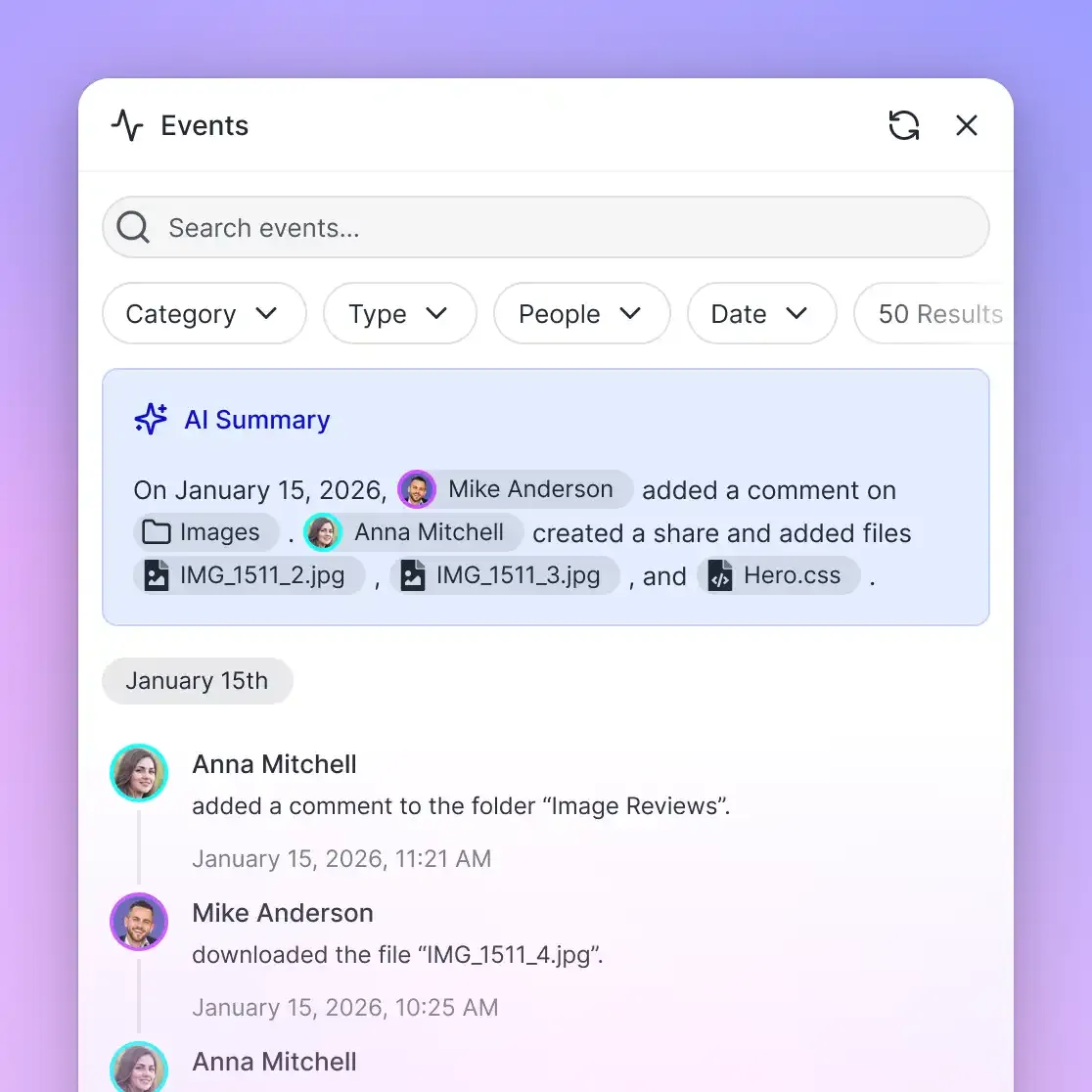
Dynamic Knowledge Base Updates If your agent powers a customer support bot, you want it to have the latest info. When a team member updates a technical doc in Fastio, the realtime activity feed or WebSocket events feed can tell the agent to re-index that specific file. This ensures your bot never gives outdated advice.
Building Reactive Agents with Fastio
Fastio provides persistent storage and a remote Model Context Protocol (MCP) server for agent access.
Consolidated MCP toolset for automation
The MCP server provides a consolidated toolset for file operations, metadata management, and search. Configure a client with Streamable HTTP at https://mcp.fast.io/mcp/tools; a headless agent sends its scoped key as a Bearer header.
Intelligence Mode and Built-in RAG You do not need a separate vector database. By toggling Intelligence Mode on a Fastio workspace, your files are automatically indexed. When an agent detects a new file via the activity feed or WebSocket events feed, it can immediately ask questions about that file using built-in RAG with citations once Intelligence is enabled for the workspace.
Ownership Transfer for Developers Teams can build shared workspaces and hand off access to human collaborators. Configure permissions, shares, and the activity feed or WebSocket events feed to coordinate file changes.
Business Trial for Developers Monthly plans start with a Business Trial of up to 14 days, which requires a credit card; see /pricing/ for current plan details.
Security Best Practices for Agent Webhooks
Securing your webhook endpoint is necessary. Since these URLs are public, you must ensure that only authorized services can trigger your agent.
Verify Signatures (HMAC) Most providers include a cryptographic signature in the headers. Calculate the HMAC of the payload using your shared secret and match it to the header. This confirms the data came from the expected source and was not tampered with.
Implement Idempotency Network issues can cause webhooks to be sent more than once. Design your agent to track unique event IDs. If it sees an ID it has already processed, it should return a success status without running the logic again. This prevents duplicate actions and saves money.
IP Whitelisting If your provider publishes their IP ranges, configure your firewall to only allow traffic from those addresses. This adds an extra layer of defense against malicious requests.
Handling Failures and Retries
Not every webhook will succeed on the first try. Your agent's architecture must be able to handle downtime.
Use a Message Queue Instead of processing the task directly in the webhook handler, push the event to a queue like RabbitMQ, Redis, or AWS SQS. This allows your handler to return a success response immediately. If your agent is busy or down, the task stays in the queue until it can be processed.
Exponential Backoff When an agent fails to process a task, use an exponential backoff strategy for retries. Start with a short delay and increase it after each failure. This prevents your system from being overwhelmed during a partial outage.
Dead Letter Queues (DLQ) If a task fails after several retries, move it to a Dead Letter Queue. This alerts your team to a permanent error that requires human intervention, such as a corrupt file or a logic bug in the agent's prompt.
Sources
References used to verify factual claims in this guide.
-
A consolidated MCP toolset for file operations, metadata management, and search
-
The 14-day Business Trial allows teams to evaluate Fastio workspaces and persistent storage
Frequently Asked Questions
What is the difference between an API and a webhook?
An API is request-driven; your agent must ask the server for data. A webhook is event-driven; the server sends data to your agent automatically when an event occurs. Webhooks are generally better for real-time automation because they eliminate the need for constant polling.
Can I use webhooks with local AI agents?
Yes. You can use a tunneling service like Ngrok or a reverse proxy to route public webhook events to an agent running on your local machine. This is a common pattern for developers using local models like Llama or Mistral while still needing real-time triggers from cloud services.
How many webhooks can an AI agent handle?
The limit depends on your listener's infrastructure. By using a message queue, a single agent can handle high volumes of events. The queue acts as a buffer, allowing the agent to process tasks at its own pace without dropping events.
How does Fastio notify AI agents of file changes?
Fastio does not provide webhooks for file changes. Use activity polling or the WebSocket events feed to coordinate AI agents when files are uploaded, deleted, or modified.
Related Resources

Give Your AI Agents Persistent Storage
Get generous storage and a consolidated MCP toolset during the trial to build agents that respond to real-time events.