Best MCP Servers for Manufacturing AI Agents
MCP servers connect manufacturing agents to PLCs and MES systems, enabling AI-driven automation on the factory floor. This guide evaluates the best Model Context Protocol servers for manufacturing, covering industrial IoT integration, predictive maintenance workflows, and agent-to-human ownership transfer. Find the right tools to build AI agents that work alongside your existing manufacturing infrastructure.

Why Manufacturing AI Agents Need MCP Servers
A manufacturing MCP server acts as the bridge between your AI agent and factory floor systems. Without one, your agent cannot communicate with programmable logic controllers (PLCs), manufacturing execution systems (MES), or industrial IoT sensors. MCP servers standardize how AI models interact with these industrial systems, making it possible to build agents that monitor production lines, trigger maintenance alerts, or approve quality checks.
The manufacturing sector is adopting AI agents at pace, driven by the need to reduce unplanned downtime and improve quality control. Predictive maintenance alone can reduce equipment downtime by multiple-multiple%, according to industry benchmarks. MCP servers make these workflows possible by giving AI agents real-time access to the data they need.
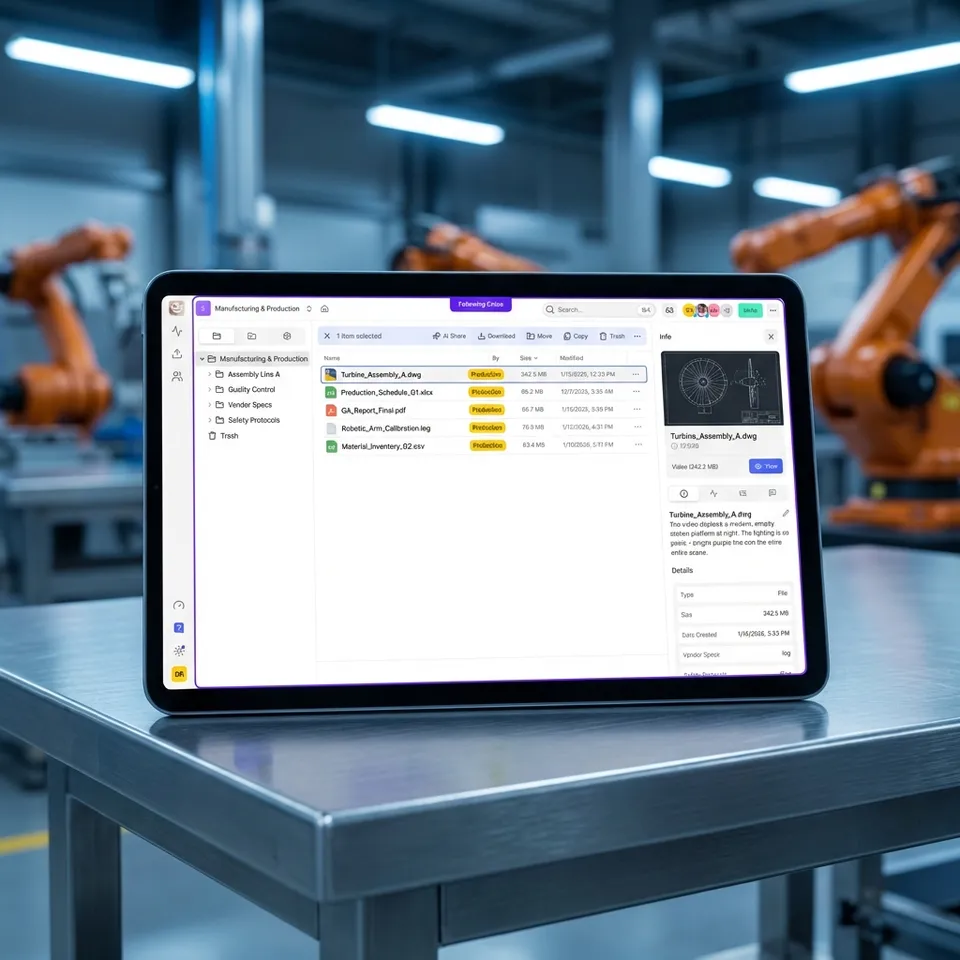
However, most current solutions focus on data collection and monitoring. The missing piece is agent-to-human workspace handoff. When an AI agent compiles quality findings or production analysis, it needs a clean way to hand over complete workspaces to human engineers. Fastio's ownership transfer allows agents to create workspaces and pass ownership to human operators seamlessly.
Helpful references: Fastio Workspaces, Fastio Collaboration, and Fastio AI.
Related guides
- Top 7 Open Source MCP Servers for AI Agents in 2026Open source MCP servers give AI agents direct access to files, databases, and APIs without black-box proprietary...
- Best MCP Servers for LLM Workflows in 2026Model Context Protocol servers give LLMs standardized access to tools, data, and services. With over 10,000 public...
- Best MCP Servers for Search: Connecting AI Agents to Real-Time DataSearch MCP servers connect AI agents to real-time web data, which cuts down on hallucinations and helps agents retrieve...
- 8 Best MCP Servers for Video Processing in 2026MCP servers for video processing let AI agents transcode, analyze, edit, and stream video through Model Context...
- 8 Best MCP Servers for Document Management in 2026MCP servers for document management give AI agents structured access to document repositories with capabilities like...
- Best MCP Servers for File Storage: Top 8 Tools for 2026MCP (Model Context Protocol) servers for file storage give AI agents persistent, structured access to cloud storage...
More on this subject: MCP and Model Context Protocol (244 guides)
What to check before scaling best mcp servers for manufacturing
We evaluated MCP servers based on industrial protocol support, ease of integration with existing manufacturing infrastructure, and ability to handle human handoffs and persistent storage. Here are the top options for building manufacturing AI agents.
1. Fastio MCP Server
The Fastio MCP server provides cloud-native storage and workspace management for manufacturing AI agents. While not purpose-built for industrial protocols, it excels at the data management layer, handling file storage, version control, and audit trails that manufacturing agents need. The server offers multiple tools for file operations, making it suitable for storing quality reports, production logs, and compliance documentation.
- Best For: Manufacturing agents that need persistent storage for quality reports, production analytics, and compliance documentation.
- Key Features: persistent cloud storage for agents, built-in RAG once Intelligence is enabled for searching historical quality data, and ownership transfer for handing off project workspaces to human supervisors.
- Unique Advantage: The combination of file storage with AI-powered search means agents can find relevant historical data quickly once Intelligence is enabled. The ownership transfer feature allows an agent to create an organization or workspace, assemble quality reports, and transfer full ownership to a human supervisor via a claim link.
- Limitations: Does not directly connect to PLCs or industrial protocols; requires additional middleware for hardware-level integration.
2. AWS IoT Core MCP Server
AWS IoT Core provides a managed platform for connecting IoT devices to the cloud. The AWS IoT MCP server allows agents to interact with connected manufacturing equipment, read sensor data, and send commands to industrial devices.
- Best For: Cloud-first manufacturing operations already invested in the AWS ecosystem.
- Key Features: Scalable device management, built-in rules engine, and integration with AWS Lambda for edge processing.
- Limitations: Requires AWS infrastructure; costs can scale quickly with high device counts; setup complexity is higher than simpler alternatives.
3. Siemens MindSphere MCP Server
MindSphere is Siemens' industrial IoT platform, and the MCP server enables agents to connect to Siemens PLCs and industrial equipment directly. This is one of the few options that natively supports industrial protocols used on factory floors.
- Best For: Factories running Siemens equipment seeking deep integration with OPC-UA compliant devices.
- Key Features: Native OPC-UA support, integration with TIA Portal, and access to Siemens-specific diagnostic data.
- Limitations: Vendor lock-in to Siemens ecosystem; limited flexibility for non-Siemens equipment; requires significant configuration for OPC-UA certificates.
4. PTC ThingWorx MCP Server
ThingWorx from PTC offers another industrial IoT path, focusing on digital twin technology and AR-assisted maintenance workflows. The MCP server gives agents access to thing definitions, telemetry data, and asset hierarchies.
- Best For: Manufacturers using PTC ecosystem tools or wanting digital twin capabilities.
- Key Features: Digital twin modeling, AR work instructions, andThingWorx analytics integration.
- Limitations: Premium pricing; steep learning curve; requires PTC ecosystem commitment.
5. Azure IoT Hub MCP Server
Microsoft's Azure IoT Hub provides another cloud pathway for manufacturing agents to interact with industrial equipment. The MCP server supports device management, message routing, and edge deployment scenarios.
- Best For: Manufacturers using Azure services or preferring Microsoft ecosystem integration.
- Key Features: Strong security features, edge computing support, and integration with Azure Functions for custom processing logic.
- Limitations: Requires Azure subscription; can become expensive at scale; some advanced features require premium tiers.



Give Your AI Agents Persistent Storage
Equip manufacturing agents with persistent workspaces, ownership transfer to human supervisors, and built-in RAG once Intelligence is enabled.
Comparing Manufacturing MCP Servers
Choosing the right MCP server depends on your existing infrastructure and specific manufacturing needs. Here is a direct comparison to help you decide.
For most manufacturing AI agent projects, a hybrid approach works best. Use Fastio for persistent storage and workspace handoffs, combined with an industrial IoT platform like AWS IoT Core or Azure IoT Hub for device connectivity. This separation of concerns lets you choose the best tool for each layer of your manufacturing AI system.
If you are running Siemens equipment specifically, MindSphere provides the deepest integration. However, expect higher costs and longer implementation timelines. The key is matching your MCP server choice to your actual manufacturing requirements, not just picking the most popular option.
Managing Agent-to-Human Handoff Workflows
The gap in agent-to-human handoff is a central challenge in manufacturing AI deployments. When an AI agent detects a quality anomaly or analyzes production parameter changes, human engineers must inspect the data in context.
Fastio addresses this through its ownership transfer feature. An agent can create an organization, structure a production workspace, upload reports, and hand it to a human supervisor through a claim link. The supervisor gains complete administrative ownership of the workspace and can inspect all context-rich files and audit trails. The activity log records actions taken by both agents and humans, which helps teams review who did what.
For other platforms, teams must build custom middleware to transfer data and maintain audit state across disjointed systems. This typically involves custom state databases and manual credential sharing.
Consider your handoff requirements early in your architecture planning. Built-in ownership transfer and persistent audit logs make Fastio an effective workspace layer alongside industrial protocol servers.
Frequently Asked Questions
What is the best MCP server for manufacturing predictive maintenance?
AWS IoT Core and Azure IoT Hub both offer strong predictive maintenance capabilities through their analytics services. For deep PLC integration, Siemens MindSphere provides the most direct access to equipment telemetry. Fastio complements these by providing the storage and collaboration layer for maintenance reports and audit trails.
Can MCP servers connect directly to PLCs?
Yes, but it depends on the server. Siemens MindSphere and PTC ThingWorx support OPC-UA directly, which connects to most modern PLCs. AWS IoT Core and Azure IoT Hub use MQTT/HTTP and require edge gateways to communicate with industrial equipment. Fastio does not connect directly to PLCs and requires middleware.
How do manufacturing AI agents hand off workspaces to human supervisors?
Fastio supports ownership transfer, allowing an agent to create an organization, populate quality reports in a shared workspace, and transfer ownership to a human supervisor via a claim link, with a detailed activity log.
Do manufacturing MCP servers support multi-LLM setups?
Most MCP servers are LLM-agnostic since they expose tools rather than embedding a specific model. Fastio specifically notes multi-LLM support including Claude, GPT-multiple, Gemini, LLaMA, and local models. This flexibility lets you choose the best model for your specific manufacturing use case.
Related Resources

Give Your AI Agents Persistent Storage
Equip manufacturing agents with persistent workspaces, ownership transfer to human supervisors, and built-in RAG once Intelligence is enabled.