Document Review Platforms: Evaluating Modern Collaborative Tools for Legal Ops
Document review platforms have expanded beyond adversarial litigation eDiscovery into fast-paced corporate diligence, contract audits, and internal investigations. Legal operations teams evaluating review software must weigh rigid per-gigabyte hosting fees against agile, workspace-based collaboration. This guide compares traditional litigation engines with modern collaborative review workspaces to help legal ops teams accelerate due diligence and control infrastructure costs.


Why Traditional Document Review Platforms Inflate Legal Ops Costs
In the Winter 2026 eDiscovery Pricing Survey published by ComplexDiscovery, 54.7% of respondents reported basic data hosting rates below $10 per GB per month, while 30.2% reported rates between $10 and $20 per GB. While these monthly hosting fees are standard practice in protracted civil litigation, applying legacy eDiscovery billing models to transactional diligence, contract reviews, and corporate investigations creates massive budgetary waste. When legal operations leads and IT managers evaluate legal document review platforms, they frequently inherit software architectures designed exclusively for adversarial courtroom discovery.
Traditional eDiscovery systems operate on an unbundled, per-volume pricing structure. Every gigabyte of ingested raw data incurs an intake processing fee to extract text, unpack archive files, and normalize system metadata. Once loaded into active review databases, that data incurs recurring monthly hosting charges. If a case requires advanced analytics, concept clustering, or technology-assisted review, vendors apply supplemental per-gigabyte fees. Finally, exporting materials requires production charges for stamping and format conversion.
This billing model functions adequately when legal teams pass litigation expenses directly to an adversarial opponent or bill them through an external client matter account. In corporate legal operations, however, this model breaks down. Corporate departments run on fixed quarterly budgets. When an M&A transaction emerges, corporate development and legal teams may collect several hundred gigabytes of vendor agreements, real estate leases, intellectual property filings, and employee records from a target entity.
Subjecting that transactional repository to a traditional litigation engine triggers compounding expenses. Ingestion fees accumulate before any attorney reviews a single page. Monthly hosting charges run continuously while deal negotiations stretch across multiple quarters. Adding outside counsel, corporate finance specialists, and tax advisors requires purchasing individual user seats or licenses. Under these traditional models, transactional due diligence document reviews can incur tens of thousands of dollars in unexpected hosting charges, turning routine commercial audits into severe budget overruns.
Related guides
- How to Build eDiscovery Document Review WorkflowsDocument review typically consumes up to 70% of total eDiscovery spend, presenting a significant financial hurdle for...
- Nextpoint eDiscovery Review: Features, Pricing, and Litigation WorkflowsNextpoint is a cloud-based eDiscovery and litigation support platform that combines evidence processing, document...
- Reveal eDiscovery: Platform Review, AI Capabilities, and Review WorkflowsLitigation discovery bottlenecks rarely occur during document tagging alone; they emerge across the entire data...
- Casepoint eDiscovery: Cloud Platform Review, Legal Hold, and Review ToolsEvaluating enterprise eDiscovery software requires assessing how well preservation workflows bridge into document...
- Electronic Discovery Software: Modern Guide for Legal TeamsElectronic discovery software manages electronically stored information across the litigation lifecycle, from legal...
- DISCO eDiscovery Pricing: Ingestion Costs, Hosting Fees, and Review EconomicsDISCO eDiscovery pricing combines monthly gigabyte hosting fees, processed data measurements, and all-inclusive AI...
More on this subject: Legal Teams (247 guides)
What Defines Document Review for Corporate Due Diligence
Document review platforms are collaborative software environments that enable legal teams, reviewers, and external counsel to inspect, analyze, annotate, and evaluate large sets of documents for compliance, transactional diligence, or legal proceedings.
Industry software directories often treat all document review as a single category centered on litigation eDiscovery. This focus creates a major blind spot for legal operations. In practice, modern corporate legal departments manage two distinct review operational models, and collaborative document review platforms address this division by separating deal diligence from courtroom discovery:
Litigation Review Versus Transactional Diligence
Litigation document review is defensive, forensic, and governed by strict court mandates. The primary objective is identifying responsive documents while aggressively shielding privileged communications from opposing counsel. Litigation software must support forensic container extraction, exact deduplication, Bates numbering, redaction burning, and Federal Rule of Civil Procedure productions.
Transactional review and corporate investigations operate under opposing requirements. In an acquisition, corporate restructuring, or internal compliance audit, legal teams do not produce documents to an adversary. Instead, they inspect internal files to identify commercial risk, verify asset ownership, and extract key contract obligations. Key requirements include:
- Ingestion Velocity: Files must be accessible within minutes of receipt, rather than waiting days for external vendor processing and indexing queues.
- Structured Data Extraction: Reviewers need to surface termination dates, assignment clauses, change-of-control triggers, and liability caps into structured records.
- Multi-Disciplinary Teamwork: Corporate counsel, outside law firms, investment bankers, and forensic accountants must review materials concurrently without prohibitive software onboarding walls.
- Cost Predictability: Storage and access costs must remain predictable rather than scaling unpredictably per gigabyte or per month.
When legal ops managers force corporate diligence into litigation review tools like Relativity, Everlaw, or CS Disco, teams face excessive procedural friction. Setting up a matter in a litigation engine often requires a certified administrator to establish review coding layouts, build batches, and configure search indexes. For a deal team that needs to evaluate several hundred contracts over a weekend, that administrative overhead delays negotiations and inflates deal expenses.
Compare Heavyweight Litigation Engines and Agile Review Workspaces
Evaluating legal review tools requires a structured document review software comparison that examines how architectural choices impact daily legal workflows, matter timelines, and operating costs. The table below contrasts traditional litigation review platforms, legacy virtual data rooms, and agile cloud review workspaces across core operational criteria.
Reviewer Licensing and Collaboration Friction
A critical operational bottleneck in traditional review software is reviewer licensing. Heavyweight platforms charge substantial monthly licensing fees for every active user seat. When an operations team coordinates a fast-moving transaction, deal teams fluctuate constantly. Specialist attorneys may join for three days to evaluate environmental disclosures, while financial auditors review balance sheets for a single week.
Paying recurring user seat charges for intermittent reviewers forces legal operations to ration software access. Associates download unredacted contracts to local drives or share documents through unencrypted email attachments to circumvent user limits. This practice introduces grave data governance and confidentiality risks.
Modern cloud review workspaces resolve this tension by uncoupling storage capacity from external collaborator access. Internal team members operate within shared organizational workspaces, while external reviewers, outside counsel, and financial consultants access designated files through secure, branded shares. Outside guests do not consume internal seats and can review materials through access links without creating accounts, maintaining strict governance while eliminating seat-licensing penalties.


Accelerate Document Review with Collaborative Workspaces
Deploy dedicated matter workspaces, share files securely with outside counsel, and extract contract metadata into queryable tables. Monthly plans start with a 14-day free trial, which requires a credit card. Plans are Starter at $9.99/mo, Business at $49.99/mo, and Enterprise at $199.99/mo.
How to Structure Matter Workspaces and External Access
Organizing a high-volume corporate document review requires deliberate workspace architecture. Legal operations managers should establish standard matter templates that mirror the physical structure of a transaction while maintaining clear access boundaries.
Matter Workspace: Project Horizon Acquisition
├── 01_Inbound_Target_Uploads/ (Receive Share: Target Co Uploads)
├── 02_Active_Review_Repository/ (Workspace Core: Corporate Counsel)
│   ├── Material_Contracts/
│   ├── Corporate_Governance/
│   ├── IP_and_Patents/
│   └── Regulatory_Filings/
├── 03_External_Advisors/ (Scoped Branded Shares: Outside Specialists)
│   ├── Tax_and_Audit/
│   └── Environmental_Disclosures/
└── 04_Closing_Binders_and_Signatures/ (Executed Records and Certificates)
Inbound Document Collection Without Login Walls
The initial phase of any corporate review is gathering source documents from target entities, subsidiaries, or internal business units. Requesting records via email produces version conflicts and risks file truncation on large attachments.
Using a Receive share link allows external target companies to drag and drop corporate records directly into an intake folder. External parties upload files through their browser without creating software accounts or accessing other matter files. For legal operations, this eliminates manual document chasing and centralizes intake into an organized workspace.
Scoped Outbound Sharing and Download Controls
During review, sensitive files must be distributed to external law firms and accounting teams. Rather than issuing universal workspace credentials, legal administrators configure scoped, branded shares. Permissions are set per organization, workspace, and share through member roles, rather than attempting fragile folder or file configurations.
A branded share can be customized with firm logos and visual themes, establishing a professional interface for third parties. To protect sensitive work product during ongoing negotiations, administrators can configure shares with specific expiration dates, password protection, and download restrictions. When downloads are disabled, external reviewers inspect and evaluate documents directly within their browser without saving local copies to unmanaged devices.
Comprehensive Change Tracking and Version Control
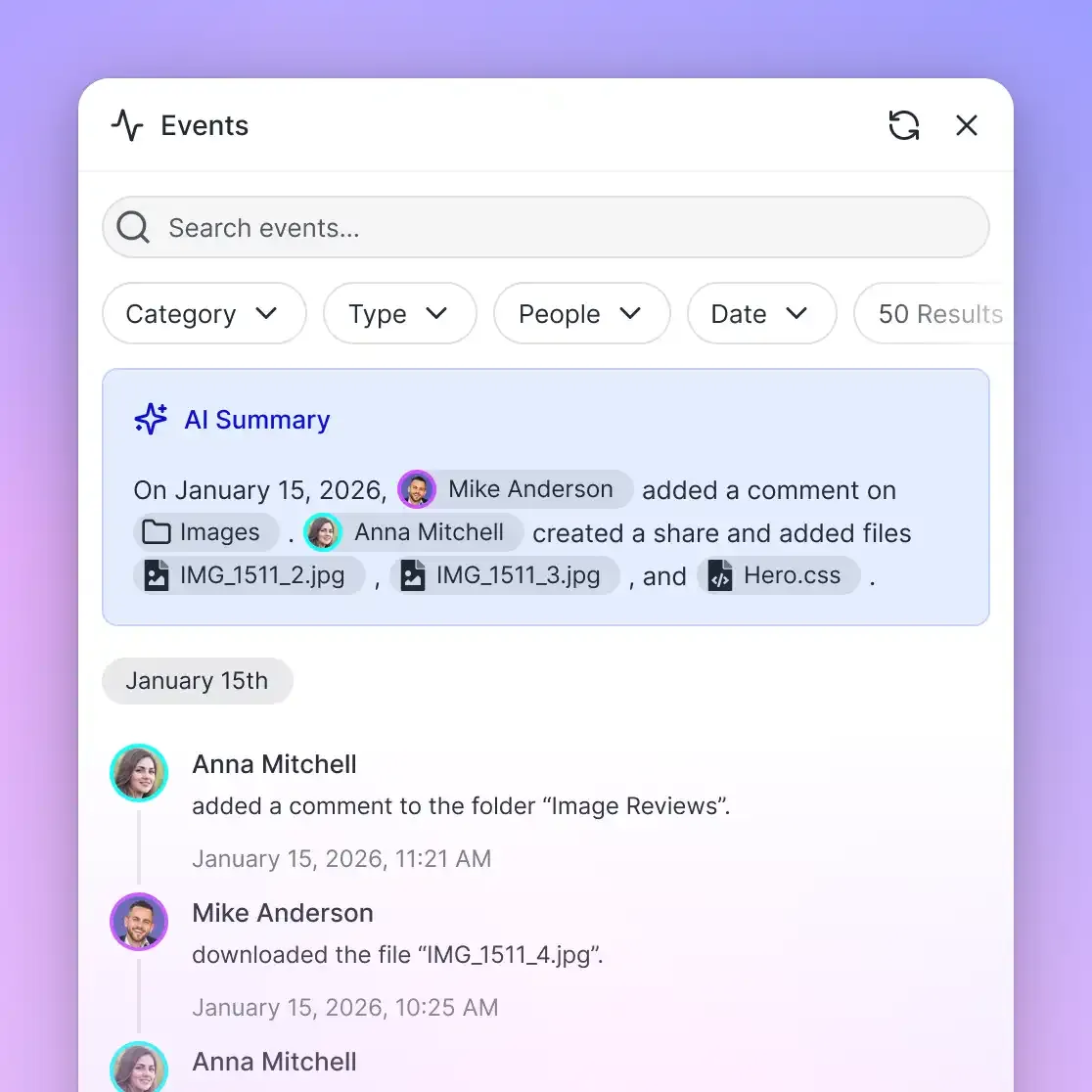
Legal document review requires complete operational accountability. Fastio maintains a detailed activity log that records changes across organizations and workspaces. The detailed activity log documents uploads, edits, moves, deletions, membership adjustments, permission updates, and share creation events. This log provides legal operations leads with a precise historical record of all organizational modifications.
Every file retains full per-file version history. When multiple reviewers annotate contracts or update working schedules, previous versions remain intact and can be restored at any point. This prevents accidental overwrites and keeps changes made by team members traceable throughout the review lifecycle.
How Metadata Views Automate Contract Term Extraction
The primary objective of transactional review is converting thousands of pages of unstructured text into actionable business intelligence. Historically, this required paralegals and junior associates to read contracts line by line, manually copying expiration dates, indemnification limits, and termination terms into disconnected desktop spreadsheets.
Modern collaborative workspaces replace manual data entry with automated extraction. Using Metadata Views, legal operations teams turn unstructured document repositories into live, queryable database grids.
Natural Language Schema Design
Instead of building brittle optical character recognition rules or manual extraction templates, administrators define the information they need in natural language. A legal ops lead can configure extraction fields for commercial contracts:
- Counterparty Name: Text field capturing the legal entity names of all contracting parties.
- Effective Date: Date & Time field identifying the contract execution date.
- Governing Law: Text field recording the chosen jurisdiction and governing state.
- Change of Control Trigger: Boolean field identifying whether an acquisition triggers termination rights.
- Liability Cap: Decimal field capturing maximum financial exposure figures.
- Termination Notice Period: Integer field recording required advance cancellation days.
Fastio applies artificial intelligence to design a typed schema (supporting Text, Integer, Decimal, Boolean, URL, JSON, and Date & Time formats). The system evaluates matched documents in the workspace and populates a filterable, sortable spreadsheet. This capability works across scanned PDFs, Word documents, TIFF images, and presentations without requiring template pre-training. If a deal team later determines they must evaluate intellectual property indemnities, administrators can add a new column to the View without re-ingesting or reprocessing the repository.
Hybrid Search and Matter Intelligence
Searching large document collections requires multi-layered discovery capabilities. Fastio combines full-text search, semantic search, and metadata filtering into a unified search experience. When workspace Intelligence Mode is enabled, documents are automatically indexed on upload.
Reviewers can perform keyword queries for specific contract numbers or execute conceptual queries to locate clauses addressing restrictive covenants. Notes kept beside the files allow human reviewers to record deal observations, flag critical indemnity risks, and draft closing summaries in the same file context, with version-checked saves protecting working notes.
Tamper-Evident E-Signature Integration
When transactional review uncovers unexecuted agreements, missing amendments, or required officer consents, legal teams can initiate signature workflows directly from the matter workspace. Using built-in e-signature capabilities, administrators send documents for signature in parallel or sequential routing.
Signers verify their identity through an optional one-time passcode. Once all parties complete execution, the platform compiles a tamper-evident audit certificate and files the executed agreement directly back into the matter workspace, keeping the final record with its review context.
How to Evaluate and Select a Document Review Platform
Selecting the appropriate document review architecture depends on the specific legal, financial, and regulatory demands of each matter. Legal operations leads should apply a structured five-part framework when selecting review tooling:
1. Assess the Dispute Context
Determine whether the matter involves active adversarial litigation or corporate transactional diligence. If your team must produce Electronically Stored Information to an opposing party under strict judicial supervision, generate formal privilege logs, or apply Bates numbering across thousands of discovery pages, a dedicated litigation platform like Relativity or Everlaw remains necessary. If the matter involves M&A diligence, a compliance audit, real estate portfolio review, or an internal investigation, an agile collaborative workspace provides faster deployment and lower operating costs.
2. Model Complete Storage and Hosting Costs
Audit historical matter billing to determine actual storage expenses. Calculate the projected cost of ingesting and hosting data in a per-gigabyte litigation engine across an estimated deal duration of three to six months. Compare that expense against predictable workspace subscriptions. Transitioning transactional matters and internal audits out of per-gigabyte platforms eliminates unexpected hosting invoices and protects department profit margins.
3. Evaluate External Collaborator Friction
Review the technical friction imposed on third-party participants. If outside specialists, corporate buyers, or external attorneys must undergo lengthy account creation flows, VPN configurations, or dedicated training sessions, review velocity drops. Choose platforms that allow external participants to access designated folders through secure, branded links with configurable download controls.
4. Verify Document Repository Synchronization
Legal documents rarely originate in review tools. They live across corporate repositories such as Google Drive, Dropbox, Box, and OneDrive. Rather than requiring staff to download gigabytes of sensitive files to local computers before uploading them to a review server, select platforms offering direct repository connectivity. Cloud Sync connects Google Drive, Dropbox, Box, and OneDrive folders to a workspace, one-way or two-way, on a schedule or on demand. This capability allows legal ops teams to stage review files directly from corporate repositories.
5. Prioritize Queryable Structured Data
A successful document review produces actionable business data, not merely tagged documents. Prioritize platforms that extract critical contract terms into structured, queryable tables that deal teams can filter, sort, and export. Transforming unstructured legal documents into structured databases accelerates closing schedules and provides executives with immediate visibility into transaction risks.
Sources
References used to verify factual claims in this guide.
-
In the Winter 2026 eDiscovery Pricing Survey, 54.7% of respondents reported basic data hosting rates below $10 per GB per month, while 30.2% reported rates between $10 and $20 per GB.
Frequently Asked Questions
What are document review platforms?
Document review platforms are collaborative software environments that enable legal teams, reviewers, and external counsel to inspect, analyze, annotate, and evaluate large sets of documents for compliance, transactional diligence, or legal proceedings. They provide tools for searching text, organizing matter folders, extracting structured metadata, and controlling external access.
How much do document review platforms cost?
Traditional litigation document review platforms unbundle costs across intake processing, monthly per-gigabyte data hosting, and individual user seat licenses. Over months of review, hosting and licensing accumulate into substantial unpredictable matter fees. In contrast, agile collaborative review workspaces charge predictable subscription rates based on total workspace capacity and include user seats, eliminating volume and seat penalties.
What is the best document review platform for corporate due diligence?
The best document review platform for corporate due diligence balances rapid file ingestion, structured contract data extraction, and flexible external sharing. While litigation tools like Relativity focus on court productions, platforms like Fastio excel in transactional diligence by offering instant workspace setup, branded client shares with download restrictions, and automated term extraction using Metadata Views.
How do collaborative cloud workspaces differ from traditional eDiscovery software?
Traditional eDiscovery software is engineered for adversarial litigation, focusing on forensic chain of custody, PST email processing, Bates numbering, and formal court production formats. Collaborative cloud workspaces focus on commercial efficiency, providing rapid ingestion, structured contract extraction, per-file version history, and role-based permissions without expensive per-gigabyte hosting fees.
Related Resources

Accelerate Document Review with Collaborative Workspaces
Deploy dedicated matter workspaces, share files securely with outside counsel, and extract contract metadata into queryable tables. Monthly plans start with a 14-day free trial, which requires a credit card. Plans are Starter at $9.99/mo, Business at $49.99/mo, and Enterprise at $199.99/mo.