Electronic Record Management: Defensible Governance and Retention for Law Firms
Electronic record management provides the governance framework legal practices need to preserve case integrity and prevent spoliation. While document management systems support active drafting and collaboration, records management enforces fixed lifecycles from matter closing through defensible disposition. This guide outlines records repository architecture, event-based retention, and migration off legacy file shares.

Why Legal Teams Need Defensible Electronic Record Management
When an active legal matter closes, its working files do not automatically transform into compliance-ready records. In most firms, closed case documents remain scattered across local drives, email threads, and shared cloud folders where anyone with access can rename, overwrite, or delete them. This gap between active document collaboration and defensible records retention exposes firms to severe evidentiary challenges, regulatory penalties, and discovery spoliation claims under rules such as Federal Rule of Civil Procedure 37(e).
Electronic record management (ERM) is the systematic control of an organization's electronic records throughout their lifecycle, from receipt or creation through defensible retention or disposal. While standard document management focuses on day-to-day productivity and drafting, electronic record management enforces static preservation, chain of custody, and regulatory adherence once documents reach finality.
To address these operational risks, ARMA International established the Generally Accepted Recordkeeping Principles as a framework describing how business records and related information should be maintained across their complete lifecycle. Applying these principles requires firm leadership to recognize that general cloud storage cannot substitute for a structured records architecture. When law firms conflate basic cloud file shares with an authoritative records repository, four operational failure modes emerge:
- Silent Overwrites and Version Drift: In collaborative file systems, users edit documents without creating tracked historic milestones, compromising the authoritative record.
- The Absence of Event-Based Lifecycle Triggers: Standard cloud storage calculates retention from the date a file was uploaded, whereas legal records require event-based triggers tied to matter closing dates or the exhaustion of appeals.
- Evidentiary Spoliation Exposure: When litigation arises, routine cleanup routines on unmanaged cloud folders can inadvertently destroy critical evidence, triggering court sanctions.
- Unmonitored Data Sprawl: When matters close without an established archival handoff, confidential client disclosures remain exposed across general team workspaces with unrestricted write access.
The Risk of Treating Cloud Drives as Compliance Repositories
Most law firms rely on cloud synchronization tools like Dropbox, Google Drive, Box, or local network file servers for daily work. While these tools assist in document synchronization and mobile file access, their architecture is mutable by design. Users can drag and drop folders, delete shared subdirectories, and rename critical filings without administrative checkpoints.
In an electronic record management framework, files associated with concluded matters transition to a read-only or tightly governed state. An authoritative legal workspace enforces organizational access boundaries, preventing unauthorized modification while preserving every previous version of a file. Consumer storage tools lack structured metadata classification, audit logging of modifications, and isolated matter boundaries required for legal compliance.
Evidentiary Burdens Under Civil Procedure Rules
Courts examine the defensibility of a firm's records management program whenever electronic discovery disputes arise. Under Federal Rule of Civil Procedure 37(e), if electronically stored information that should have been preserved in the anticipation or conduct of litigation is lost because a party failed to take reasonable steps to preserve it, courts may order measures to cure the prejudice. If the court finds the party acted with the intent to deprive another party of the information's use in litigation, sanctions can include adverse inference jury instructions or dismissing the action entirely.
Defensibility requires consistency. A law firm cannot defend its recordkeeping by claiming staff deleted files manually whenever laptop hard drives ran low on space. Defensible governance requires an established policy, an authoritative repository, structured retention schedules, and a detailed audit trail documenting every modification taken on matter files.
Related guides
- FileTrail Records Management: Law Firm Information Governance GuideLaw firms handle an expanding volume of paper archives, DMS files, and outside counsel compliance mandates. FileTrail...
- Records Management for Law Firms: Retention, Governance, and Lifecycle TrackingLaw firm records management is the systematic administration of client and firm records from creation and active matter...
- How to Build a SharePoint Law Firm Site Template: Architecture and Matter TaxonomyStandard SharePoint deployments fail law firms when generic folder structures collide with strict ethical walls,...
- Document Management Software for Small Law Firms: Simple Cloud SolutionsFor solo and boutique practices, managing case files and client records without a dedicated IT department can lead to...
- Practice Management Software for Law Firms: Operations & Architecture GuidePractice management software for law firms coordinates matter records, legal calendaring, time capture, and client...
- Best Software for Law Firms: Legal Tech Buyer's GuideSelecting the best software for law firms requires balancing daily practice management with secure document handling...
More on this subject: Legal Teams (247 guides)
How EDMS and ERM Differ: Collaboration vs. Compliance
Understanding the difference between an Electronic Document Management System (EDMS) and an Electronic Record Management (ERM) platform is critical for IT leads and legal operations managers. While both systems manage digital files, they serve distinct operational goals.
An EDMS manages active work-in-progress, supporting attorneys and paralegals during document creation, contract drafting, redlining, and peer review where documents change frequently. An ERM platform manages static, authoritative business evidence. Once a document reaches finality, such as a filed motion, an entered judgment, an executed lease, or a formal closing binder, it is declared an official record. In an ERM system, records must be preserved against alteration, cataloged with structured metadata, governed by formal retention schedules, and disposed of defensibly when their required retention period expires.
Many firms maintain both capabilities within an integrated workspace architecture. The active matter workspace functions as the collaborative EDMS during litigation or transactional negotiations. When the matter concludes, the workspace transitions into an authoritative ERM archive, locking down permissions, capturing structured metadata, and initiating the compliance retention clock.
The Record Declaration Milestone
The record declaration point is the operational moment when a collaborative draft becomes an official business record. In legal practice, this transition occurs at defined milestones: an agreement is signed by all counterparties, a pleading receives a court timestamp, an expert report is finalized, a real estate closing binder is approved, or a final bill is issued to the client.
Before the declaration point, attorneys need the flexibility to revise text and exchange feedback. After declaration, the document must not be edited. An effective ERM system preserves the declared record with its exact filing metadata and prior version history while preventing post-closing modifications.
Event-Based Triggers vs. Creation-Date Clocks
A common failure in legacy records systems is applying retention schedules based strictly on document creation dates. General commercial archiving software often sets rules such as deleting documents a set number of years after creation.
In legal practice, creation-based retention creates severe compliance risks. A complex commercial dispute can proceed through years of discovery, trial, and appellate review before reaching resolution. If the firm applies a creation-based retention policy to foundational intake records and early pleadings, those records risk premature destruction while the dispute remains active.
Event-based schedules begin the retention countdown only when a specific qualifying event takes place, such as formal matter closure, entry of a final court judgment, or corporate dissolution, keeping records intact throughout the operational life of the matter plus the statutory retention window.


Build a Defensible Record Repository for Your Firm
Organize client files into structured matter workspaces with per-file version history, detailed activity logging, and AI metadata extraction. Starts with a 14-day free trial.
Core Architecture: What a Legal Record Repository Requires
Building an electronic records repository capable of withstanding scrutiny from courts, opposing counsel, and regulatory bodies requires specific architectural capabilities. A defensible records repository is not simply cloud storage with password protection. It is a governed environment designed around client and matter boundaries.
An authoritative legal records platform rests on five architectural pillars:
- Matter-Centric Workspace Isolation: In modern cloud workspaces, every client engagement operates inside an isolated workspace. Permissions are configured at the organization, workspace, and share levels through distinct member roles, preventing cross-matter contamination and isolating practice groups.
- Comprehensive Version History and Detailed Activity Logging: Every document maintains an authoritative per-file version history where prior iterations remain recoverable. Concurrently, a detailed activity log records what changed and who changed it across the organization, tracking substantive changes without recording passive events like views or downloads.
- Structured Document Extraction via Metadata Views: Modern record systems employ Metadata Views to transform incoming documents into structured, queryable data. Natural language extraction automatically identifies key fields, such as matter numbers, jurisdictions, closing dates, and retention categories, across PDFs and word processing documents without rigid templates.
- Scoped External Delivery and Client Intake: An ERM platform replaces unencrypted email attachments with branded shares configured for specific delivery needs, including expiring links and download restrictions. Receive-style shares allow clients to upload disclosures directly into the matter workspace without external account friction.
- Integrated E-Signature with Tamper-Evident Certification: An integrated e-signature solution allows firm members to prepare and dispatch engagement letters and settlement releases directly from the workspace. Upon execution, the completed document is filed back into the matter repository accompanied by a tamper-evident audit certificate verifying signature timestamps, participant details, and completion hashes.
Automating Classification with Structured Metadata Views
Traditional records cataloging required legal assistants to manually index each document, tagging author, document type, client matter ID, and retention codes. Metadata Views eliminate this operational bottleneck by applying automated document data extraction directly within the workspace.
When discovery productions or corporate filings enter the repository, the system evaluates the text and populates structured database views with typed columns: Matter ID, Filing Date, Governing Jurisdiction, Document Classification, Event Trigger Date, and Retention Schedule. Attorneys and compliance officers can sort, filter, and export these views across thousands of matter documents without reprocessing original files.
Activity Logging and Administrative Oversight
Evidentiary defensibility depends on showing an unbroken record of custodial operations. If a document's authenticity is challenged in court, the firm must demonstrate who possessed administrative authority, when files were introduced to the repository, and whether unauthorized alterations took place.
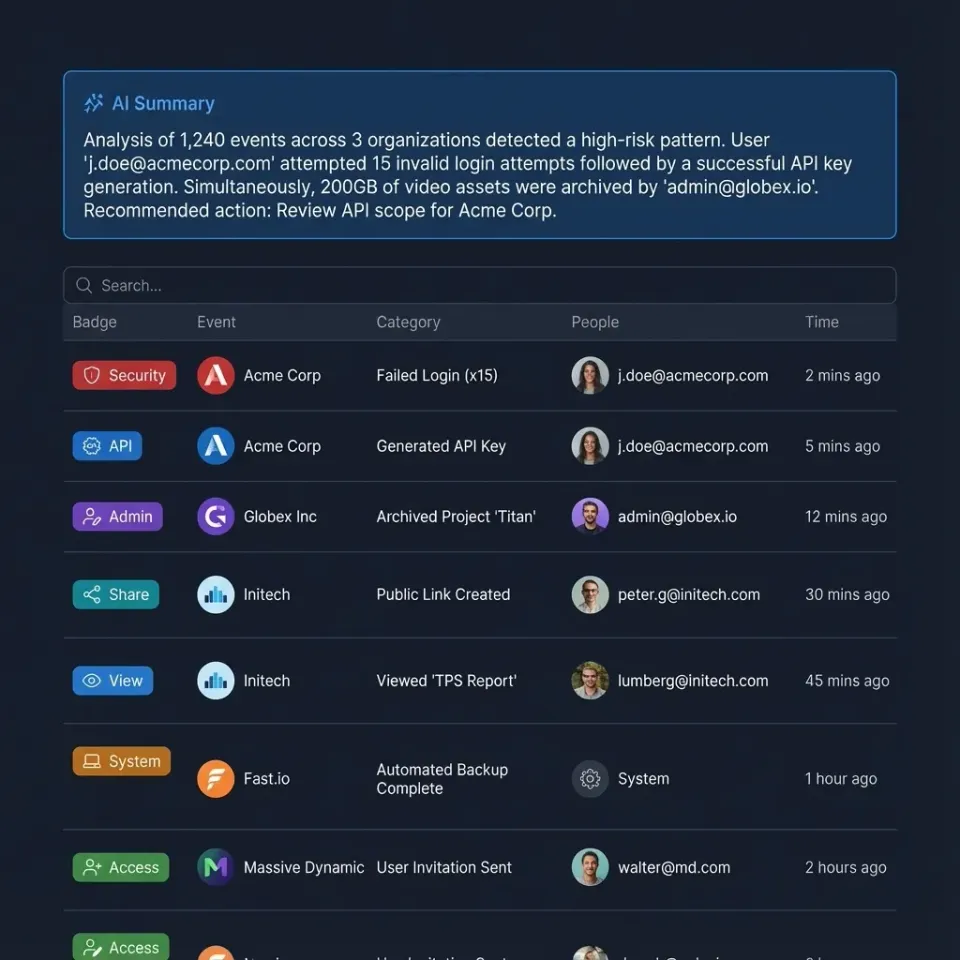
Fast.io provides a detailed activity log that tracks all substantive change events across the organization, including file creations, updates, moves, deletions, and share link generations. By recording what changed and who changed it, the activity log delivers clean administrative oversight without cluttering the governance record with extraneous telemetry.
How to Design a Defensible Retention and Disposition Schedule
Creating a defensible retention and disposition schedule requires close coordination between managing partners, general counsel, practice group leaders, and IT directors. The schedule must be codified into systematic workflows that dictate how files are archived, reviewed, and disposed of across their lifecycle.
A defensible records program follows a structured four-stage implementation process:
- Inventory and Categorize Firm Records: Catalog every category of electronic record generated across the practice, separating client matter records from internal administrative, financial, and personnel files.
- Define Specific Event-Based Triggers: Establish the exact operational milestone that initiates the retention countdown for each record series, avoiding arbitrary calendar schedules.
- Establish Formal Legal Hold Protocols: Create a documented procedure to halt automated disposition schedules whenever litigation, subpoenas, or regulatory inquiries are reasonably anticipated.
- Codify Defensible Disposal Procedures: When the retention period expires and no legal holds exist, execute disposition systematically, documenting the disposal rationale and preserving a permanent certificate of destruction.
Statutory retention requirements vary significantly across practice areas and jurisdictions; check with your firm's own counsel or records policy to establish definitive timelines before codifying schedules.
Legal Hold Protocols and Spoliation Prevention
A legal hold overrides all standard retention and disposition rules. The moment a firm or its corporate client reasonably anticipates litigation, government investigation, or an audit, an affirmative legal duty arises to preserve all potentially relevant electronic records.
In a governed electronic records management architecture, legal holds are applied systematically at the workspace level. The legal ops team flags the specific matter workspace subject to the hold, immediately freezing scheduled disposition reviews and deletion routines. Role-based permissions are reviewed to confirm only authorized custodians can modify files, while surrounding practice workspaces continue their normal operational retention cycles without disruption.
Defensible Disposition Documentation
Defensible disposal is the deliberate, authorized destruction of electronic records that have exceeded their required retention period and are not subject to a pending legal hold. Indiscriminate document hoarding is not a safe strategy; retaining closed files indefinitely inflates discovery review expenses during litigation and exposes the firm to data breach liability.
A defensible disposal workflow includes three verification gates: automated eligibility flagging based on the matter trigger date, responsible attorney certification confirming no ongoing proceedings require preservation, and permanent disposal certification detailing the matter identifier, record series, governing rule, date of destruction, and authorizing official.
How to Migrate From Legacy File Shares to a Governed Architecture
Transitioning an established law firm from fragmented network file shares and disparate cloud folders to a unified electronic records management platform requires an organized, phased migration. A successful rollout follows a five-phase technical roadmap:
Phase 1: Information Audit and ROT Remediation: Before migrating data, run an audit of existing file shares. Legal practices discover that a substantial portion of legacy file share storage consists of duplicate drafts, temporary cache files, and personal employee downloads. Classify files into active cases, closed matters, and non-record working materials, purging verifiable ROT data under attorney supervision.
Phase 2: Establish Standardized Matter Workspace Structures: Design a consistent matter workspace taxonomy with standardized directories: Pleadings & Filings, Discovery & Disclosures, Client Correspondence, Work Product & Research, Executed Agreements & Orders, and Billing & Accounting Records. Configure role-based permissions at the organization, workspace, and share levels.
Phase 3: Automated Ingestion via Cloud Sync and Cloud Import: Migrate data into matter workspaces using native cloud connectors rather than manual desktop uploads. Fast.io Cloud Sync connects Google Drive, Dropbox, Box, and OneDrive folders directly to a workspace on a schedule or on demand. When migrating legacy archival repositories from corporate accounts, Cloud Sync and direct URL cloud import pull large volumes of discovery exhibits, deposition video, and scanned records into workspace storage without workstation bandwidth bottlenecks.
Phase 4: Connect Legal AI Agents via Scoped MCP Tooling: The Fast.io Model Context Protocol (MCP) server enables external AI agents to read, index, and organize matter records safely over Streamable HTTP (https://mcp.fast.io/mcp/tools for Claude Desktop and general workflow clients; https://mcp.fast.io/mcp/operations for custom ChatGPT and Codex connectors; or https://mcp.fast.io/mcp/code for coding agents like Cursor, Claude Code, and Gemini CLI). Agents authenticate with role-based workspace permissions so they access only their assigned matter workspaces.
Phase 5: Deprecate Legacy Silos and Enforce Central Intake: Lock down legacy file shares to read-only status and transition client intake to branded workspaces. Replace email file attachments with branded receive-style share links where clients upload tax returns, corporate contracts, and discovery documents directly into the active matter repository.
Connecting AI Agents to Governed Repositories
Deploying AI agents inside a legal records environment introduces strict security and permission requirements. If an AI agent has unconstrained access to a general corporate drive, it can inadvertently expose confidential client work product from one matter into research conducted for an unrelated client.
Connecting agents through the Fast.io MCP server eliminates this exposure. Fast.io exposes action-based MCP tooling for storage, workspace, and metadata operations scoped to a single matter workspace. When Intelligence Mode is enabled on a workspace, files are indexed automatically for hybrid search, combining full-text search with semantic understanding and metadata filtering to provide citation-backed answers.
Establishing Central Intake and Retiring Local Storage
The final operational milestone in ERM adoption is eliminating the shadow IT practices that lead to data fragmentation. Attorneys frequently save drafts to desktop folders or forward contract redlines through personal consumer tools when enterprise systems feel slow or complex.
Fast.io provides web and desktop applications across Mac and Windows that make saving to the central repository as fast as saving locally. Branded client portals provide outside clients with a polished file exchange surface where large files, including deposition videos and trial exhibits, transfer reliably without email attachment restrictions. By pairing strict governance controls with an intuitive user experience, firm administrators eliminate the temptation for staff to bypass the official records system.
Sources
References used to verify factual claims in this guide.
-
ARMA International established the Generally Accepted Recordkeeping Principles as a framework describing how business records and related information should be maintained.
Frequently Asked Questions
What is an electronic record management system?
An electronic record management system (ERM) is software that controls the creation, receipt, maintenance, use, and defensible disposition of electronic records throughout their lifecycle. Unlike basic cloud file storage, an ERM system enforces static record retention, event-based retention triggers, role-based access governance, and detailed activity logging to preserve evidentiary integrity and regulatory compliance.
What is the difference between EDMS and ERM?
An Electronic Document Management System (EDMS) focuses on active collaboration, iterative drafting, version rollbacks, and team review of work-in-progress. An Electronic Record Management (ERM) system focuses on static compliance, preserving finalized documents as authoritative business evidence, applying retention schedules, managing legal holds, and executing defensible disposal once the operational and legal lifecycle ends.
What are the core components of electronic record management?
The core components of an electronic record management system include matter-centric workspace isolation, per-file version history, a detailed activity log of modifications, structured metadata extraction, event-based retention schedules, legal hold enforcement, and defensible disposal procedures.
How do event-based retention triggers differ from date-based schedules?
Date-based retention calculates storage periods from the file creation or upload date, which creates legal risk if active casework spans several years. Event-based retention calculates storage periods from a specific triggering milestone, such as formal matter closing, entry of a final court judgment, contract expiration, or corporate dissolution, preserving files for the full statutory duration post-matter.
How does a law firm defensibly execute a legal hold in a cloud workspace?
A firm executes a defensible legal hold by identifying the specific matter workspace associated with the dispute, freezing all automated disposition reviews for that workspace, restricting editing roles to authorized custodians, and recording the hold action in an administrative activity log. Unaffected workspaces continue their standard retention cycles without disruption.
Can AI agents interact with an electronic record management system without compromising governance?
Yes, when connected through scoped protocols like the Fast.io Model Context Protocol (MCP) server. Agents authenticate with permissions restricted to specific matter workspaces, preventing cross-matter data contamination. They can read case files, execute semantic queries, and extract structured metadata while remaining subject to firm-wide access controls and activity logging.
Related Resources

Build a Defensible Record Repository for Your Firm
Organize client files into structured matter workspaces with per-file version history, detailed activity logging, and AI metadata extraction. Starts with a 14-day free trial.