How to Build Agent Workspaces: Fastio API Quickstart
The Fastio API lets developers programmatically create and manage intelligent agent workspaces. Instead of treating storage as a passive repository, this framework provides a persistent coordination layer for autonomous AI systems. With a consolidated MCP toolset, built-in Retrieval-Augmented Generation (RAG), and direct URL imports, you can set up a working intelligent workspace in under five minutes.


Why Build Agent Workspaces with the Fastio API?
The Fastio API lets developers programmatically create and manage intelligent agent workspaces. Most storage API tutorials ignore agentic frameworks and RAG integrations. Traditional cloud storage platforms treat files as passive objects. When you upload a PDF to a standard bucket, it just sits there until someone downloads it. This creates bottlenecks for autonomous agents. They need active knowledge systems, not static archives.
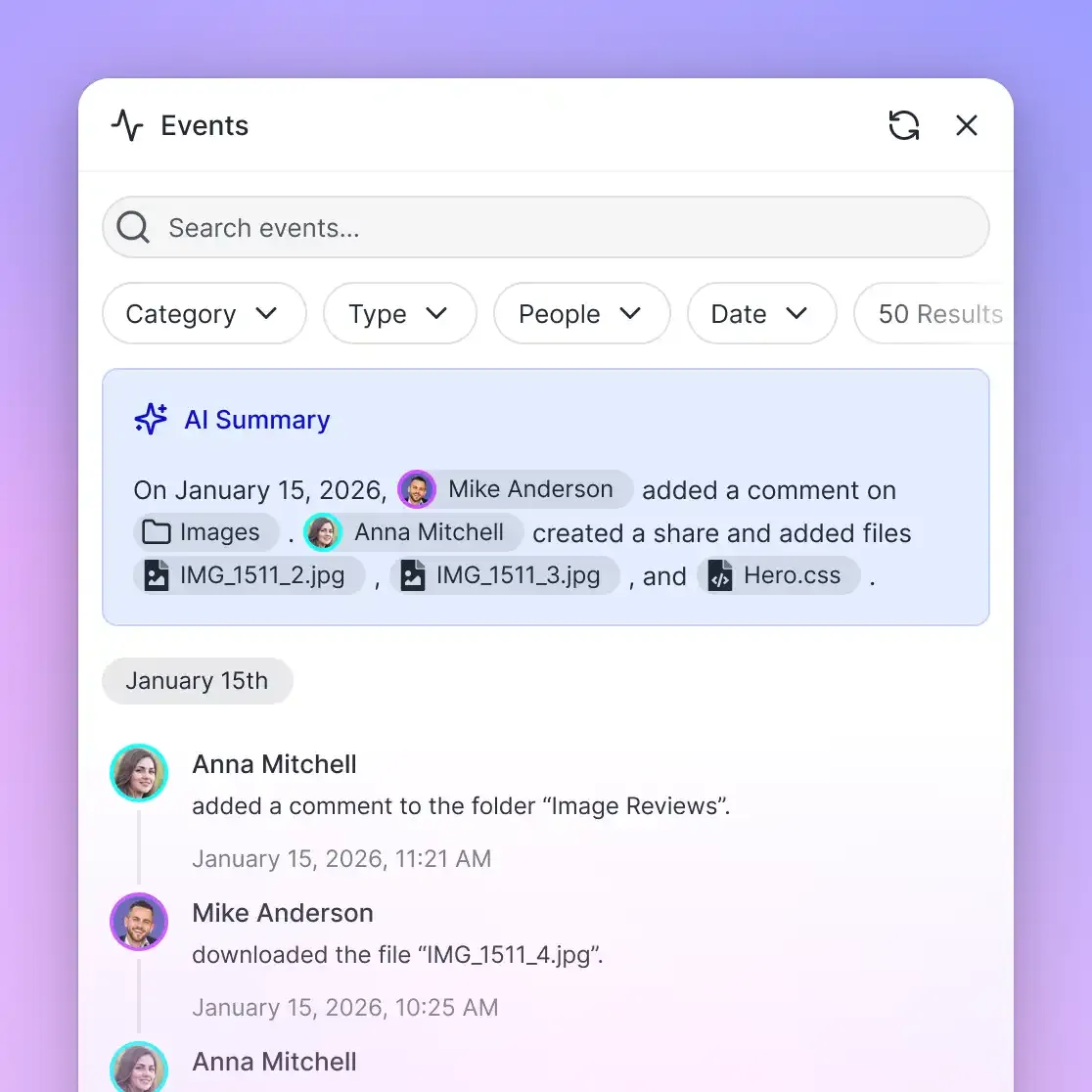
Fastio acts as an active environment where humans and AI models collaborate directly. A workspace built through the API becomes the persistent coordination layer for your intelligent systems. Files you upload are available to Ripley, the built-in RAG agent, and to semantic search. You can add agents and humans as workspace members, then review every change in the audit log.
Get an API key in Settings > Devices & Agents > API Keys, or create one with POST /current/user/auth/key/. Authenticated calls send Authorization: Bearer {api_key} to https://api.fast.io/current/. From there you can create workspaces, invite members, import files from a URL, and ask Ripley for cited answers. Building on an architecture designed for AI workflows helps teams ship faster. It also removes the maintenance overhead of fragmented microservices.
Helpful references: Fastio Workspaces, Fastio Collaboration, and Fastio AI.
Related guides
- How to Build a Discord AI Agent with the Fastio APIBuilding an intelligent Discord bot often means hitting a wall: Discord restricts free users to small file uploads....
- How to Build a Fastio API Golang ImplementationBuilding a Fastio API Golang implementation allows developers to manage workspaces, upload files concurrently, and...
- How to Build a Headless CMS with Fastio APIBuilding a headless CMS with Fastio API allows developers to use scalable workspaces and file metadata to serve...
- How to Build a GraphQL Wrapper for the Fastio APIA GraphQL wrapper for the Fastio API allows developers to fetch specific file data, metadata, and workspace details in...
- How to Build a Fastio API Folder StructureManually creating workspaces slows down development and client onboarding. A Fastio API folder structure creation guide...
- How to Build a Fastio API Integration With Remix ApplicationsGuide to fastio api integration with remix applications: Integrating Fastio with Remix means using server-side Action...
More on this subject: Agent Integrations and APIs (192 guides)
How to Authenticate and Make Your First API Call
Authentication requires a Bearer token. Create an API key in Settings > Devices & Agents > API Keys, or with POST /current/user/auth/key/. This token grants your application programmatic access to workspace resources. These tokens carry broad permissions, so store them securely as environment variables instead of hardcoding them into source files.
To verify your connection, list the workspaces you can access. Here is a curl request for your first API call:
curl -X GET "https://api.fast.io/current/workspaces/all/" \
  -H "Authorization: Bearer YOUR_API_KEY"
If the token is valid, the server returns your workspaces. Profile IDs are 19-digit numeric strings. Keep the trailing slashes on every path. For a production application, parse this response to see whether the target workspace already exists.
Error handling at this stage is simple. Error code 1650 means the token is invalid. Error code 1680 means access is denied. HTTP 429 with error code 1671 means you are rate limited; back off until the x-ve-limit-expires header. Implementing retry logic and clear error logging during this initial setup will save debugging time as your architecture scales.
How to Initialize an Intelligent Workspace with Built-in RAG
Developers often spend days configuring vector databases and chunking strategies before an agent can answer simple questions about a document. Fastio handles this with workspace intelligence. Ripley, the built-in RAG agent, answers questions against the files in the workspace and returns cited answers.
Create a workspace with POST /current/org/{org_id}/create/workspace/. Then start a Ripley chat with POST /current/workspace/{workspace_id}/ai/agent/ and send a message with POST /current/workspace/{workspace_id}/ai/agent/{chat_id}/message/. Semantic search is available at GET /current/workspace/{workspace_id}/storage/search/.
Once the workspace exists, you can upload PDF reports, source code, or text logs. As soon as the files are in the workspace, your agents can search by meaning. They no longer need to process the whole document locally. Instead, they can ask targeted questions and receive cited answers from Ripley.
This architecture reduces computational overhead and minimizes token usage. The agent only processes the relevant material returned by the platform. You can set up an intelligent workspace in under five minutes and start feeding it domain-specific knowledge.
Upload Files and Automate URL Imports
Intelligent systems rely on fresh data to remain accurate. You can stream local files through the API using multipart form data, and you can import a file from a URL so the platform pulls it server-side.
A small local file is one request to POST /current/upload/. Send multipart fields name, size, chunk (the bytes), action=create, instance_id (the workspace id), and folder_id=root. A successful small upload returns HTTP 201 with result, id, and new_file_id. Same-name upload into the same folder overwrites in place and keeps the old content as a recoverable version. The node_id stays stable.
For a file that already lives at a URL, use server-side import:
curl -X POST "https://api.fast.io/current/web_upload/" \
  -H "Authorization: Bearer YOUR_API_KEY" \
  -H "Content-Type: application/x-www-form-urlencoded" \
  -d "source_url=https://example.com/report.pdf" \
  -d "file_name=report.pdf" \
  -d "profile_id=1234567890123456789" \
  -d "profile_type=workspace" \
  -d "folder_id=root"
The backend fetches the file into the workspace folder you named. Watch for the new node with GET /current/events/search/ or long-poll GET /current/activity/poll/{entityId}?wait=95&lastactivity={timestamp}. Your agent can wait on that activity, then ask Ripley about the imported file.


Give Your AI Agents Persistent Storage
Create an API key, list your workspaces, and start uploading into a workspace with built-in RAG. Start building with the Fastio API today.
Connect the MCP Server to Your Agent
The Model Context Protocol standardizes how language models interact with external environments. Rather than writing custom integration code for every operation, you can connect your agent directly to the platform's toolset.
Official guidance is to use the MCP server for agent integrations. Connect over Streamable HTTP at https://mcp.fast.io/mcp/tools (or https://mcp.fast.io/mcp/code for coding agents), with a Bearer header from headless agents. Named mode exposes a consolidated MCP toolset, including auth, workspace, share, fileshare, storage, upload, download, ai, find, event, member, and how-to, with changes going to the matching _manage tool.
For agent frameworks, connect to the remote MCP server URL. This connection gives your model file management, search, and Ripley through those tools.
Agents can list folders, create Send, Receive, or Exchange shares, search document contents, and ask Ripley for a cited answer. A tools/call looks like this:
{"jsonrpc":"2.0","id":1,"method":"tools/call",
 "params":{"name":"upload_manage","arguments":{"action":"web-import","url":"https://example.com/report.pdf",
 "profile_type":"workspace","profile_id":"1234567890123456789"}}}
Because the tools execute within the Fastio infrastructure, they inherit the permission model of the workspace. Your agent stays inside its assigned workspace or share, which reduces the risk of data leakage.
Manage Multi-Agent Concurrency with File Locks and Version History
Production environments rarely feature a single AI agent operating in isolation. Teams deploy multiple specialized models working in parallel. Concurrent writes introduce the risk of race conditions, where two agents attempt to overwrite the same document at the same time.
Fastio provides advisory file locks so agents can coordinate shared writes, alongside automatic file version history. An agent acquires a lock with POST /current/workspace/{workspace_id}/storage/{node_id}/lock/, heartbeats it with POST .../storage/{node_id}/lock/heartbeat/, and releases it when finished. Another agent attempting to lock the same file receives HTTP 409 and can wait or read. If an agent crashes, the lock expires automatically or can be taken over by anyone with write permission. Because locks are advisory, version history acts as the safety net: every write is preserved.
# Acquire an advisory lock before writing
curl -X POST "https://api.fast.io/current/workspace/{workspace_id}/storage/{node_id}/lock/" \
  -H "Authorization: Bearer YOUR_API_KEY"

# Retrieve version history for a storage node
curl -X GET "https://api.fast.io/current/workspace/{workspace_id}/storage/{node_id}/versions/" \
  -H "Authorization: Bearer YOUR_API_KEY"
Version history applies across workspace files. By coordinating through advisory locks and maintaining a detailed activity log, multi-agent systems stay orderly under load. You can deploy multiple researchers, writers, and analysts into the same directory without fear of unrecoverable data loss.
Perform Ownership Transfer for Client Handoff
Many developer agencies build intelligent workspaces on behalf of external clients. A common workflow involves an AI agent creating an organization, building a directory structure, populating it with targeted research, and then inviting the client to take over day-to-day use.
Create the organization with POST /current/org/create/. Create the workspace with POST /current/org/{org_id}/create/workspace/. Add the client with POST /current/workspace/{workspace_id}/members/{email_or_user_id}/. List members with GET /current/workspace/{workspace_id}/members/list/.
For a branded handoff, create a Send, Receive, or Exchange share with POST /current/workspace/{workspace_id}/create/share/, or a durable single-file link with POST /current/workspace/{workspace_id}/create/fileshare/. The client opens a branded portal instead of a raw dump of files.
This workflow is valuable for service providers who package autonomous agents as specialized products. The developer focuses on building the intelligence layer and configuring the MCP tools. The client joins as a member or reviews the work through a share. Audit logs stay available through GET /current/events/search/.
Monitor Health and Activity Events
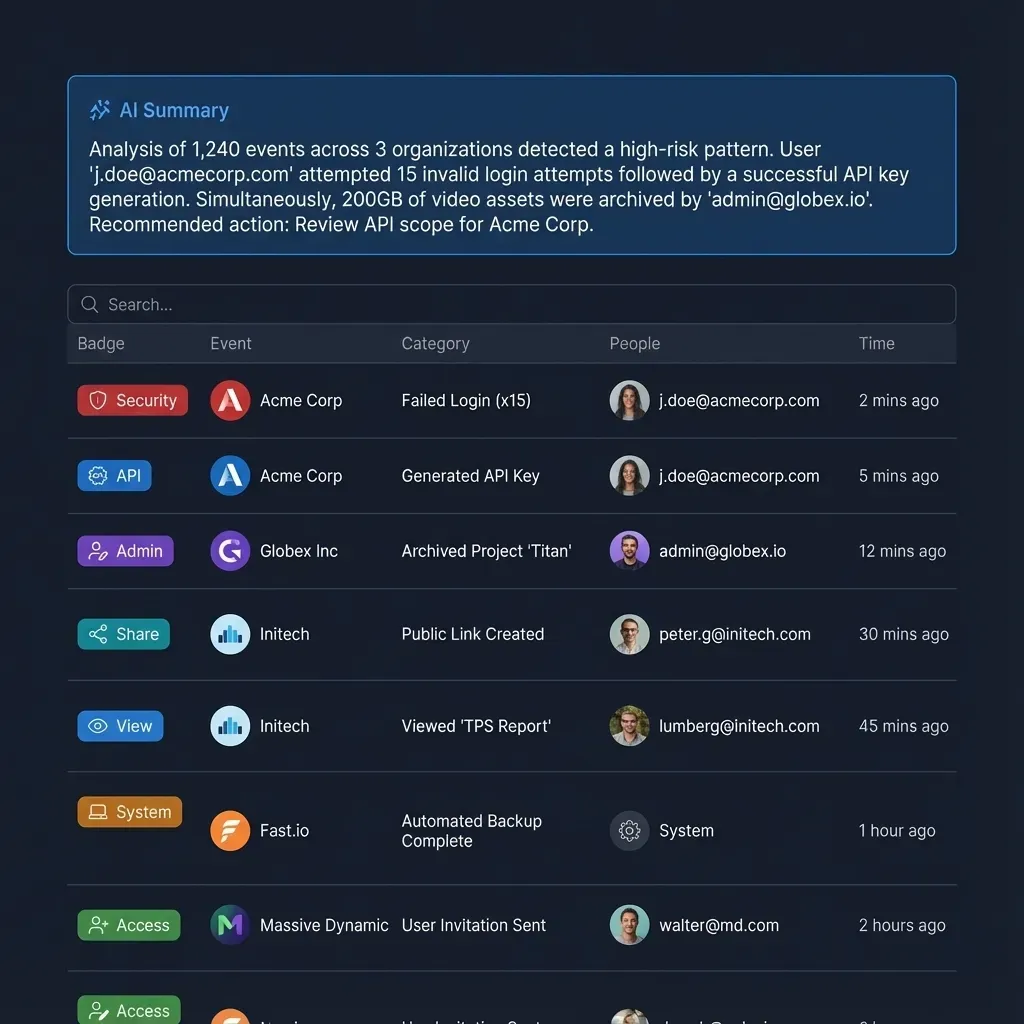
Active workspaces generate constant event traffic. Files are updated, agents make changes, and humans leave comments on shared assets. Tight polling loops waste resources and delay agent responses.
For file and workspace activity, search the audit log with GET /current/events/search/, or long-poll with GET /current/activity/poll/{entityId}?wait=95&lastactivity={timestamp}. Your architecture can wait on those endpoints and wake agents only when new activity appears.
curl -X GET "https://api.fast.io/current/events/search/" \
  -H "Authorization: Bearer YOUR_API_KEY"

curl -X GET "https://api.fast.io/current/activity/poll/{entityId}?wait=95&lastactivity={timestamp}" \
  -H "Authorization: Bearer YOUR_API_KEY"
For example, an analysis agent can stay idle until activity/poll or events/search shows a new PDF in the workspace. Combined with the audit log, teams can see exactly how and when their models interact with the workspace. This establishes accountability for every action taken by the software.
Sources
References used to verify factual claims in this guide.
-
List workspaces with GET /current/workspaces/all/ using a Bearer API key
-
Exposes a consolidated MCP toolset
-
Set up an intelligent workspace in under five minutes
Frequently Asked Questions
How do I use the Fastio API?
Generate an API key in Settings > Devices & Agents > API Keys, or with POST /current/user/auth/key/. Authenticated calls send Authorization Bearer against https://api.fast.io/current/. Most POST bodies are application/x-www-form-urlencoded. Uploads use multipart/form-data. Start by listing workspaces with GET /current/workspaces/all/.
How do I set up a Fastio developer account?
Create a Fastio account, open a workspace, and generate an API key in Settings > Devices & Agents > API Keys. You can also create a key with POST /current/user/auth/key/. Point your client at https://api.fast.io/current/, or connect an agent to MCP at https://mcp.fast.io/mcp/tools.
Can the API handle concurrent operations from multiple agents?
Yes. Fastio supports advisory file locks and automatic file version history. An agent can acquire a file lock before modifying a file so others know to wait. Version history preserves every update regardless, allowing easy inspection and rollback.
Does the Fastio API replace a vector database?
Yes. Ripley, the built-in RAG agent, answers questions against workspace files. Start a chat with POST /current/workspace/{workspace_id}/ai/agent/, or use semantic search at GET /current/workspace/{workspace_id}/storage/search/. You do not need a separate vector database for this workspace RAG path.
Related Resources

Give Your AI Agents Persistent Storage
Create an API key, list your workspaces, and start uploading into a workspace with built-in RAG. Start building with the Fastio API today.