How to Choose Between Fastio API vs Box API for Agent Workspaces
Box API handles traditional enterprise document management, while Fastio API provides native vector search and intelligence features built for AI agent workspaces. This comparison examines how both platforms handle API access, file uploads, built-in RAG capabilities, and Agent-to-Human handoffs. Developers evaluating storage for their language models need to understand why autonomous systems rely on native tooling protocols instead of standard synchronization frameworks.


How to implement Fastio API vs Box API for agent workspaces reliably
Cloud storage APIs were built to keep human users in sync across devices. Their architecture relies on file trees, synchronization conflicts, and user interface updates. When developers try to connect AI agents to these environments, they hit immediate roadblocks. An autonomous agent needs different tools than a human employee.
An agent workspace gives language models a place to process data, store reasoning steps, and collaborate with other agents or people. Agents need specific tools to work reliably. They need vector embeddings to understand document meaning without reading every line. They also need structured tool access to perform actions without custom glue code for every endpoint. Comprehensive version tracking and audit logging are also necessary to maintain data integrity when multiple models work on the same dataset at the same time.
Box API provides solid synchronization for enterprise desktops, but it requires developers to build significant middleware to translate human-centric storage into agent workflows. Fastio API offers native vector search and intelligence features built for AI agent workspaces. It eliminates the middleware layer by treating the agent as a core part of the workspace infrastructure.
Helpful references: Fastio Workspaces, Fastio Collaboration, and Fastio AI.
Related guides
- Fastio API vs Supabase Storage for Agent WorkspacesPicking the right backend for your AI application shapes your engineering roadmap. Developers often treat all cloud...
- How to Implement Persistent Storage for AutoGen using Fastio APIAdding persistent storage to AutoGen via Fastio API allows multi-agent conversations to share and modify files reliably...
- How to Integrate Dify File Storage for AgentsDify defaults to local file storage, which limits scalability and agent capabilities.
- How to Set Up File Storage for n8n AI Workflowsn8n AI workflows need persistent file storage to save documents, process AI outputs, and build RAG pipelines. This...
- How to Add File Storage to Flowise ChatflowsFlowise makes it easy to build AI agents, but managing the files they create or use can be tricky. Most default setups...
- How to Add Persistent Cloud Storage to SuperAGI AgentsSuperAGI agents often run in temporary environments where files are lost after the job finishes. By using Fastio as a...
More on this subject: Agent Memory and Storage (263 guides)
What to check before scaling Fastio API vs Box API for agent workspaces
The structural differences between the two APIs show up during initial authentication and connection setup. Both platforms use RESTful endpoints, but they make different assumptions about the client.
The Box API relies on modern OAuth flows built for human authorization. Applications usually redirect users to a Box login screen to grant permissions. When making calls, the pagination design makes sense for rendering tables in a user interface. Direct file uploads work well for small files, but the system has limits. According to the Box Developer Documentation, direct file uploads are limited to 50MB. For larger payloads, developers must write chunked upload logic, adding overhead to simple agent scripts.
Fastio API takes an automation-first approach. It provides built-in Model Context Protocol (MCP) compatibility out of the box, meaning developers do not need to write REST client wrappers. They can expose the workspace directly to their language model using a standardized protocol. Fastio supports Streamable HTTP and Server-Sent Events (SSE), letting long-running agent processes keep persistent connections without polling.
Fastio manages session state smoothly across operations. When an agent opens a session, the workspace maintains its context, active queries, and version history. This setup prevents agents from losing their place during complex reasoning tasks that take several minutes to run.
Native RAG vs. Bring-Your-Own Pipeline
Retrieval-Augmented Generation (RAG) is the main way developers give language models access to private data. The setup work varies greatly between these two platforms.
With the Box API, developers usually have to build and maintain their own RAG pipelines. This means downloading files from Box, parsing the text, generating embeddings with a provider like OpenAI, and storing those vectors in a database like Pinecone or Weaviate. Whenever a file changes in Box, the developer has to listen for webhooks and trigger a re-indexing job. Box offers enterprise AI features, but they sit behind chat interfaces instead of acting as raw infrastructure for custom agent development.
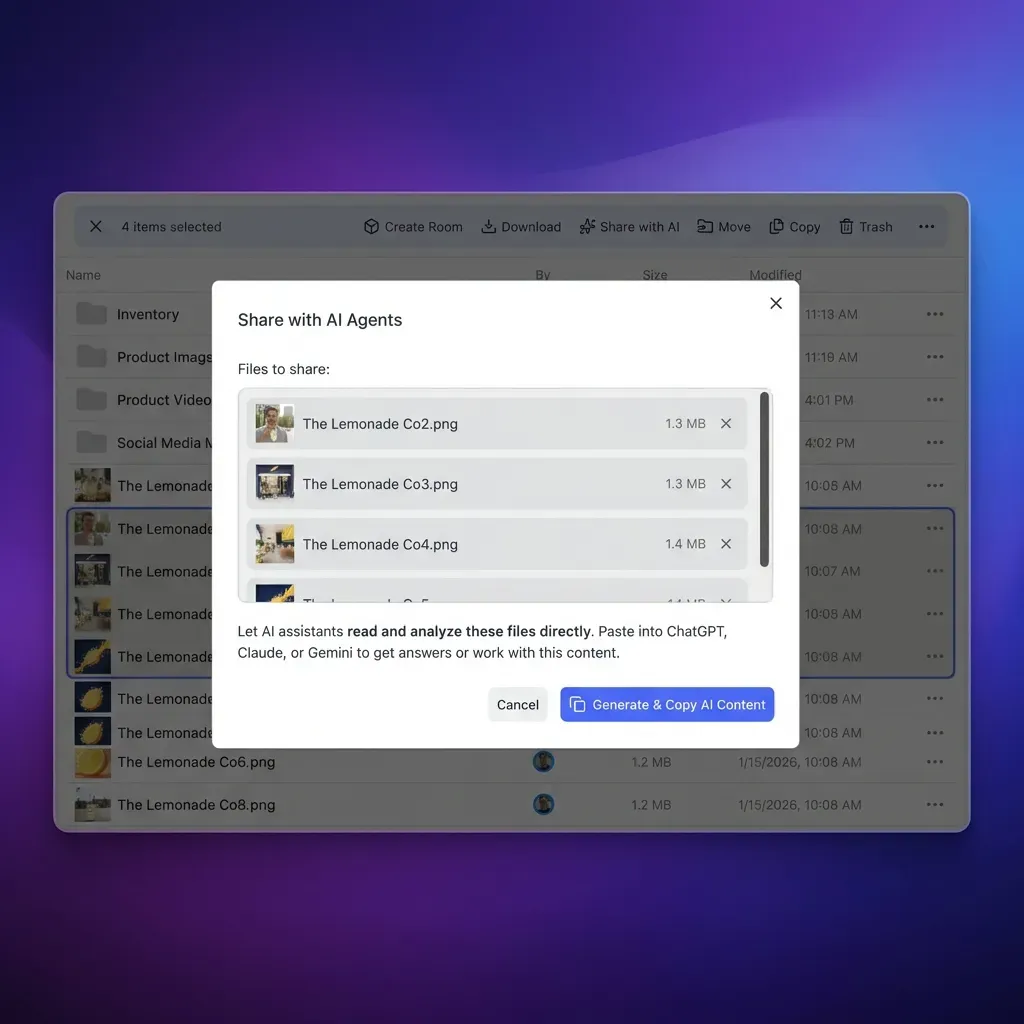
Fastio indexes documents natively without external RAG pipelines. When a developer toggles Intelligence Mode on a workspace, the platform automatically parses incoming files, generates embeddings, and keeps the vector index alongside the file system. There is no separate vector database to manage.
Querying this data takes a single API call or MCP tool invocation. An agent can submit a semantic query to the workspace and get exact text matches, page numbers, and relevance scores. This built-in RAG setup ensures the agent always has the latest information without developers managing sync jobs between storage and search clusters.
The Fastio Tool Advantage: Model Context Protocol
The Model Context Protocol (MCP) standardizes how language models interact with external tools and data sources. This protocol is quickly becoming the standard integration layer for autonomous systems.
Fastio API includes built-in MCP compatibility out of the box. Through the Model Context Protocol, developers gain access to an extensive suite of native MCP tools. Every capability in the Fastio user interface has a corresponding tool exposed to the agent. An agent can list directories, read file contents, extract specific metadata, update tags, and generate share links using natural language commands translated through the protocol.
Box API requires developers to build custom MCP servers if they want agents to interact with Box using this standard. The developer has to map Box REST endpoints to MCP tool definitions, handle rate limiting, and manage token refreshes manually. This creates extra maintenance work as the agent's responsibilities grow.
Connecting an agent to Fastio takes seconds. Point your agent to the remote MCP server at https://mcp.fast.io/mcp/tools (or https://mcp.fast.io/mcp/code for coding agents) over Streamable HTTP. Interactive clients sign in with OAuth in the browser and carry no API key, while headless environments send an Authorization: Bearer <api key> header on the connection. Setup steps are documented in the Fastio documentation. This gives your agent a consolidated, zero-config toolset right away, enabling natural language file management without installing local packages. The agent can create organizational structures, build workspaces, and manage file movements without any custom code.


Give Your AI Agents Persistent Storage
Connect your agents to intelligent workspaces with a consolidated MCP toolset and built-in RAG. Built for fast api box api agent workspaces workflows.
Upload Handling and URL Imports
Data ingestion often creates a bottleneck for AI applications. Agents frequently need to process large datasets hosted across different cloud providers, and pulling that data into the working environment can be slow.
The Box API handles ingestion through standard upload endpoints. If an agent needs to process a massive dataset hosted on Google Drive, it must download the data to local memory or disk, then upload it to Box. This local I/O requirement increases infrastructure costs and slows down processing time. As noted earlier, exceeding the direct upload limit forces the developer to manage chunked upload sessions.
Fastio API handles this through native URL Import capabilities. An agent can tell Fastio to pull files directly from Google Drive, OneDrive, Box, or Dropbox via OAuth. The Fastio infrastructure handles the transfer server-side. There is no local I/O required from the agent's host machine. The agent sends the import command and gets a notification when the files are indexed and ready for semantic search. This setup helps high-throughput AI systems process massive external datasets efficiently.
Ownership Transfer and Multi-Agent Collaboration
AI applications often involve agents working on behalf of human users. An agent might analyze a dataset, generate a report, and hand that report to a human for review. The permissions model determines how this handoff works.
Box handles collaboration through standard enterprise setups. A user or service account creates a folder and sends an email invitation to collaborators. This model is secure, but it assumes a hierarchical corporate structure. Administrators have to manage service accounts carefully so they don't consume paid licenses.
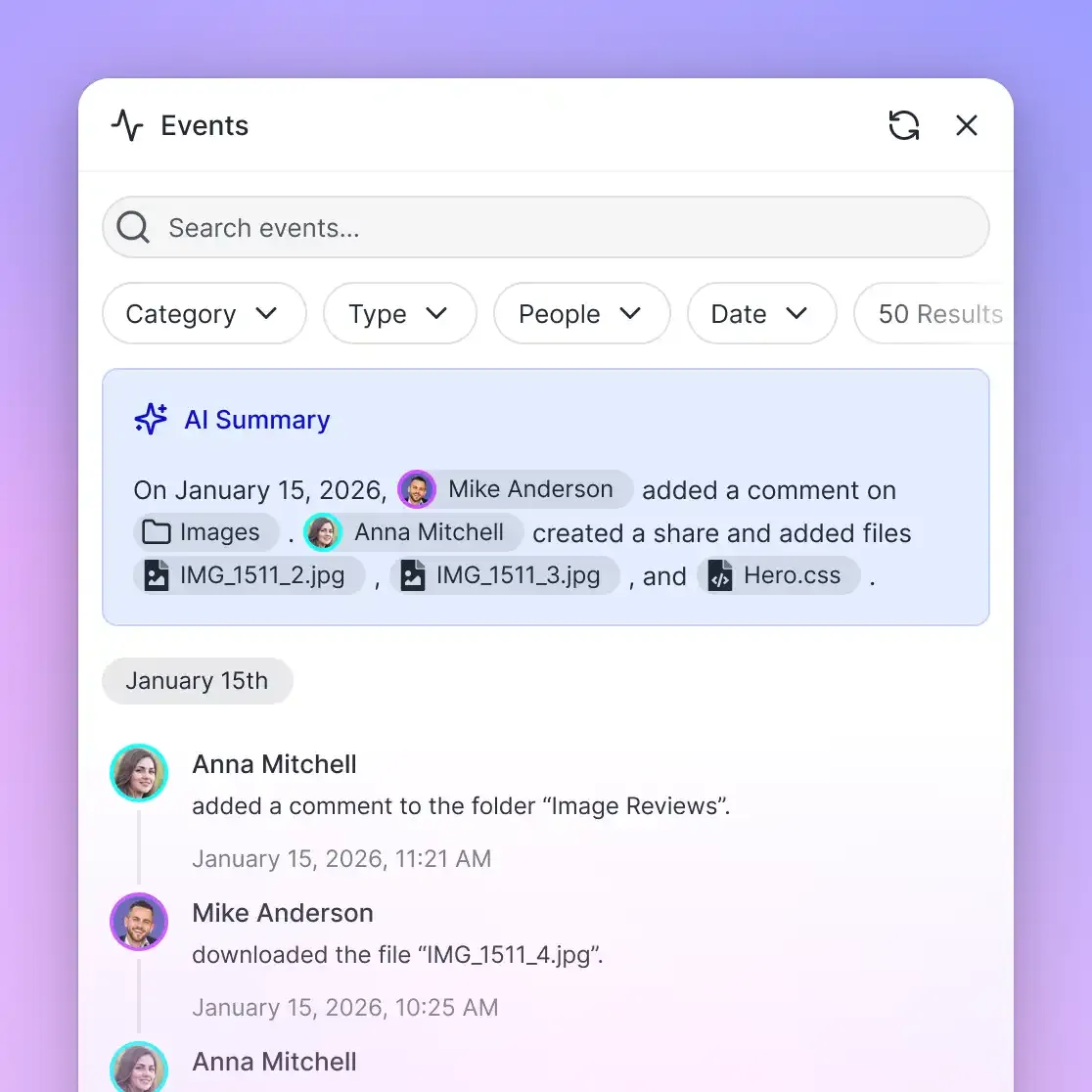
Fastio includes Ownership Transfer specifically for agent workflows. An agent can create an organization, provision dedicated workspaces, populate them with content, and securely transfer ownership of the workspace to a human client. The agent can also keep administrative access to continue updating the files.
In multi-agent systems, collaboration creates a risk of race conditions. Fastio provides advisory file locks so an agent can acquire a file lock before writing, heartbeat it while working, and release it when done. Another agent that tries to lock the same file gets an HTTP 409 and can wait or read. If a holder disappears, the lock expires automatically or can be taken over by anyone with write permission, while version history preserves every write as a safety net.
Event-Driven Workflows: Activity Feeds and WebSocket Events
Agents shouldn't waste compute cycles repeatedly polling a storage API to check for new files. Reactive programming helps prevent this.
Both platforms support reactive patterns, but they target different workflows. Box webhooks are highly configurable and work alongside enterprise middleware platforms to trigger compliance checks or sync data to enterprise resource planning systems.
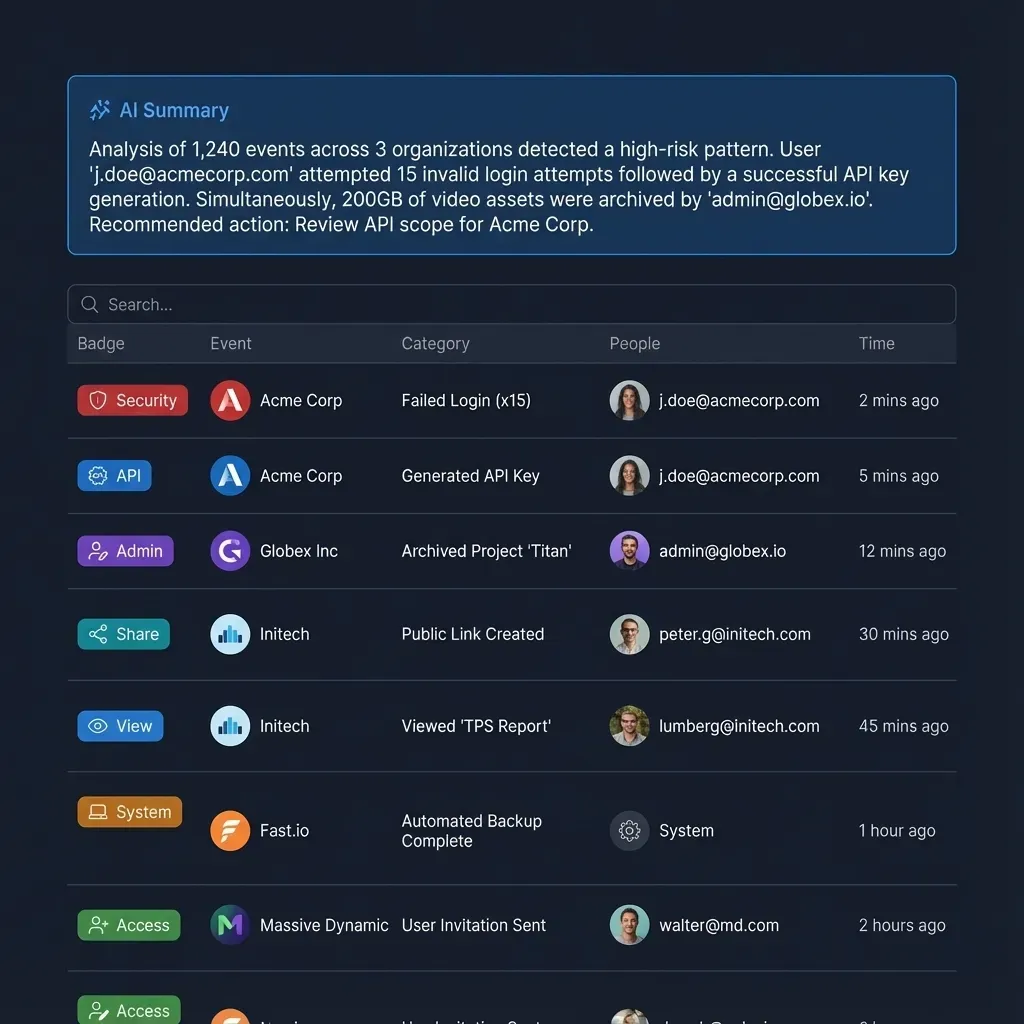
Fastio provides a WebSocket events feed and a pollable realtime activity feed to wake up sleeping agents. Developers can subscribe to the events feed to notify an application the moment a file changes, a new upload completes, or an indexing job finishes once Intelligence is enabled. This helps teams build event-driven AI pipelines. For example, a user drops a PDF into a Fastio workspace. The WebSocket event fires and wakes up a processing agent. The agent reads the file using its MCP tools, extracts key entities, and saves a JSON summary back to the workspace. This flow happens reactively, keeping idle compute costs low.
Pricing and Developer Tiers
The pricing models of both platforms reflect their target audiences. These structures influence how developers build their autonomous systems, especially early in a project.
Box requires paid enterprise tiers for API scale. While they offer developer accounts, moving an application into production with high throughput and large files usually involves a sales process. Pricing is tied to user seats and storage volume, making it expensive to spin up short-lived workspaces for agent tasks.
Fastio offers transparent plans designed for agentic workloads: Starter, Business, and Enterprise, with usage-based credits and seat allowances. Teams can evaluate the platform using the 14-day Business Trial (credit card required) to test agentic workspaces, remote MCP connectivity, and built-in semantic search before choosing a plan on the pricing page.
Fastio API vs Box API Comparison Summary
The infrastructure you choose for your language models directly impacts the complexity of your application code.
For traditional enterprise integrations where human users need desktop synchronization and corporate governance, the Box API is a strong option. But if your goal is to provide an intelligent memory layer for AI agents, Fastio is the better fit. It indexes documents natively without external RAG pipelines and provides the MCP support autonomous systems need to run reliably.
Sources
References used to verify factual claims in this guide.
-
direct file uploads are limited to 50MB
Frequently Asked Questions
Is Fastio better than Box for AI agents?
Yes, Fastio works better for AI agents because it provides native vector search and native Model Context Protocol (MCP) tools out of the box. Box requires developers to build custom RAG pipelines and middleware for similar automation.
What is the difference between Fastio API and Box API?
The main difference is their focus. Fastio API is built for autonomous agents, offering features like URL imports without local I/O, built-in semantic search, and ownership transfer. Box API is built to synchronize files for human users across devices.
How do Claude and other AI agents connect to Fastio?
Fastio provides a remote Model Context Protocol (MCP) server over Streamable HTTP at `https://mcp.fast.io/mcp/tools` for Claude and general MCP clients, and `https://mcp.fast.io/mcp/code` for coding agents. For Claude (web, desktop, mobile), open Customize, then Connectors; add a custom connector and paste `https://mcp.fast.io/mcp/tools`; select Connect and sign in to Fastio in the window that opens; in a chat, turn Fastio on from the + menu under Connectors. Interactive clients sign in with OAuth in the browser and carry no API key, while headless code sends `Authorization: Bearer <api key>` on the connection, gaining instant access to a consolidated MCP toolset without writing custom API wrappers or installing local server packages. Setup steps for each client are documented in the [Fastio documentation](https://mcp.fast.io/docs).
What happens when a file exceeds the direct upload limit in these APIs?
When uploading to Box, files exceeding the direct upload limit require the developer to write a chunked upload API workflow. Fastio handles larger files natively, and its URL Import feature lets agents bypass local upload limits entirely by transferring files server-side.
How does Fastio handle concurrency in multi-agent systems?
Fastio handles multi-agent concurrency through advisory file locks alongside version history. An agent can acquire a file lock before writing, heartbeat it while working, and release it when done. Other agents attempting to lock the same file get an HTTP 409 and can wait, while version history preserves every write regardless.
Related Resources

Give Your AI Agents Persistent Storage
Connect your agents to intelligent workspaces with a consolidated MCP toolset and built-in RAG. Built for fast api box api agent workspaces workflows.