Automating Free AI Photo Editor Tasks in Clay Pipelines
A detailed guide on automating free ai photo editor tasks in Clay tables. Learn to set up a custom FastAPI rembg server, run background removal, and store the output files in Fastio workspaces with version history.


Why Teams Automate Free AI Photo Editor Tasks
Background removal is the most requested automated photo edit task, accounting for nearly 28% of all image edits processed in automated pipelines.
For marketing and creative teams managing digital asset libraries, product photography is a primary bottleneck. Traditional workflows depend on designers manually opening files in desktop software, performing background isolation, applying color corrections, and uploading the files back to storage. When managing thousands of SKUs or marketing assets, this manual approach is slow, expensive, and difficult to scale. Freelance retouchers command between thirty and one hundred and fifty dollars per hour, which quickly balloons operational budgets for high-volume content operations.
Automating these tasks eliminates the repetitive labor of file handling. Using modern data enrichment platforms like Clay, companies can process entire spreadsheets of product data and leads in parallel. While Clay provides powerful data routing and orchestration, it does not feature native image manipulation. This limitation requires connecting Clay to external image processing APIs.
By combining Clay tables, a free online AI photo editor API, and Fastio storage, organizations can build automated, serverless image processing pipelines. Fastio serves as the central, persistent workspace where files are organized, versioned, and shared. Developers can set up storage for agents to run these workflows programmatically.
Related guides
- Automating Base44 File Workflows with WebhooksEvent-driven webhooks allow Base44 applications to initiate instant downstream processing whenever users or AI agents...
- How to Automate GitHub REST API Tasks with GitHub CopilotAutomating repository configurations requires a deep understanding of rate boundaries, especially since authenticated...
- Integrating Canva AI Photo Editor with GTM PipelinesOutbound and account-based marketing campaigns require highly personalized visual assets, but manual creation stalls...
- How to Use Canva Magic Design in Clay Outbound Creative PipelinesUS searchers look up "canva magic design" about 3,600 times per month, and the $7.34 CPC points to commercial...
- How to Use the GIMP Photo Editor in Clay Creative OpsThe phrase "gimp photo editor" draws 33,100 monthly US searches with keyword difficulty 27 and a CPC of $2.81. Most...
- Image Converter Workflows for Clay GTM PipelinesUS search demand for image converter alone sits at 22,200 monthly queries, while related seeds like webp to png and png...
More on this subject: Clay and GTM Agents (82 guides)
How to Choose the Best Free AI Photo Editor API
Developing a programmatic photo workflow requires choosing an image editing engine that offers API access. While many free online AI photo editor tools exist for browser use, developer automation demands REST endpoints that can receive images, run machine learning models, and return the edited files.
Several APIs provide free or sandbox access for background removal, color optimization, and file conversion. The table below compares the leading options:
The remove.bg API offers high-quality background removal, but the free tier is capped at fifty low-resolution previews monthly, which is only suitable for small tests. The Pixlr developer SDK (github.com/pixlrcom/sdk) is more generous, offering up to one thousand requests monthly for general image modifications, but specific machine learning tasks consume separate account credits. The Photoroom API provides a sandbox mode that allows developers to run up to one thousand testing calls, but the output images include watermarks, making them unsuitable for production.
For high-volume automation, a self-hosted API running the open-source python library rembg is the most scalable choice. Running rembg on your own server or within a serverless container provides unlimited background removal with no licensing costs or per-image fees.
How to Build a Custom Background Removal API with FastAPI and rembg
To avoid the usage limits and costs of commercial APIs, developers can deploy a custom background removal service. The open-source rembg library, which uses the U²-Net machine learning model, runs efficiently inside a lightweight FastAPI web framework.
To build this service, organize your project directory with three basic files.
First, create a requirements.txt file specifying the Python dependencies:
fastapi
uvicorn[standard]
rembg
requests
Second, write the application code in a file named main.py. This script exposes a POST endpoint that downloads an image from a URL, processes it to remove the background, and returns the result as a PNG file:
from fastapi import FastAPI, HTTPException
from fastapi.responses import StreamingResponse
from rembg import remove
import requests
from io import BytesIO

app = FastAPI(title="Free AI Photo Editor API")

@app.post("/remove-bg/")
async def remove_background(payload: dict):
    image_url = payload.get("image_url")
    if not image_url:
        raise HTTPException(status_code=400, detail="Missing image_url parameter")

    try:
        response = requests.get(image_url, timeout=15)
        response.raise_for_status()
        input_data = response.content
    except requests.exceptions.RequestException as e:
        raise HTTPException(status_code=400, detail=f"Failed to fetch image: {str(e)}")

    try:
        output_data = remove(input_data)
    except Exception as e:
        raise HTTPException(status_code=500, detail=f"Image processing failed: {str(e)}")

    return StreamingResponse(BytesIO(output_data), media_type="image/png")
Third, package the application using a Dockerfile to ensure consistent deployment:
FROM python:3.11-slim

WORKDIR /app

RUN apt-get update && apt-get install -y --no-install-recommends \
    libgl1-mesa-glx \
    libglib2.0-0 \
    && rm -rf /var/lib/apt/lists/*

COPY requirements.txt .
RUN pip install --no-cache-dir -r requirements.txt

COPY . .

EXPOSE 8000

CMD ["uvicorn", "main:app", "--host", "0.0.0.0", "--port", "8000"]
This Docker container can be deployed to free-tier cloud platforms like Render or Hugging Face Spaces. The first time the API receives a request, the rembg library automatically downloads the U²-Net model. Subsequent calls process images in under two seconds.


Organize and Version Your Automated Creative Assets
Access a shared workspace featuring per-file version history, metadata views, and event-driven automation to store your AI-edited images. Monthly plans start with a Business Trial of up to 14 days.
How to Connect Your Photo Editor API to Clay Tables
Once the custom API is deployed and reachable, you can connect it directly to Clay to enrich product listings or marketing data. Clay uses spreadsheet-style tables where columns can trigger external HTTP requests.
To build the integration in Clay, follow these steps:
Create a table in Clay containing your list of records. Ensure you have a column containing the URL of the original image stored in your Fastio workspace.
Add a new enrichment column by selecting the HTTP API integration option. This feature allows you to send custom payloads to any web service.
Configure the HTTP API enrichment settings:
Method: Set this to POST.
Endpoint URL: Input the address of your deployed FastAPI service, ending in /remove-bg/.
Headers: Add a key for Content-Type and set its value to application/json.
Body: Select the JSON option and pass the image URL from your table. Define the payload structure to match your API requirements:
  {
    "image_url": "/your-image-url-column/"
  }
- Run the enrichment column on a test row. Clay sends the image URL to your custom API, receives the background-removed PNG byte stream, and stores the resulting image file in the row.
If the API fails to process an image because of network timeouts, Clay automatically retries the request based on your column settings. This ensures that large batches of images are processed without manual intervention.
How to Manage Edited Assets in Fastio Workspaces
After Clay processes the images, storing them in a collaborative workspace is necessary for team access. Storing files in local folders or temporary cloud shares creates silos. Fastio provides a centralized workspace platform where humans and AI agents work on the same assets.
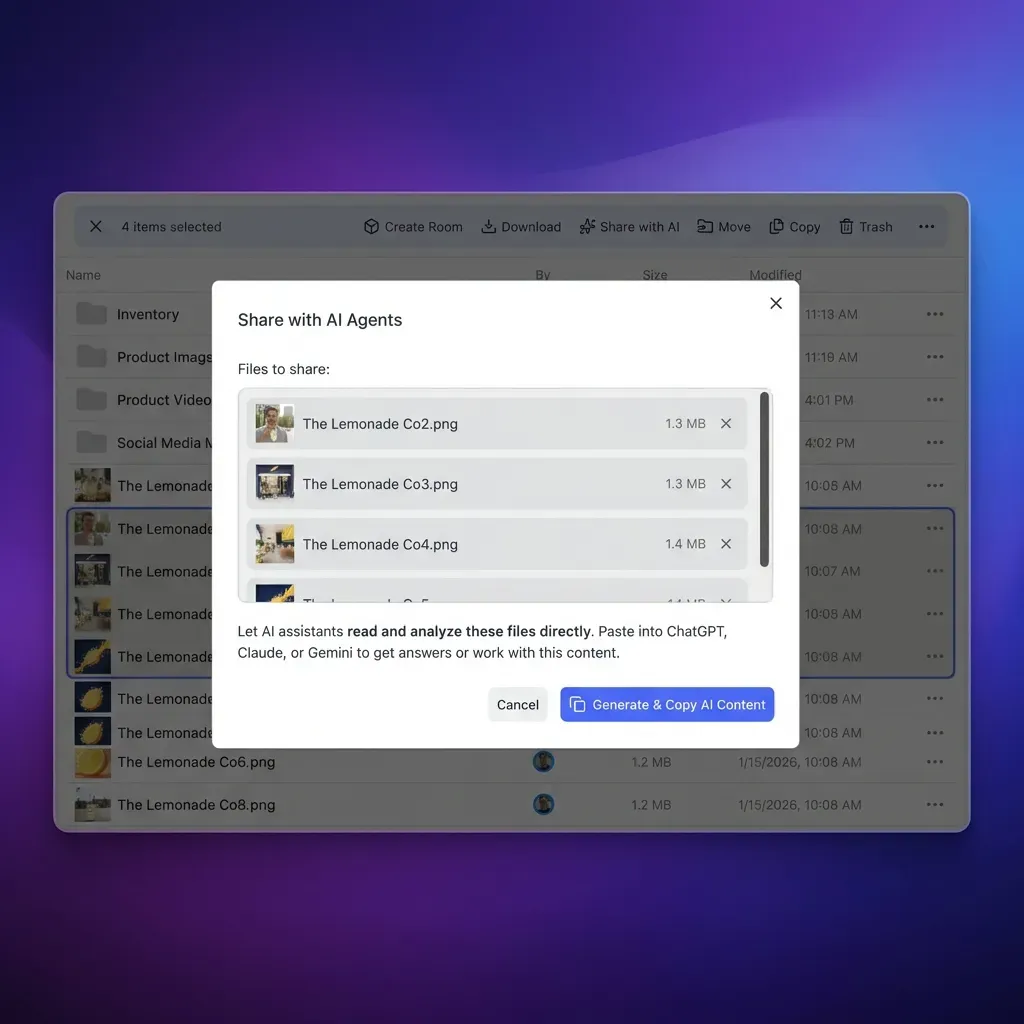
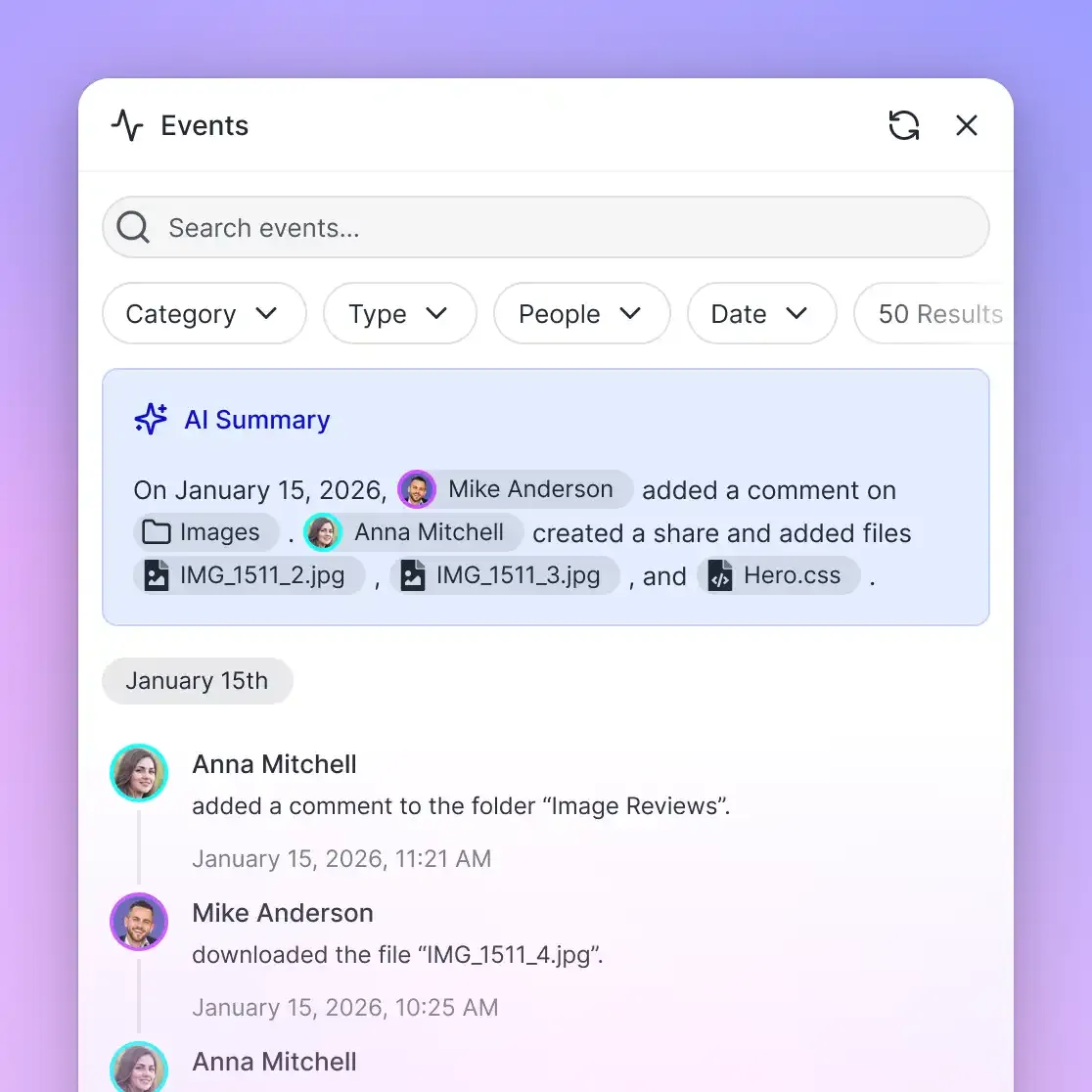
You can monitor Fastio's realtime activity feed or WebSocket events feed to trigger downstream pipelines automatically. For developers, the storage for agents and Fastio MCP tools provide the necessary primitives to manage folders and query views programmatically. Once Clay completes the background removal, it uploads the edited image back to Fastio using the Fastio API or url import feature.
When files are uploaded back to Fastio, the platform handles organization through two main layers:
File Version History: Every file in a Fastio workspace maintains a complete version history. If an AI agent updates an existing image, the file is overwritten in-place rather than creating duplicates. Human designers can view the version history in the UI, compare changes, and restore prior versions.
Metadata Views: Unlike standard search indexing, Fastio Metadata Views turn your creative assets into a live, queryable database. By visiting the document data extraction page, you can define the fields you want extracted in natural language. The built-in AI designs a typed schema (such as Text, URL, Boolean, or JSON) and scans the images to extract details. For a product catalog, you can create columns for Dominant Color, Background Status, and Subject Category. The AI tags the files automatically, letting teams sort, filter, and search by metadata values.
Fastio organization billing includes generous seat and storage allowances alongside usage-based credits. Paid subscriptions start with the Starter plan at $9.99 a month or $99 a year, providing 3 seats, 250 GB of storage, and 100,000 credits/mo. The Business plan is $49.99 a month or $499 a year with 10 seats and 5 TB of storage, and the Enterprise plan is $199.99 a month or $1,999 a year with 30 seats and 25 TB of storage. Check the Fastio Pricing page for a full breakdown of plans and usage-based credits. Monthly plans start with a Business Trial of up to 14 days (credit card required); annual plans have no trial. An agent can create an organization to test the API and set up spaces, then hand off the organization to a human who completes the trial setup.
Sources
References used to verify factual claims in this guide.
-
Background removal is the most requested automated photo edit task, accounting for nearly 28% of all image edits
-
Starter plan at $9.99 a month or $99 a year, providing 250 GB of storage and 100,000 credits Business plan is $49.99 a month or $499 a year with 5 TB of storage, and the Enterprise plan is $199.99 a month or $1,999 per year with 25 TB of storage
Frequently Asked Questions
Which is the best free AI photo editor?
The best free AI photo editor depends on your deployment style. For manual, browser-based edits, Pixlr Express is highly regarded for general retouching and design tasks. For developers who need to scale workflows, a custom server running the open-source rembg library is the best choice because it provides unlimited, high-resolution processing without usage limits.
Can you automate background removal for free?
Yes, you can automate background removal for free by deploying the open-source rembg Python library on a serverless container. Commercial API services like remove.bg offer free tiers, but they limit you to fifty low-resolution images monthly. Hosting your own FastAPI container removes these caps and watermarks.
How do I integrate a free photo editor into my workflow?
You can integrate a free photo editor into your workflow by setting up an HTTP enrichment column in Clay to send image URLs to a custom FastAPI container. Once processed, the clean images can be sent back to Fastio workspaces using the Fastio REST API or URL import, preserving file history and versioning automatically.
Related Resources

Organize and Version Your Automated Creative Assets
Access a shared workspace featuring per-file version history, metadata views, and event-driven automation to store your AI-edited images. Monthly plans start with a Business Trial of up to 14 days.