How to Implement Multi-Agent Context Sharing Patterns
Multi-agent context sharing patterns are architectural frameworks that define how AI agents exchange state and memory. Efficient sharing allows teams to coordinate multiple agents without redundant processing or context conflicts. Implementing the right pattern can help multi-agent systems complete complex tasks up to four times faster than isolated agents.


How to implement multi agent context sharing patterns reliably
As AI workflows evolve from single-prompt interactions to complex multi-agent systems, coordination becomes the primary bottleneck. Context management is cited as the top challenge in multi-agent system design. When agents operate in isolation, they often repeat work, overwrite each other's progress, or fail to account for intermediate results produced by their peers.
According to recent industry benchmarks, multi-agent systems with a structured shared context complete complex tasks 2-4 times faster than those using simple sequential handoffs. This efficiency comes from reducing the "context bloat" that occurs when every agent is forced to ingest the entire conversation history. Instead, specialized patterns allow agents to access only the specific data they need, when they need it.
Helpful references: Fastio Workspaces, Fastio Collaboration, and Fastio AI.
Related guides
- How to Build Multi-Agent File Annotation WorkflowsManual data annotation is a bottleneck for AI development. Multi-agent file annotation allows parallel labeling with...
- How to Automate Document Processing with AI AgentsAI agent document processing uses autonomous agents to extract, analyze, and transform information from documents...
- Top 5 File Sharing Tools for AI WorkflowsOver 60% of AI workflows involve document or file processing. Multi-agent systems can generate hundreds of artifacts...
- How to Implement AI Agent RBAC File PermissionsRBAC for AI agent file permissions is a security model that assigns file access rights based on role, task scope, and...
- How to Implement Agent-to-Agent Communication Protocols Using Shared FilesFile-based agent communication uses a shared workspace as a 'blackboard.' Agents post tasks, results, and state updates...
- Best Document Processing Tools for AI AgentsDocument processing tools for AI agents automate the extraction, parsing, and transformation of unstructured documents...
More on this subject: Agent File and Document Workflows (325 guides)
What to check before scaling multi agent context sharing patterns
The blackboard pattern is one of the oldest and most reliable architectures for multi-agent coordination. In this model, a central "blackboard" serves as a shared memory space. Various specialized agents watch the blackboard for information they are qualified to process.
When an agent finds a piece of data it can handle, it performs its task and writes the result back to the blackboard. This pattern is ideal for complex, non-linear problems where the sequence of steps isn't known in advance.
Key Characteristics:
- Decoupled Agents: Agents don't need to know about each other; they only need to know the blackboard.
- Opportunistic Processing: Agents act as soon as the necessary information becomes available.
- Centralized State: The blackboard provides a single source of truth for the entire system status.
2. The Shared Workspace Pattern
A shared workspace acts as a persistent communication fabric for agents and humans. Unlike a transient blackboard that might exist only during a single execution, a shared workspace provides a durable environment where files, logs, and state persist across sessions.
Fastio implements this pattern by allowing agents to join workspaces as first-class members. In an intelligent workspace, agents can access shared files, contribute to a neural index, and use built-in RAG (Retrieval-Augmented Generation) without managing their own vector databases.
Advantages of Shared Workspaces:
- Human-in-the-Loop: Humans can view agent progress and intermediate artifacts in real-time.
- Persistent Memory: Agents can reference work done in previous sessions or by other agents days earlier.
- Unified Intelligence: Every file uploaded to the workspace is auto-indexed and searchable by meaning.



Start with multi agent context sharing patterns on Fastio
Fastio gives teams shared workspaces, MCP tools, and searchable file context to run multi agent context sharing patterns workflows with reliable agent and human handoffs.
3. Message Passing and Hierarchical Delegation
Message passing involves direct communication between agents. This is common in frameworks like AutoGen or CrewAI, where a "manager" agent delegates specific sub-tasks to specialized "worker" agents.
In a hierarchical model, the manager agent receives the high-level goal, breaks it down into a plan, and passes limited context to sub-agents. This "context scoping" prevents sub-agents from becoming overwhelmed with irrelevant data, keeping token costs low and accuracy high.
Best For:
- Clear, step-by-step workflows.
- Tasks that require a specific sequence of operations.
- Systems where one agent needs to supervise the quality of another's output.
4. Event-Driven Context Sharing
Event-driven patterns use triggers to move context between agents. When a specific event occurs, such as a file being uploaded or a status changing, a notification is sent to the relevant agents.
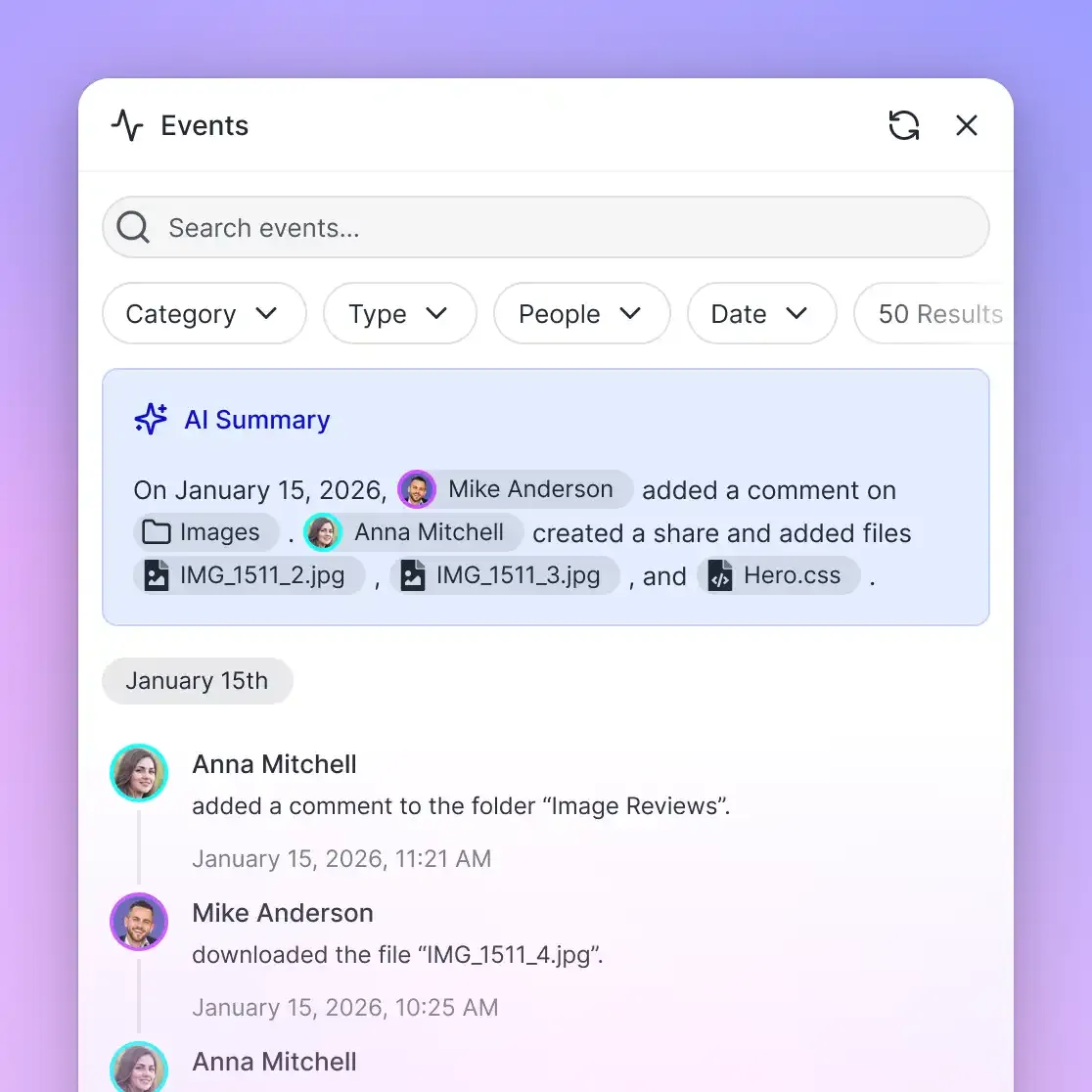
Fastio supports this through the WebSocket events feed and activity polling. An agent can listen to workspace events and receive real-time updates whenever files change. This allows for reactive workflows where agents only wake up and process data when there is a specific change to handle.
Common Triggers:
- File Upload: Trigger an agent to summarize or index a new document.
- Metadata Change: Signal that a human has updated an intermediate result.
- Timer/Schedule: Trigger periodic cleanup or status reporting agents.
Choosing the Right Sharing Pattern
Selecting the right pattern depends on the complexity and nature of your task. Use this table to evaluate which approach fits your multi-agent architecture.
For most development teams, a Shared Workspace combined with Event-Driven triggers offers the best balance of visibility, persistence, and performance.
Implementing Patterns with Fastio and MCP
The Model Context Protocol (MCP) provides a standardized way for agents to share context and tools. Fastio's official MCP server offers a consolidated toolset that allows agents to implement any of the patterns mentioned above.
Agents can use Fastio as their shared workspace, acquiring advisory file locks before modifying shared files to coordinate concurrent operations. Once Intelligence is enabled for the workspace, it handles the heavy lifting of indexing and retrieval, so your agents can focus on logic rather than infrastructure.
Advanced Implementation Tips:
- Use URL Import: Pull files from Google Drive or Dropbox via OAuth to avoid local I/O bottlenecks.
- Use Advisory File Locks and Version History: Acquire an advisory file lock before writing so other agents wait, while version history preserves every revision as a safety net.
- Ownership Transfer: Have an agent build a client portal or data room, then transfer ownership to a human teammate.
Sources
References used to verify factual claims in this guide.
-
multi-agent systems with structured shared context complete complex tasks 2-4 times faster than sequential handoffs
-
Fastio official MCP server offers a consolidated toolset for agents
-
Claude-based agent work in same workspace as GPT-4 agent sharing files neural index without provider lock-in
Frequently Asked Questions
How do multiple AI agents share context efficiently?
Efficient context sharing involves using patterns like shared workspaces or blackboard architectures. Instead of passing the entire history to every agent, developers use context scoping to provide agents only the specific data needed for their current task, often managed through a central coordinator or shared storage layer.
What is the blackboard pattern in multi-agent systems?
The blackboard pattern is a centralized coordination model where a common memory space (the blackboard) holds the system state. Multiple specialized agents monitor the blackboard and contribute their results back to it, allowing for opportunistic and non-linear problem solving without direct agent-to-agent communication.
How do you prevent context conflicts between agents?
To prevent context conflicts, use advisory file locks and granular permissions. Advisory file locks let an agent signal it is editing a file so other agents wait, while granular permissions limit access and version history ensures every change is traceable. Fastio provides these controls natively through its API and MCP tools.
What is the best way to share state between AI agents?
A shared workspace is often the best way to share state, as it provides a persistent, human-readable environment for both agents and team members. This approach supports long-term memory, version control, and real-time collaboration, making it superior to transient message-passing for complex projects.
Can agents from different providers share the same context?
Yes, by using open standards like the Model Context Protocol (MCP) and LLM-agnostic storage solutions like Fastio. This allows a Claude-based agent to work in the same workspace as a GPT-4 agent, sharing the same files and neural index without provider lock-in.
Related Resources

Start with multi agent context sharing patterns on Fastio
Fastio gives teams shared workspaces, MCP tools, and searchable file context to run multi agent context sharing patterns workflows with reliable agent and human handoffs.