How to Share Files Between Multiple AI Agents
Multi-agent file access lets AI agents read, write, and share files through a centralized storage system with proper access controls.


What Is Multi-Agent File Access?
Multi-agent file access is how multiple autonomous AI agents read, write, and collaborate on files through a shared storage system. Instead of passing files directly between agents (which creates coupling and state management issues), agents interact with a centralized file store that provides coordination, versioning, and access control. In practice, one agent uploads a file to shared storage and passes the file identifier (not the file itself) to the next agent, which retrieves it. This approach lets agents work asynchronously, handle large files efficiently, and maintain a single source of truth for file state. Multi-agent systems process more data than single agents, making solid file handling the foundation of reliable agentic workflows.
Helpful references: Fastio Workspaces, Fastio Collaboration, and Fastio AI.
Related guides
- How to Share a Google Drive Folder with AI AgentsSharing Google Drive folders with AI agents requires balancing API limits, authorization protocols, and security risks....
- Multi-Agent File Sharing: Patterns, Storage & CodeHow multiple AI agents share, read, write, and collaborate on files in production systems. Covers storage...
- Best AI File Organizers in 2026: 8 Tools That Actually Sort Your FilesMcKinsey estimates that employees spend 1.8 hours every day just searching for and gathering information. AI file...
- How to Manage Files with the Gemini APIGoogle's Gemini API offers powerful multimodal capabilities, allowing you to analyze images, audio, and video directly....
- How to Implement Agent-to-Agent Communication Protocols Using Shared FilesFile-based agent communication uses a shared workspace as a 'blackboard.' Agents post tasks, results, and state updates...
- How to Give ChatGPT Access to Local Files and Synced FoldersConnecting ChatGPT to local files and synced cloud directories eliminates repetitive manual uploads and keeps document...
More on this subject: Agent File and Document Workflows (325 guides)
Why Multi-Agent Systems Need Shared File Storage
As AI systems evolve from single-agent chatbots to multi-agent workflows, file handling becomes a critical bottleneck. AI teams frequently report file handoff as a top bottleneck in their systems.
Passing files between agents doesn't scale. Early multi-agent systems tried serializing files in API payloads, embedding them in context windows, or storing them in message queues. All three approaches fail at scale:
- API payloads: Limited by size restrictions (1-10MB typical), slow to transfer, no versioning
- Context windows: Consume valuable token budget, can't handle binary formats, disappear when context clears
- Message queues: Not designed for large objects, introduce coupling between agents
Shared storage solves coordination problems. When agents access files through a centralized system, you get:
- Single source of truth: No confusion about which agent has the latest version
- Asynchronous workflows: Agents don't block waiting for file transfers
- Better large file handling: Stream files without loading into memory
- Audit trails: Track which agent accessed or modified which file
- Access control: Restrict which agents can read or write specific files
Common Multi-Agent File Access Patterns
Real-world multi-agent systems use these proven patterns for file collaboration. Consider how this fits into your broader workflow and what matters most for your team. The right choice depends on your specific requirements: file types, team size, security needs, and how you collaborate with external partners. Testing with a free account is the fast way to know if a tool works for you.
Consider how this fits into your broader workflow and what matters most for your team. The right choice depends on your specific requirements: file types, team size, security needs, and how you collaborate with external partners. Testing with a free account is the fast way to know if a tool works for you.
Sequential Pipeline Pattern
Agents process files in a defined order, each adding value before passing to the next agent.
How it works: Agent A uploads a file, stores the file ID in a task queue, and marks the task "ready". Agent B polls the queue, downloads the file, processes it, uploads the result as a new file, and passes that file ID to Agent C.
Use cases:
- Document processing (OCR → extraction → summarization → classification)
- Media workflows (upload → transcode → thumbnail → metadata extraction)
- Data pipelines (ingest → validate → transform → load)
Fastio implementation: Each agent creates files in a shared workspace. Use the WebSocket events feed to trigger downstream agents when files are added instead of polling.
Concurrent Read Pattern
Multiple agents read the same source file simultaneously to perform different analyses.
How it works: Agent A uploads a file and notifies multiple downstream agents. Agents B, C, and D all download the same file and process it independently, writing their results to separate output files.
Use cases:
- Multi-model analysis (run GPT-4, Claude, and Gemini on the same document)
- Parallel feature extraction (extract text, images, metadata, and structure simultaneously)
- A/B testing (compare outputs from different agent versions)
Fastio implementation: Share a read-only file with multiple agents. Each agent writes results to their own workspace to avoid write conflicts.
Collaborative Editing Pattern
Multiple agents contribute to building or refining the same file over time.
How it works: Agents acquire a file lock before modifying a shared file, make their edits, and release the lock. Other agents wait for the lock to become available before proceeding.
Use cases:
- Research report compilation (multiple agents contribute sections)
- Code review (multiple agents suggest improvements to the same file)
- Collaborative summarization (agents refine summaries iteratively)
Fastio implementation: Use advisory file locks (lock-acquire, lock-release) to coordinate concurrent edits. Fastio lets agents acquire a lease before writing so other agents wait, while version history preserves every revision.
Producer-Consumer Pattern
One agent continuously generates files while multiple consumer agents process them as they arrive.
How it works: A producer agent uploads files to a shared folder. Consumer agents subscribe to file upload events via webhooks and process new files as they appear.
Use cases:
- Real-time data ingestion (scraper agent feeds processing agents)
- Batch job distribution (one agent generates tasks, workers claim and process them)
- Event-driven workflows (file arrival triggers downstream processing)
Fastio implementation: Producer writes to a workspace, consumers listen on the WebSocket events feed. Fastio streams notifications when files are added to watched folders.


Start with multi agent file access on Fastio
Fastio provides AI agents with persistent storage, version history, WebSocket events, and a consolidated MCP toolset. Get started on the Fast.io pricing page.
File Conflicts and Race Conditions
File conflicts cause 40% of multi-agent failures. Understanding and preventing them is essential for production systems.
Lost updates: Two agents read the same file, modify it independently, and both write back. The second write overwrites the first agent's changes without merging them.
Solution: Use advisory file locks before writing so other agents wait, supported by per-file version history. Fastio maintains advisory file locks alongside version history with restore capabilities to coordinate agent writes and prevent lost progress. Teams can inspect audit logs and restore prior versions if conflicts occur.
Read-modify-write race: Agent A reads a file, Agent B reads the same file, Agent A writes changes, Agent B writes changes based on stale data. Agent A's work is lost.
Solution: Implement optimistic locking with version checks. Before writing, verify the file version matches what you read. If the version changed, re-read and retry.
Directory listing races: Agent A lists files in a folder, Agent B adds a new file, Agent A processes the list it retrieved (which is now incomplete).
Solution: Use event notifications instead of polling directory listings. The Fastio WebSocket events feed notifies agents immediately when files are added, ensuring no files are missed.
Partial write visibility: Agent A starts uploading a large file, Agent B sees the file appear in the directory listing before the upload completes, and tries to process an incomplete file.
Solution: Use atomic uploads or write to a temporary location and move the file when complete. Fastio chunked uploads are atomic - files appear only after the final chunk is committed.
File Locking Strategies for Multi-Agent Systems
File locks are the primary mechanism for preventing concurrent write conflicts. Choose the right locking strategy for your workflow.
Pessimistic locking (acquire before reading): Agent acquires a lock before reading the file, performs work, writes changes, and releases the lock. Other agents cannot read or write while the lock is held.
When to use: Short operations where you want guaranteed exclusive access. Works well for quick edits or when read-modify-write must be atomic.
Drawback: Blocks all other agents, even readers. Can create bottlenecks if agents hold locks for long periods.
Optimistic locking (check before writing): Agent reads the file without locking, performs work, and attempts to acquire a lock only when writing. If another agent modified the file in the meantime, retry with fresh data.
When to use: Long-running operations where holding a lock the entire time would block too many agents. Works well for independent transformations that can be safely retried.
Drawback: Requires retry logic and may waste computation if conflicts are frequent.
Shared/exclusive locks (readers-writer pattern): Multiple agents can hold read locks simultaneously, but write locks are exclusive. Acquiring a write lock waits for all read locks to release.
When to use: Workloads with many readers and occasional writers. Maximizes concurrency while preventing write conflicts.
Drawback: More complex to implement correctly. Distributed systems often implement this pattern through application-level queues.
Lock timeouts and deadlock prevention: Always set timeouts on lock acquisition. If an agent crashes while holding a lock, the timeout ensures the lock is automatically released. Use a consistent lock ordering if agents need to acquire multiple locks. In multi-agent systems, advisory leases coordinate writers while version history and activity logging ensure that all operations remain traceable and recoverable.
How Fastio Handles Multi-Agent File Access
Fastio provides the infrastructure multi-agent systems need for reliable file sharing, with features built for AI agents.
Agent workspaces: Each agent can create and manage workspaces just like human users. A workspace is a shared folder with permissions, activity tracking, and optional AI indexing. Agents organize files by project, client, or workflow stage.
Advisory file locks and version history: Coordinate concurrent writes using advisory file locks (lock-acquire, lock-status, lock-release) and restore earlier file versions if uncoordinated edits land.
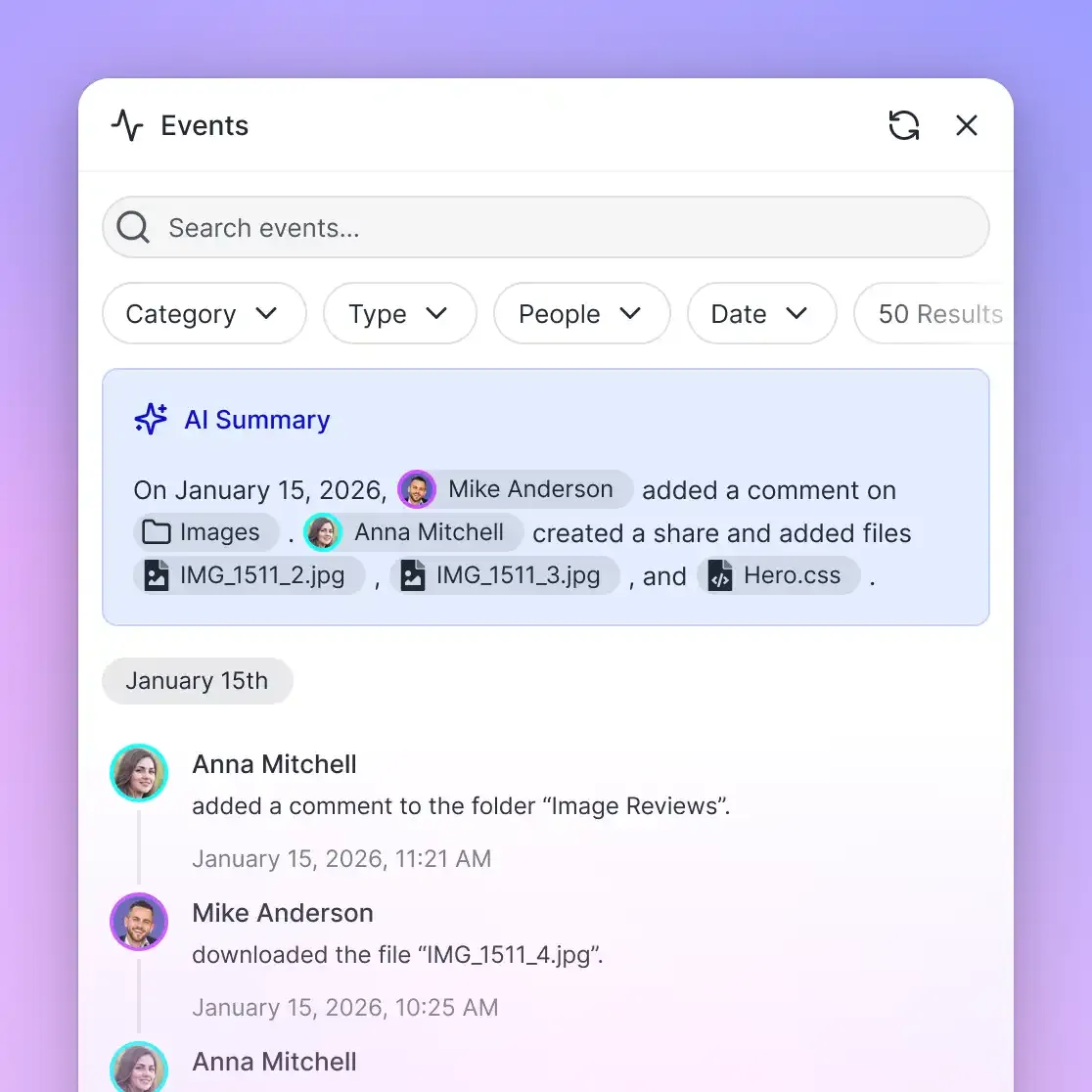
WebSocket events and activity feed: Receive real-time notifications via WebSocket events or poll the activity feed when files are uploaded, modified, or accessed. Build reactive workflows without blind polling. Event feeds eliminate the directory listing race condition common in polling-based systems.
URL Import: Agents can import files from external sources (Google Drive, OneDrive, Box, Dropbox) without downloading locally. Useful for multi-cloud workflows or when agents run in serverless environments with no persistent disk.
Ownership transfer: An agent can build a complete workspace, populate it with files, and transfer ownership to a human user while keeping admin access. This lets agents prepare deliverables for human review or client handoff.
Intelligence Mode and RAG: Once Intelligence is enabled for the workspace, Fastio auto-indexes files for semantic search and Q&A. Agents can query workspace contents in natural language and receive cited answers, which supports knowledge-sharing across agent teams.
MCP integration: Fastio provides a consolidated MCP toolset over Streamable HTTP at https://mcp.fast.io/mcp/tools for Claude and most MCP clients, and at https://mcp.fast.io/mcp/code for coding agents such as Cursor. MCP-compatible agents (Claude Desktop, Cursor, etc.) get zero-config file access and sign in with OAuth in the browser.
Headless agents: Connect to https://mcp.fast.io/mcp/tools and send a scoped API key as an Authorization: Bearer header, with no local install.
Business Trial: Fastio offers a 14-day Business Trial on monthly plans, card required; see /pricing/. Paid plans include generous storage, per-plan seats, and usage-based credits.
Architecture Patterns for Multi-Agent Storage
Design your storage layer to match your multi-agent workflow requirements.
Workspace per workflow: Create a dedicated workspace for each multi-agent workflow instance. Agents involved in that workflow share access to the workspace. When the workflow completes, archive or delete the workspace.
Benefits: Clean isolation between workflows, easy cleanup, clear access boundaries.
Use case: Processing customer support tickets where each ticket gets its own workspace with relevant agents.
Workspace per agent: Each agent gets a private workspace for its own files, plus access to shared workspaces for collaboration.
Benefits: Agents maintain state across workflows, clear ownership, agents can organize files how they prefer.
Use case: Research agents that accumulate knowledge over time and contribute to multiple projects.
Workspace per project: All agents working on a project share a single workspace. Use folders to organize by agent or file type.
Benefits: Simple, centralized view of all project files, easy for humans to audit.
Use case: Content production pipelines where multiple agents contribute to building a final deliverable.
Hybrid: folders within shared workspaces: Create agent-specific folders within a shared workspace. Each agent writes to its own folder but can read from others.
Benefits: Combines organization and sharing, reduces permissions overhead.
Use case: Data pipelines where each stage (ingest, validate, transform, export) gets a folder.
Best Practices for Multi-Agent File Systems
Follow these guidelines to build reliable multi-agent file workflows.
Use file identifiers, not file paths. Paths can change (files move, workspaces rename). Store file IDs in task metadata and resolve them to paths at runtime. Fastio provides stable file IDs that persist across moves.
Make operations idempotent. Agents should produce the same output when processing the same input file multiple times. Use content-based naming (hash of input) or check if the output file already exists before processing.
Version your file formats. When agents produce structured files (JSON, CSV, etc.), include a version field. If the schema changes, downstream agents can detect and handle older versions gracefully.
Log all file operations. Record when agents create, read, update, or delete files. Include agent ID, timestamp, file ID, and operation type. Fastio provides automatic audit logs for all file events.
Set file retention policies. Decide how long intermediate files should be kept. Create cleanup jobs that delete old files after a retention period. Fastio supports expiration dates on files and folders.
Use descriptive file names. Include agent name, timestamp, and operation in file names. Example: summarizer-[timestamp]-summary.txt. This makes debugging and audit trails much easier.
Add retry with exponential backoff. When file operations fail (network timeout, rate limit, etc.), retry with increasing delays. Set a maximum retry limit to avoid infinite loops.
Monitor file system metrics. Track storage usage, file count, operation latency, and error rates. Set alerts for unusual patterns (sudden spike in files, high error rate, etc.).
Security and Access Control for Agent File Systems
Multi-agent systems need strong security to prevent unauthorized access and data leaks.
Principle of least privilege: Grant each agent access only to files it needs. Don't give all agents admin access to all workspaces. Use read-only permissions when agents only need to consume files.
Agent authentication: Each agent should have its own API credentials. Avoid shared API keys across multiple agents. If one agent is compromised, you can revoke its access without affecting others.
Workspace permissions: Use workspace-level permissions to group related agents. For example, a "data-processing" workspace accessible to ingestion, validation, and transformation agents, but not to external-facing agents.
Audit all agent actions: Log every file read, write, and permission change with the agent's identity. Audit logs help diagnose issues and detect malicious behavior.
Encrypt sensitive files: Use encryption at rest and in transit. Fastio encrypts all files by default. For extra-sensitive data, encrypt files before upload using agent-managed keys.
Human verification for high-risk operations: For operations like deleting large batches of files, transferring ownership, or changing permissions, verify with a human supervisor before executing.
Watermark agent-generated files: Embed metadata identifying which agent created or modified a file. This tracks provenance and detects unauthorized modifications.
Sources
References used to verify factual claims in this guide.
-
File conflicts cause 40% multi-agent failures
-
Fastio provides a consolidated toolset via the Streamable HTTP transport with persistent storage and usage-based credits
Frequently Asked Questions
How do AI agents share data without passing files directly?
AI agents share data by storing files in centralized cloud storage and passing file identifiers (not the files themselves) between agents. One agent uploads a file and gets back a file ID, which it includes in the task metadata for the next agent. The downstream agent retrieves the file using that ID. This pattern keeps agents decoupled, handles large files efficiently, and provides a single source of truth for file state.
Can multiple AI agents access the same file simultaneously?
Yes, multiple agents can read the same file concurrently without conflicts. For write operations, agents can acquire advisory file locks before writing to coordinate access. Fastio preserves prior versions automatically and logs every action in a detailed activity log, ensuring that teams can review changes and restore earlier versions if needed.
What is agent-to-agent communication in multi-agent systems?
Agent-to-agent communication refers to how autonomous agents coordinate and share information. Common patterns include message passing (via queues or pub/sub), shared memory (databases or file storage), and direct API calls. File-based communication is popular for large datasets where agents upload files to shared storage and notify other agents via webhooks or task queues. This approach decouples agents and handles data too large for message payloads.
How do you prevent file conflicts in multi-agent systems?
Prevent file conflicts using advisory file locks, version history, granular folder permissions, atomic chunked uploads, and the WebSocket events feed instead of polling. Fastio preserves prior versions automatically and logs every action in a detailed activity log.
What storage system works best for multi-agent file sharing?
Cloud storage with programmatic access works best for multi-agent systems. Look for features like persistent storage (files don't expire), API access for all operations, granular permissions for conflict prevention, WebSocket events for reactive workflows, and plans with seats included plus usage-based credits for AI work. Fastio provides all of these with structured workspaces, a consolidated MCP toolset, built-in RAG, and ownership transfer to humans.
How does Fastio prevent write conflicts for AI agents?
Fastio prevents write conflicts through automatic per-file version history, granular permissions, and detailed activity logging. When multiple agents write to a workspace, versions are preserved so teams can review differences and restore prior versions if needed.
What is the difference between ephemeral and persistent agent storage?
Ephemeral storage (like OpenAI's Files API) deletes files after a period of inactivity or when agents are deleted. Persistent storage (like Fastio) keeps files indefinitely until explicitly deleted. For multi-agent systems, persistent storage is critical because workflows often span hours or days, files are reused across multiple workflow runs, and audit trails require long-term file retention. Fastio provides persistent storage with generous storage for agents.
Can AI agents transfer file ownership to human users?
Yes, Fastio supports ownership transfer where an agent creates an organization, builds workspaces and files, and then transfers ownership to a human user. The agent retains admin access after the transfer. This lets agents prepare complete deliverables (like data rooms, client portals, or project folders) and hand them off to humans for final review or client delivery. It's one of the key features for true human-agent collaboration.
Related Resources

Start with multi agent file access on Fastio
Fastio provides AI agents with persistent storage, version history, WebSocket events, and a consolidated MCP toolset. Get started on the Fast.io pricing page.