Perplexity Message Limit: Pro Search Quotas, Daily Caps, and Workarounds
The Perplexity message limit restricts Pro Search queries across Free and Pro tiers, while API endpoints enforce tier-based rate limits. When teams conduct iterative research across document collections, repetitive exploratory queries quickly exhaust message quotas. Connecting external intelligent workspaces through the Model Context Protocol offloads document retrieval, letting assistants query indexed files without hitting chat caps.


What Are the Perplexity Message Limits Across Account Tiers?
The Perplexity message limit is the daily or interval-based quota governing how many Pro Search queries and conversational interactions a user or API client can execute before reverting to standard search or rate throttling. For analysts evaluating technical specifications, market research, or corporate filings, iterative queries against attached files rapidly burn through these allowances, triggering rate limit errors or downgrading responses to basic web search.
Perplexity structures message limits around two distinct search architectures: standard quick search and Pro Search. Standard quick search performs a single-pass index lookup against web sources, generating fast answers with minimal computational overhead. Pro Search activates multi-step reasoning, executing sequential search queries, evaluating source credibility, executing code in sandboxes when necessary, and synthesizing findings across complex chains of thought. Because Pro Search consumes extensive computational resources, Perplexity meters its frequency across consumer, enterprise, and developer tiers.
Understanding these boundaries is essential for structuring research sessions. An individual user conducting occasional web lookups rarely encounters the ceiling on a Pro plan. However, when an analyst or developer attempts to use Perplexity as an analytical workspace for deep document libraries, message limits become an immediate bottleneck.
Free Tier Rolling Limits and 4-Hour Reset Windows
Free consumer accounts operate under an allocation of 5 Pro Search queries every 4 hours. This allowance does not reset at predetermined clock hours like midnight or noon. Instead, it runs on an individual rolling timer tracked from the moment a Pro search is submitted.
When a free user exhausts their 5 Pro queries, the interface disables the Pro Search toggle. The input box remains functional for standard quick searches, but advanced multi-step reasoning and multi-source synthesis become inaccessible until the 4-hour window clears. A countdown indicator in the interface shows the remaining time before the next Pro search slot opens. Standard quick searches remain unmetered for general browsing under standard fair-use thresholds.
Perplexity Pro Daily Caps and Model Routing Thresholds
Upgrading to Perplexity Pro at $20 per month expands the quota to 300+ Pro Search queries per day. For standard desktop research, 300 queries provides significant headroom. A user can run comprehensive industry inquiries, compare technical benchmarks, and cross-reference news stories without interruption.
Perplexity Pro also unlocks model selection, allowing subscribers to direct their search queries through frontier models including Claude Sonnet 4.6, Claude Opus 4.8, GPT-5 variants, or Perplexity's native Sonar Pro model. Every query executed with Pro Search active consumes one unit from the daily 300+ allotment, regardless of which underlying model is chosen.
The 300+ limit operates on a rolling 24-hour cycle rather than resetting at midnight. If you conduct 150 Pro searches during an intensive afternoon work sprint, those queries do not refresh until the corresponding afternoon hours of the following day. Once the 300+ threshold is crossed, the system notifies the user that Pro Search is temporarily exhausted and automatically downgrades subsequent queries to standard search until the rolling allowance recovers.
Perplexity API Rate Limits: RPM, QPS, and the Leaky Bucket System
Developers integrating Perplexity into autonomous software agents or backend data pipelines encounter a different regulatory framework. Rather than daily conversational caps, the Perplexity API platform enforces programmatic throughput limits measured in queries per second (QPS) and requests per minute (RPM).
Perplexity enforces dual rate limits across its API infrastructure, capping requests by queries per second and model requests per minute according to account usage tiers. Account tiers advance automatically based on cumulative lifetime credit purchases in the API Console.
Once an account advances to a higher spending tier, that tier remains permanent with no downgrades. This tiered structure ensures that enterprise production workloads receive dedicated capacity while protecting platform stability from uncontrolled request spikes.
The Leaky Bucket Algorithm and Burst Capacity
Perplexity uses a leaky bucket algorithm to regulate API query limits, allowing short burst capacity while maintaining long-term rate control. In this model, the bucket capacity represents the maximum number of requests a client can execute simultaneously, while the leak rate defines the sustained rate limit over time.
Token replenishment is continuous rather than stepped. On an endpoint configured for 50 QPS, one token refills every 20 milliseconds. On a Tier 2 configuration supporting 500 RPM, tokens replenish every 2 milliseconds.
This design allows developers to submit quick bursts of parallel requests for batch jobs without adding artificial client-side delays. If an application submits 50 concurrent requests when the bucket is full, all 50 pass immediately. However, subsequent requests submitted before tokens replenish are rejected until the leak rate restores capacity.
Diagnosing and Resolving HTTP 429 Errors
When an application exceeds its QPS or RPM allowance, the API returns an HTTP 429 Too Many Requests status code accompanied by a Retry-After response header. This header specifies the exact number of seconds the application must wait before retrying the call. Requests rejected with a 429 status code are not billed against your credit balance.
Resolving frequent rate-limit exceptions requires three engineering practices:
- Implement exponential backoff with jitter in client networking logic, preventing retry storms when multiple workers encounter throttling simultaneously.
- Separate batch operations from interactive real-time queries, queuing non-urgent background tasks during lower-traffic windows.
- Monitor consumption patterns in the API Console under the Usage Tiers dashboard, adding credits proactively when production traffic approaches tier boundaries.
Why Exploratory Document Research Depletes Message Limits
Most published guides focus on general subscription pricing without explaining why researchers and technical teams hit message caps during normal working hours. The primary cause of quota exhaustion is not searching the public web; it is iterative exploratory research over uploaded files.
When an analyst attaches a complex financial audit, a technical manual, or a collection of vendor contracts to a Perplexity thread, every subsequent interaction consumes a Pro Search query. If you ask 10 questions clarifying definitions, 15 questions cross-referencing tables, and 20 follow-up queries probing edge cases, you burn 45 Pro searches on a single document set.
Repeating this workflow across several matters or research projects throughout the day exhausts the 300+ daily limit well before the workday finishes. Treating conversational search threads as an ad-hoc document repository creates structural friction that chat tools were never engineered to handle.
Context Contention and Ephemeral Chat Storage
Attaching files directly to a chat prompt forces the system to treat those documents as temporary conversational context. When an attached file enters a thread, the platform parses the content and injects text passages into the active prompt window alongside system instructions, search snippets, and conversational history.
As the conversation lengthens, the accumulated message history competes directly with document text for working memory. When context windows become crowded, large language models suffer from attention degradation. Important clauses located in the middle of long documents get overlooked, and the model struggles to maintain consistency across earlier turns.
Furthermore, chat attachments are ephemeral. If you start a new conversation to examine a separate aspect of the project, you must upload the files again and spend additional Pro Search queries re-indexing the material from scratch.
The Claude Projects Context Ceiling and Knowledge Boundaries
Perplexity is not alone in enforcing tight document boundaries. In Claude Projects, Anthropic notes that the number of files is unlimited, but individual files are capped at 30MB and total content must fit within Claude's context window (https://support.claude.com/en/articles/8241126-upload-files-to-claude). The real ceiling researchers hit is context-window capacity rather than a file-count cap, as cumulative token volume fills available memory. These knowledge boundaries represent the exact moment real users begin seeking external storage and retrieval architectures.
Whether using Claude Projects or Perplexity Spaces, researchers quickly realize that chat applications are designed for conversational exchange, not persistent document management. When a research project involves dozens of technical specifications, legal depositions, or corporate filings, forcing that corpus into a chat tool creates fragmented data silos and burns expensive conversational allowances on basic text retrieval.
Connecting AI Assistants to Persistent Workspaces via Remote MCP
The architectural solution to message limit exhaustion is separating storage from inference. Instead of pushing raw documents into an AI assistant's chat window, organizations store their corpus in a persistent cloud workspace and connect the assistant through the Model Context Protocol (MCP).
Under this architecture, your documents live in organized, shared workspaces. The workspace platform indexes the files automatically, parsing text and generating vector embeddings. When an AI assistant needs information, it does not ingest the entire file or burn daily search quotas. Instead, it queries the workspace through a remote MCP server, retrieves the exact relevant excerpts, and incorporates those focused passages into its answer with source citations.
Fastio provides this persistent layer for agentic teams. By storing research libraries in shared, organization-owned workspaces, teams eliminate the friction of manual attachment caps and daily query throttling. Fastio exposes a consolidated MCP toolset over Streamable HTTP at https://mcp.fast.io/mcp and legacy Server-Sent Events at https://mcp.fast.io/sse. Fastio does not raise or alter Perplexity's own internal search quotas; rather, it replaces repetitive document attachments with targeted external retrieval.
Ingesting and Syncing Large Document Corpora
Moving a research library into a workspace should not require downloading gigabytes of data to a local machine only to re-upload it through a web browser. Fastio supports direct cloud import from Google Drive, Dropbox, Box, and OneDrive via OAuth, in addition to direct URL imports. Teams can sync files on a schedule or on demand from Dropbox, Box, or OneDrive; Google Drive imports are available today, with automated sync coming soon.
Large file uploads also use chunked sessions, allowing teams to move massive PDF collections, scanned archives, and technical datasets directly into the cloud. Once stored, files are protected by granular access controls at the organization, workspace, folder, and file level.
Automated Indexing with Intelligence Mode
Storing files in a conventional cloud drive solves storage capacity, but leaves documents invisible to semantic AI search. Finding relevant facts still requires manual reading or exact keyword searches that fail on conceptual queries.
Fastio solves this with Intelligence Mode. When enabled on a workspace, Intelligence Mode automatically indexes every incoming document for retrieval-augmented generation (RAG). The platform parses the content and builds a hybrid search index that combines exact full-text keyword matching, semantic vector search, and search-by-metadata values.
When an AI assistant queries the workspace via MCP, Fastio searches across hundreds or thousands of documents in milliseconds. The model receives only the specific paragraphs needed to answer the user's question, accompanied by source document citations. This targeted retrieval keeps prompt token counts small, avoids context window bloat, and allows an assistant to answer questions across a massive document repository as easily as a brief document.
Configuring Remote MCP Access for Research Workflows
Connecting an assistant to a Fastio workspace takes minutes. Because Fastio hosts a remote MCP server, developers and researchers do not need to install local npm packages, run background Docker containers, or manage local daemon processes.
To connect an MCP client like Claude Desktop, Cursor, Cline, or an autonomous research agent, configure the remote endpoint using your Fastio API key. Here is a standard configuration using Streamable HTTP with Bearer authentication:
{
  "mcpServers": {
    "fastio": {
      "url": "https://mcp.fast.io/mcp/key",
      "headers": {
        "Authorization": "Bearer your_fastio_api_key_here"
      }
    }
  }
}
Once connected, the assistant gains access to workspace tools. It can search folders, retrieve file text, list directory contents, and inspect metadata without uploading a single megabyte into the chat conversation.


Query Large Research Libraries Without Message Caps
Store your document archives in a Fast.io workspace, index them for semantic search, and query them via remote MCP instead of burning daily chat limits. Every organization starts with a 14-day free trial.
Structuring Persistent Knowledge Bases for Team Research and Analysis
Transitioning from temporary chat attachments to an intelligent cloud workspace changes how teams conduct research. Instead of treating documents as disposable query inputs, organizations build cumulative knowledge repositories that improve in value over time. Rather than duplicating work in siloed browser tabs, analysts establish an authoritative system of record where reference files, research memos, and data extractions remain accessible to everyone.
To maximize the value of this architecture, teams should follow clear structural conventions for document management, metadata extraction, and access governance. This approach bridges the gap between raw document storage and autonomous agent workflows, allowing humans and AI assistants to operate from a single source of truth.
Automated Document Extraction with Metadata Views
Unstructured document collections often contain structured operational data that researchers must analyze across files. For example, a legal team reviewing contracts needs counterparty names and expiration dates, while an investment team reviewing quarterly filings needs revenue numbers and operating margins.
Fastio provides Metadata Views to solve this without requiring complex OCR templates or custom scraping scripts. Metadata Views turn document collections into a live, queryable database. Users describe the fields they want extracted in natural language, and AI designs a typed schema supporting Text, Integer, Decimal, Boolean, URL, JSON, and Date & Time formats.
The system scans matching documents across the workspace and populates a structured, sortable, and filterable spreadsheet. Team members can add new columns at any time without reprocessing files from scratch. Agents can also create Views, trigger extractions, and inspect the resulting data tables via the MCP server. To learn more about setting up structured extraction, explore the product guide for document data extraction.
Version History and Audit Tracking Across Concurrent Workflows
In fast-moving research environments, files change constantly. Analysts publish revised drafts, legal teams update contract clauses, and automated agents generate updated summaries.
Fastio maintains per-file version history for every document in a workspace. When multiple team members or automated agents access and update files concurrently, earlier iterations are preserved rather than overwritten. Users can compare changes, track modifications over time, and revert to prior versions whenever necessary.
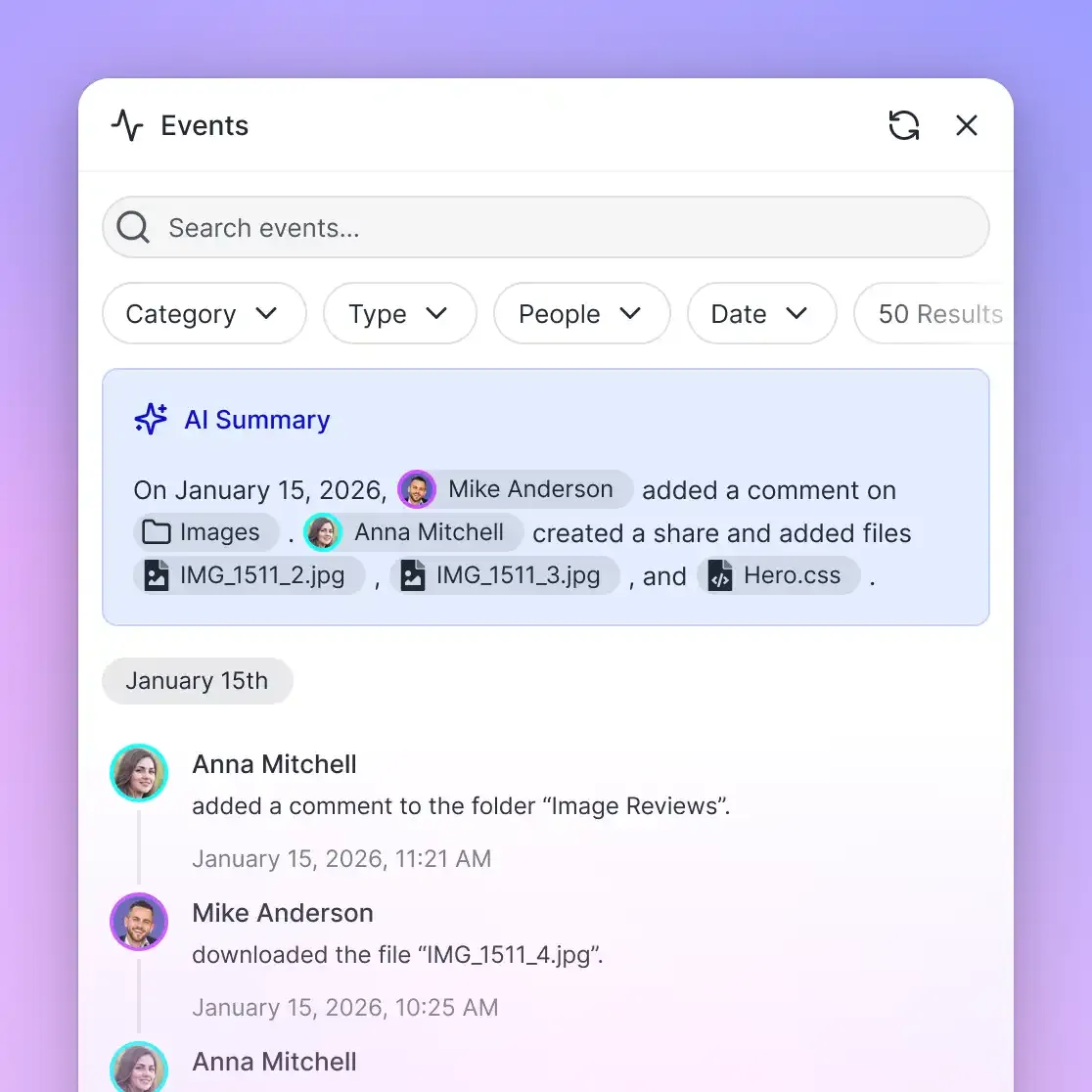
Every action taken within a workspace is recorded in an append-only audit log. The audit log tracks file uploads, downloads, share creation, permission updates, and search queries. This immutable activity trail ensures complete transparency for organizational compliance and team coordination.
Team Coordination and Fast.io Subscription Plans
Research workflows frequently involve external contractors, agency partners, or specialized AI agents setting up project structures. Fastio supports ownership transfer, allowing an agent or external specialist to build an organization, configure workspaces, import reference documents, and transfer primary ownership to a human stakeholder while retaining appropriate administrative permissions.
Teams can share project findings using branded shares. Fastio supports Send, Receive, and Exchange workflows with durable or expiring links and granular per-recipient access controls, replacing risky email attachments and generic shared drive links.
Every organization starts with a 14-day free trial, which requires a credit card. Fastio offers predictable subscription tiers designed for teams collaborating with AI:
- Starter at $29/mo (includes 5 seats, 1 TB of storage, and 300,000 AI credits)
- Business at $99/mo (includes 20 seats, 10 TB of storage, and 1,200,000 AI credits)
- Growth at $299/mo (includes 50 seats, 50 TB of storage, and 4,500,000 AI credits)
To set up a shared document workspace and test MCP connectivity with your research tools, visit the Fastio pricing page and review the agent storage documentation.
Sources
References used to verify factual claims in this guide.
-
Perplexity enforces dual rate limits across its API infrastructure, capping requests by queries per second and model requests per minute according to account usage tiers. Perplexity uses a leaky bucket algorithm to regulate API query limits, allowing short burst capacity while maintaining long-term rate control.
Frequently Asked Questions
What is the daily message limit on Perplexity Pro?
Perplexity Pro provides 300+ Pro Search queries per day on a rolling 24-hour window, alongside unlimited standard quick searches. Once the 300+ Pro Search allocation is reached, subsequent queries default to standard search until the rolling 24-hour capacity replenishes.
How many free Pro searches do you get on Perplexity?
Free Perplexity users receive 5 Pro Search queries every 4 hours. This counter operates on a rolling timer from the time queries are used rather than resetting at fixed calendar times. Free users retain access to unlimited standard quick searches.
How do I fix the Perplexity rate limit exceeded error?
In the web interface, a rate limit error indicates your Pro Search quota is exhausted for the current interval. Toggle off Pro Search to continue querying with standard search, or wait for your rolling window to reset. For API users encountering HTTP 429 errors, implement exponential backoff with jitter or advance your account spend tier in the API Console to unlock higher requests per minute and queries per second.
Does Perplexity limit standard quick searches?
Perplexity does not enforce a numerical ceiling on standard quick searches for Free or Pro accounts under normal fair use. Standard queries use single-pass web retrieval rather than multi-step reasoning, allowing high throughput without daily message limits.
How does the Perplexity message limit compare to Claude Projects knowledge limits?
Perplexity limits usage by query frequency, such as 5 Pro searches every 4 hours on Free or 300+ daily on Pro, while Claude Projects project knowledge is limited by the context window, 30MB per file (https://support.claude.com/en/articles/8241126-upload-files-to-claude). Both platforms encounter friction when analyzing large document collections in chat, as repeated document questions deplete message allowances and fill context windows.
Does Fast.io increase Perplexity's internal query limit?
Fast.io does not alter or raise Perplexity's internal server quotas. Instead, Fastio provides an external workspace where document collections are stored, versioned, and indexed with Intelligence Mode. AI assistants connect to Fastio via a remote Model Context Protocol server to search and retrieve relevant document passages on demand, preventing repetitive document queries from consuming daily message allowances.
Related Resources

Query Large Research Libraries Without Message Caps
Store your document archives in a Fast.io workspace, index them for semantic search, and query them via remote MCP instead of burning daily chat limits. Every organization starts with a 14-day free trial.