How to Set Up AI Agent File Indexing (The Easy Way)
Most AI agent file indexing requires complex Python pipelines and vector databases. This guide shows you how to skip the infrastructure setup and give your agents instant, searchable access to documents using Fastio's built-in Intelligence Mode.


What is AI Agent File Indexing?
AI agent file indexing is the process of scanning, parsing, and cataloging files so that AI agents can quickly discover and retrieve relevant documents by content, metadata, or semantic meaning rather than just file names.
Without indexing, an agent acts like a human without a filing system. It has to open and read every single document to find what it needs. This "brute force" approach is slow, expensive, and often hits context window limits. With proper indexing, agents can instantly pinpoint the exact paragraph in a lengthy PDF that answers a user's question.
Why Semantic Indexing Matters
Traditional search relies on keywords. If you search for "invoice," you get files named "invoice." Semantic indexing, used by modern AI agents, understands meaning. An agent searching for "billing discrepancies from Q3" will find a file named quarterly-financial-report.pdf because the index understands that the content matches the intent.
Related guides
- Top 5 File Sharing Tools for AI WorkflowsOver 60% of AI workflows involve document or file processing. Multi-agent systems can generate hundreds of artifacts...
- How to Automate File Classification with AI AgentsAI agent file classification automation uses intelligent agents to categorize incoming documents, apply tags, and route...
- How to Manage Files for Resume Parsing AgentsManaging files for resume parsing agents means organizing candidate documents for AI recruitment systems. Learn to...
- How to Extract Metadata from Docker Container ImagesDocker container images carry structured metadata far beyond the filesystem layers themselves. OCI manifests, image...
- How to Use AI Assistants for File Management and OrganizationAI assistant file management uses artificial intelligence to organize, categorize, search, and manage files...
- Multi-Agent File Sharing: Patterns, Storage & CodeHow multiple AI agents share, read, write, and collaborate on files in production systems. Covers storage...
More on this subject: Agent File and Document Workflows (325 guides)
The Old Way: Building Manual RAG Pipelines
Until recently, giving an agent access to your files meant building a complex "Retrieval-Augmented Generation" (RAG) pipeline from scratch. This engineering-heavy approach typically involves:
- Ingestion Scripts: Writing Python code to watch folders and upload files.
- Text Extraction: integrating OCR tools like Tesseract or Amazon Textract to read PDFs and images.
- Chunking: Splitting text into manageable pieces (and hoping you don't cut sentences in half).
- Embedding: Paying for API calls to convert text into vector numbers.
- Vector Database: Managing a separate database like Pinecone or Milvus to store those numbers.
This stack is powerful but brittle. If a file changes, you have to rebuild the index. If you delete a file, you have to manually prune the database. For most teams, this maintenance burden is a dealbreaker.
The Fast Way: Zero-Config Indexing with Fastio
Fastio takes a different approach. We believe the storage layer itself should be intelligent. Instead of glueing together five different services, you store your files in a Fastio workspace and enable Intelligence Mode.
When you upload a file, whether via the web UI, API, or an agent, Fastio automatically handles the entire pipeline:
- Instant Ingestion: Files are processed immediately upon arrival.
- Universal Parsing: We handle PDFs, Word docs, spreadsheets, and even media transcripts.
- Managed Vector Store: No external database required. The index lives with the data.
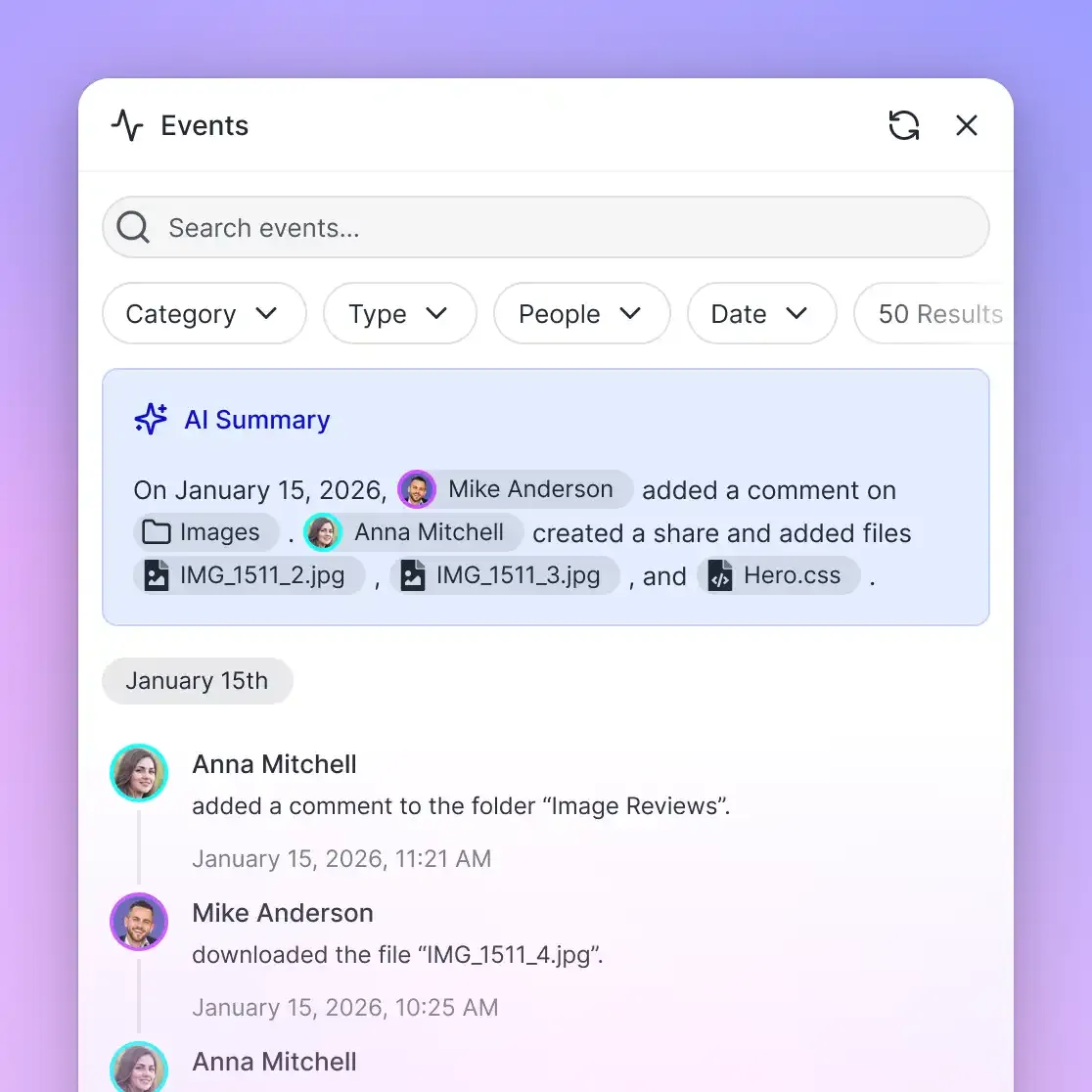
- Live Updates: Edit a file, and the index updates instantly. Delete a file, and it's gone from the index.
This transforms your storage from a "dumb" hard drive into a dynamic knowledge base that any agent can query.


Give Your AI Agents Persistent Storage
Stop building pipelines and start building agents.
Step-by-Step: Enabling File Indexing for Agents
Setting up an indexed environment for your agents takes less than two minutes. Here is the process:
1. Create a Workspace Log in to Fastio and create a new workspace. This will be the shared drive for your humans and agents.
2. Enable Intelligence Mode Go to Workspace Settings > Intelligence. Toggle "Intelligence Mode" to ON. You will see a status indicator as existing files are indexed.
3. Connect Your Agent Use the Fastio MCP Server to give your agent access. If you are using Claude Desktop or Cursor, this is as simple as adding the server configuration to your config file.
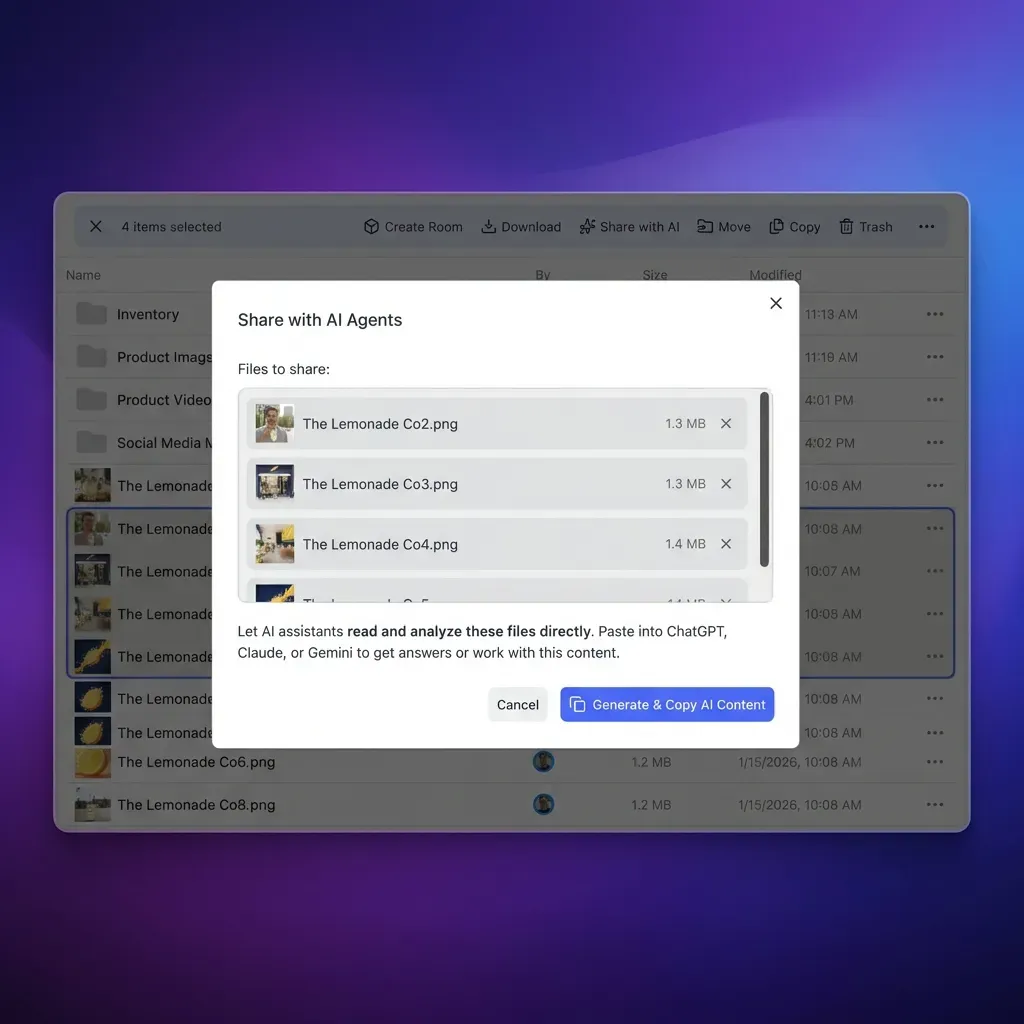
4. Start Querying Your agent can now search the workspace by meaning and ask questions that come back with cited answers, through the MCP server. It doesn't need to download files first. It asks the storage layer for the answer.
How Agents Access Indexed Files
Once indexed, there are three primary ways agents interact with your data:
1. Model Context Protocol (MCP)
For agents running in Claude, Cursor, or other MCP-compliant environments, Fastio provides a remote MCP server at https://mcp.fast.io/mcp/tools (Cursor and other coding agents use https://mcp.fast.io/mcp/code) with a consolidated toolset. Agents can search content by meaning or retrieve summaries and key snippets once Intelligence is enabled for the workspace.
2. Fastio CLI
If you are running scripts, local pipelines, or automation workflows, the Fastio CLI (@vividengine/fastio-cli, binary fastio, documented at /cli/) offers command-line file management and workspace operations for any environment.
3. Direct API Access
For developers building bespoke integrations, the REST API at https://api.fast.io/current/ exposes endpoints that return cited answers and workspace contents.
Frequently Asked Questions
What file types can be indexed for AI agents?
Fastio indexes text-based formats like PDF, DOCX, TXT, MD, and CSV automatically once Intelligence is enabled for the workspace. Audio and video transcripts are also indexed for search.
Does indexing happen in real-time?
Yes, once Intelligence is enabled for the workspace. As soon as a file is uploaded or modified in an Intelligence-enabled workspace, indexing processes the document so it is available for search.
Do I need a separate vector database like Pinecone?
No. Fastio includes a managed vector store once Intelligence is enabled for the workspace. You do not need to set up, pay for, or manage an external vector database.
Can I control which files the agent sees?
Yes. Fastio uses granular permissions at the organization, workspace, folder, and file level. You can restrict an agent's API key to specific workspaces or folders, ensuring it only indexes and accesses authorized data.
Is this different from OpenAI's file search?
Yes. OpenAI's file storage is ephemeral and tied to specific assistant sessions. Fastio provides persistent, organizational storage that works across any LLM or agent framework.
How much does AI indexing cost?
Intelligence is included across Fastio plans, metered by usage-based credits. Fastio offers a 14-day Business Trial (credit card required) to test intelligent workspaces with full indexing capabilities.
Can I transfer the indexed data to a client?
Yes. Fastio allows agents to build workspaces and then transfer full ownership to a human client, keeping the index and data intact.
Related Resources

Give Your AI Agents Persistent Storage
Stop building pipelines and start building agents.