Fastio Event Feeds: A Guide to Real-Time File Events
Fastio enables developers to trigger AI agents or human workflows instantly when files are added, modified, or deleted in a workspace. Real-time WebSocket event feeds and activity polling eliminate inefficient short-polling and power responsive event-driven architectures.

Does Fastio Support Webhooks?
Developers often look for webhooks to trigger AI agents or human workflows instantly when files are added, modified, or deleted in a workspace. While Fast.io does not offer native inbound or outbound HTTP webhooks, it provides real-time event streaming via its WebSocket events feed and the workspace activity long-polling endpoint (GET /current/activity/poll/{entity_id}) over the REST API at https://api.fast.io/current/.
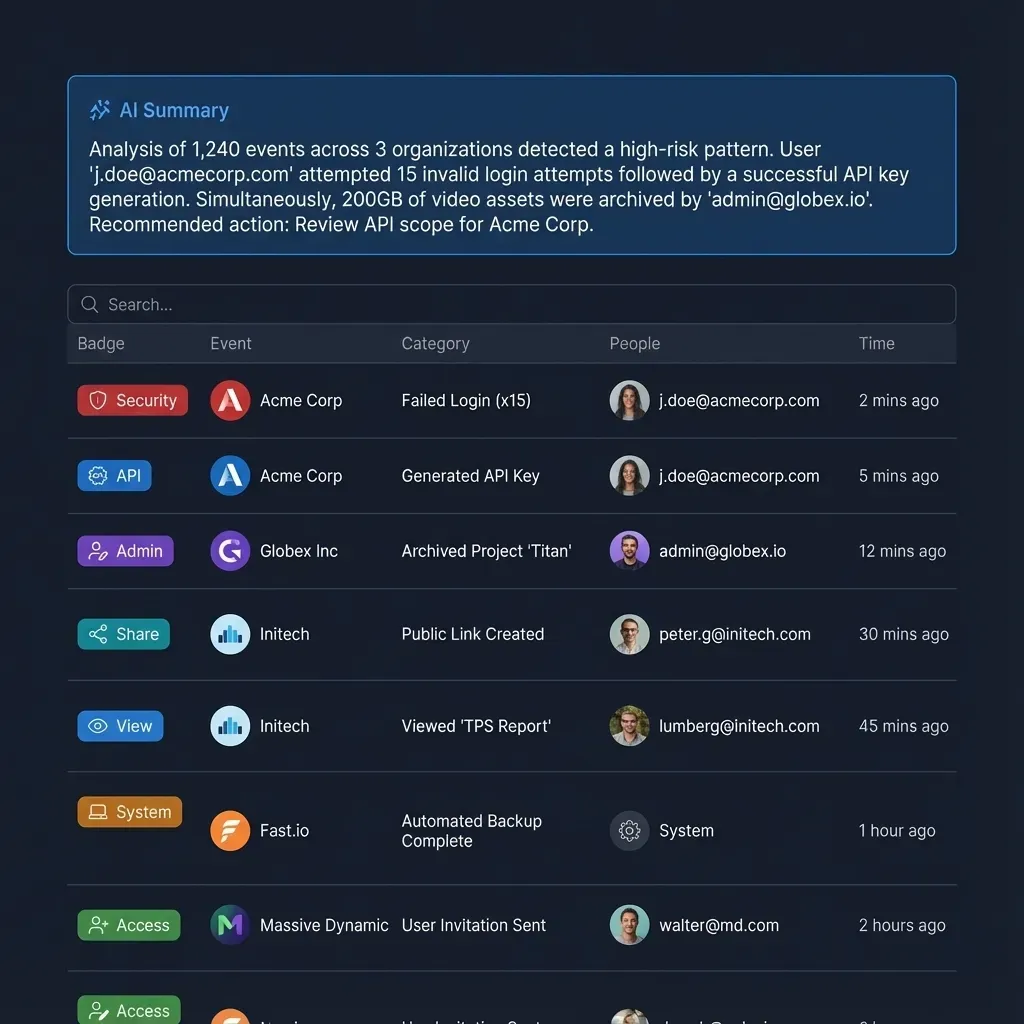
Rather than requiring your application to continuously query the server with aggressive short-polling loops, Fastio's real-time events feed and long-poll endpoint push notifications immediately. When an event occurs inside a workspace, the system records it in the activity log and delivers the event payload to connected clients in milliseconds.
Related guides
- How to Build an Agentic File Router with Fastio EventsAn agentic file router uses Fastio realtime events to dispatch uploaded files to specialized AI agents based on...
- How to Implement Fastio API Real-Time File Event NotificationsFile sharing is the practice of distributing digital files between users over a network, but when AI agents...
- How to Extract File Metadata with PowerShell on WindowsPowerShell ships with every Windows 10 and 11 machine, making it the fastest way to read file metadata without...
- How to Extract File Metadata with Python LibrariesPython has more than ten mature libraries for reading metadata from files, each specialized for different formats. This...
- How to Edit and Extract XMP Metadata from Any FileXMP (Extensible Metadata Platform) is the ISO standard for embedding structured metadata in files like PDFs, images,...
- How to Extract File Metadata with C# and .NET LibrariesC# has several mature libraries for reading metadata from files, each targeting different formats. This guide compares...
More on this subject: Agent File and Document Workflows (325 guides)
Why API Polling Fails for File Workflows
Many legacy applications rely on short polling to detect changes in cloud storage. Polling involves sending repeated HTTP requests on a fixed schedule (such as every five seconds) to check for updates. While simple initially, short polling fails when scaling event-driven AI architectures.
The Latency Penalty If a human client uploads a contract PDF, an agent polling every 30 seconds may wait nearly half a minute before detecting the document. This delay breaks interactive user experiences.
Network Churn and Rate Limits Polling empty workspaces generates thousands of unnecessary HTTP requests each day. Fastio solves this by offering a persistent WebSocket events feed and an activity long-poll endpoint. Clients maintain a single open connection that waits up to 95 seconds for activity before returning, delivering events immediately when mutations happen without burning request quotas.
The Architecture of Event-Driven AI Execution
Understanding event-driven execution is essential for building robust agent workflows. At the core of this system is the Fastio workspace, an organization-owned boundary where humans and agents collaborate.
When a file event occurs, Fastio updates its activity log and broadcasts the event across the WebSocket stream. The listening agent parses the event schema, inspects the file metadata, and determines the appropriate task. Once Intelligence is enabled for the workspace, documents are automatically indexed for semantic search and citation-backed RAG queries via the remote MCP server.


Build Reactive Agent Workflows Today
Connect your AI agents directly to real-time file events with Fastio. Replace naive polling with scalable, event-driven architectures.
How to Bridge Fastio Events to Webhooks
To bridge Fastio real-time file events to third-party webhook endpoints or external automation services, developers deploy a lightweight listener daemon.
Step 1: Set Up the Event Listener
Create a lightweight worker that authenticates with your Fastio API key and connects to Fastio's WebSocket feed or long-polls https://api.fast.io/current/activity/poll/{workspace_id}.
Step 2: Parse Workspace Events
When an event message arrives, extract the event_type, file_id, and workspace_id from the JSON payload.
Step 3: Dispatch to External Webhooks The worker formats an HTTP POST request and forwards the payload to your downstream webhook destination, signing the request with a shared secret to ensure end-to-end security.
Connecting Real-Time Events to OpenClaw and MCP
Fastio is designed specifically to support agentic workflows, integrating with modern frameworks via the Model Context Protocol (MCP). Fastio hosts a remote MCP server at https://mcp.fast.io/mcp/tools (Streamable HTTP) with a consolidated MCP toolset.
When combined with real-time event feeds, developers unlock autonomous capabilities. When a file arrives, the event feed wakes the agent, which connects to the remote MCP server to read files, extract structured metadata, or query document contents with built-in RAG.
Fastio also supports ownership transfer. An agent can create an organization, build workspaces, populate documents, and transfer the organization to a human client using a claim link.
Common Use Cases for Real-Time File Streaming
Real-time file streaming unlocks sophisticated use cases across creative and technical industries.
Automated Media Ingestion In video production and design workflows, team members upload large RAW photos, PSDs, and video footage. Fastio provides in-browser streaming and previews. Real-time events alert encoding agents to process proxies or extract technical metadata without manual human intervention.
Automated RAG Ingestion Legal and financial teams drop contracts and disclosure forms into shared workspaces. When Intelligence is enabled, Fastio indexes files automatically, enabling agents to instantly answer questions with exact citations.
Handling File Events Securely and Idempotently
Building a robust event bridge requires careful attention to security and idempotency.
Authentication and Token Scoping Always use scoped API keys when connecting listener workers to Fastio's activity endpoints. Fastio records every action in a detailed activity log, providing complete visibility into agent operations.
Idempotent Event Handling
Network drops can cause workers to reconnect and re-read recent events. Every Fastio event includes a unique event_id. Store processed event IDs in a cache like Redis with a time-to-live to prevent duplicate downstream executions.
Best Practices for Troubleshooting and Scalability
As your event-driven architecture grows, maintaining reliability and clean connection management is paramount.
Implement Comprehensive Logging Record incoming event IDs, timestamps, and downstream dispatch outcomes. Fastio's audit log provides an authoritative source of truth to cross-reference if discrepancies arise.
Manage Connection Lifecycles Network interruptions will occur. Configure your listener with exponential backoff and random jitter when reconnecting to WebSocket feeds or polling endpoints. This ensures high availability without overwhelming networks during intermittent drops.
Frequently Asked Questions
How do I receive real-time file events from Fastio?
Fastio does not use outbound HTTP webhooks. Instead, connect to Fastio's WebSocket events feed or poll the activity endpoint (GET /current/activity/poll/{entity_id}) using a scoped API key.
Can real-time events trigger an AI agent?
Yes. When an event fires over the WebSocket feed or activity polling endpoint, agents can immediately inspect files and query workspace data via the remote MCP server.
What happens if a connection drops?
If a WebSocket or polling connection drops, clients should reconnect using exponential backoff and resume listening using the last recorded event timestamp.
Are Fastio event feeds faster than traditional polling?
Yes. Fastio's WebSocket feed and long-poll endpoint eliminate the delay and high request overhead of traditional fixed-interval short polling, delivering events in milliseconds.
How do I forward Fastio events to external webhooks?
Run a lightweight bridge service that listens to the Fastio WebSocket feed or activity endpoint and dispatches authenticated HTTP POST requests to your external webhook URLs.
Related Resources

Build Reactive Agent Workflows Today
Connect your AI agents directly to real-time file events with Fastio. Replace naive polling with scalable, event-driven architectures.