How to Connect Claude to Dropbox: Integration Guide
A Claude Dropbox integration links Anthropic Claude models and Claude Code CLI to Dropbox folders, allowing agents to retrieve document excerpts on demand through the Model Context Protocol. Native connectors and direct folder scans often struggle with tool call sprawl and unindexed, scanned files. Fast.io solves this by syncing Dropbox folders into an intelligent workspace, enabling Claude to run fast hybrid searches over indexed documents through a remote MCP server.


The Context Barrier for Claude Dropbox Integration
In a benchmark published on 9 September 2026, Fastio completed a 211-file audit faster than Dropbox (2 minutes and 50 seconds versus 4 minutes and 24 seconds), requiring 29 calls versus 115 for Dropbox, while avoiding unreadable document errors that affected 4 Dropbox documents (including scanned credit memos). Every session ran in Claude in Cowork, the desktop app, with claude-opus-5 as the main agent. The published figures come from 15 fresh sessions on 9 September 2026, one per provider per test.
A Claude Dropbox integration links Anthropic Claude models and Claude Code CLI to Dropbox folders, allowing agents to retrieve document excerpts on demand through the Model Context Protocol. Engineering teams, legal practices, and operations departments store their core institutional records across cloud storage platforms including Dropbox, Google Drive, OneDrive, Box, and SharePoint. Giving artificial intelligence models like Claude Opus, Claude Sonnet, and Claude Code direct visibility into these repositories allows teams to automate contract audits, review technical specifications, draft operational briefs, and query document archives without manual file exports.
Connecting Claude directly to cloud repositories presents immediate architectural and operational hurdles. Most online guides assume developers must manually upload documents into Claude Projects. This manual approach quickly hits project file limits, creates duplicate copies of confidential documents, and fails to reflect updates made to source folders. Other guides suggest writing bespoke Python scripts against the Dropbox API. Building custom API scripts forces engineering teams to maintain OAuth refresh loops, write custom pagination routines, and construct document parsing logic from scratch.
When an autonomous agent attempts to discover information across a complex folder structure, raw storage access breaks down. Enterprise storage sites contain nested folders, versioned documents, scanned receipts, presentations, and spreadsheets. When an agent queries a folder through a direct storage connector, it must discover directories, inspect file metadata, and download entire files into its context window. This sequential retrieval pattern creates tool call sprawl, burns context tokens on irrelevant boilerplate text, and quickly triggers API rate limits. Teams need an integration pattern that preserves existing cloud storage while giving agents rapid, indexed access to specific document excerpts.
Why Direct Folder Traversal and Raw Connectors Slow Down Agents
Connecting Claude to Dropbox natively has expanded with recent developments across the Model Context Protocol ecosystem. Dropbox provides remote MCP connector endpoints, including the Dropbox remote MCP server and the Dropbox Dash remote MCP server. For example, developers can configure Claude Code with the command claude mcp add --transport http DropboxDashMCP https://mcp.dropbox.com/dash, or configure Claude Desktop through custom connector settings.
However, in production environments where autonomous agents process hundreds of documents across project directories, direct connector configurations encounter distinct operational bottlenecks.
The Problem of Tool Call Sprawl
When an agent searches for specific answers across a raw Dropbox folder, it cannot query document contents directly. Instead, it must walk the directory tree. The agent calls directory listing tools to discover subfolders, evaluates file names, issues download requests for candidate files, and reads the raw text into its prompt.
In a multi-document repository, this recursive search creates severe tool call sprawl. To locate three relevant data points across forty files, an agent might issue dozens of separate connector calls. Each round trip incurs network latency, consumes agent execution time, and risks hitting client timeout thresholds. The model spends the majority of its execution budget locating files rather than reasoning over data.
Context Window Exhaustion
When an agent downloads files through direct storage connectors, it ingests entire document payloads. A sixty-page vendor agreement may contain only two relevant termination clauses, yet the model must load tens of thousands of tokens of boilerplate legalese.
Loading multiple complete files into Claude prompt window exhausts token allowances, increases per-query inference costs, and triggers context fragmentation. As the prompt expands with irrelevant text, the model ability to recall specific facts degrades, increasing the likelihood of hallucinated answers or missed clauses.
Unreadable Scanned Documents and Missing OCR
Cloud storage APIs return raw binary streams. When a repository contains scanned PDF agreements, image-based invoices, or handwritten notes, direct connectors pass the unparsed file data to the model. Without an integrated optical character recognition layer, the model receives unreadable text or raw binary markers.
In the 9 September 2026 benchmark, this exact failure occurred: Dropbox failed on 4 documents, including scanned credit memos, leaving critical financial data invisible to the agent. When an audit requires complete accuracy across legal and finance records, silent document read failures create unacceptable risks.
API Throttling and Network Latency
High-frequency requests by autonomous agents place heavy demands on cloud storage endpoints. Dropbox enforces API rate limits to protect service availability. When an agentic script or terminal workflow issues rapid bursts of folder listing and file download requests, endpoints return HTTP 429 rate limit responses. The agent must pause, back off, and retry, turning a quick inquiry into a protracted, unreliable operation.
How to Set Up Claude Dropbox Integration via Fast.io Remote MCP
To resolve the bottlenecks of direct API traversal, teams use an intelligent workspace architecture. Instead of migrating away from Dropbox, teams keep Dropbox as their primary corporate system of record. They sync the necessary folders into a Fastio workspace, which indexes documents in the cloud and provides a remote Model Context Protocol endpoint for Claude.
Fast.io supports Cloud Sync for Dropbox, Box, and OneDrive folders. Synchronization can run one-way or two-way, on a recurring schedule or on demand. Google Drive imports files today with recurring sync coming soon. Synchronization operates on scheduled intervals rather than real-time streams, protecting source storage while keeping workspace indexes up to date.
Connecting Claude Desktop or Claude Code to your synced Dropbox workspace takes five straightforward steps:
- Step 1: Create your Fast.io workspace. Creating an account is free; running workspaces requires an organization on a paid subscription. Every organization starts with a 14-day free trial, which requires a credit card. Plans are Starter at $29/mo, Business at $99/mo, and Growth at $299/mo on Fast.io pricing.
- Step 2: Connect your Dropbox account via Cloud Import. In the Fast.io dashboard, open Cloud Import and authorize your Dropbox account via OAuth. Select the target folders containing your project files or team documents. Fast.io mirrors the directory structure into your workspace.
- Step 3: Enable Intelligence Mode. In your workspace settings, enable Intelligence Mode. Fast.io automatically indexes incoming documents on arrival, generating text chunks and vector embeddings across PDFs, Word files, spreadsheets, presentations, and scanned pages.
- Step 4: Configure Claude Desktop or Claude Code. The Fast.io MCP server is remote, hosted at
https://mcp.fast.io/mcpover Streamable HTTP with a legacy Server-Sent Events transport at/sse.
For Claude Desktop, open your claude_desktop_config.json configuration file:
- On macOS:
~/Library/Application Support/Claude/claude_desktop_config.json - On Windows:
%APPDATA%\Claude\claude_desktop_config.json
Add the Fast.io remote MCP server configuration under the mcpServers block:
{
  "mcpServers": {
    "fastio": {
      "url": "https://mcp.fast.io/mcp"
    }
  }
}
If authenticating with a scoped Fast.io API key, configure the /mcp/key endpoint with an authorization bearer header:
{
  "mcpServers": {
    "fastio": {
      "url": "https://mcp.fast.io/mcp/key",
      "headers": {
        "Authorization": "Bearer YOUR_FASTIO_API_KEY"
      }
    }
  }
}
For developers using Claude Code CLI in the terminal, add the remote MCP endpoint directly:
claude mcp add --transport http fastio https://mcp.fast.io/mcp
- Step 5: Query your indexed files. Restart Claude Desktop or launch your Claude Code session. Claude detects Fast.io consolidated MCP toolset. You can now prompt Claude to search, summarize, and cross-reference documents across your entire Dropbox folder hierarchy.
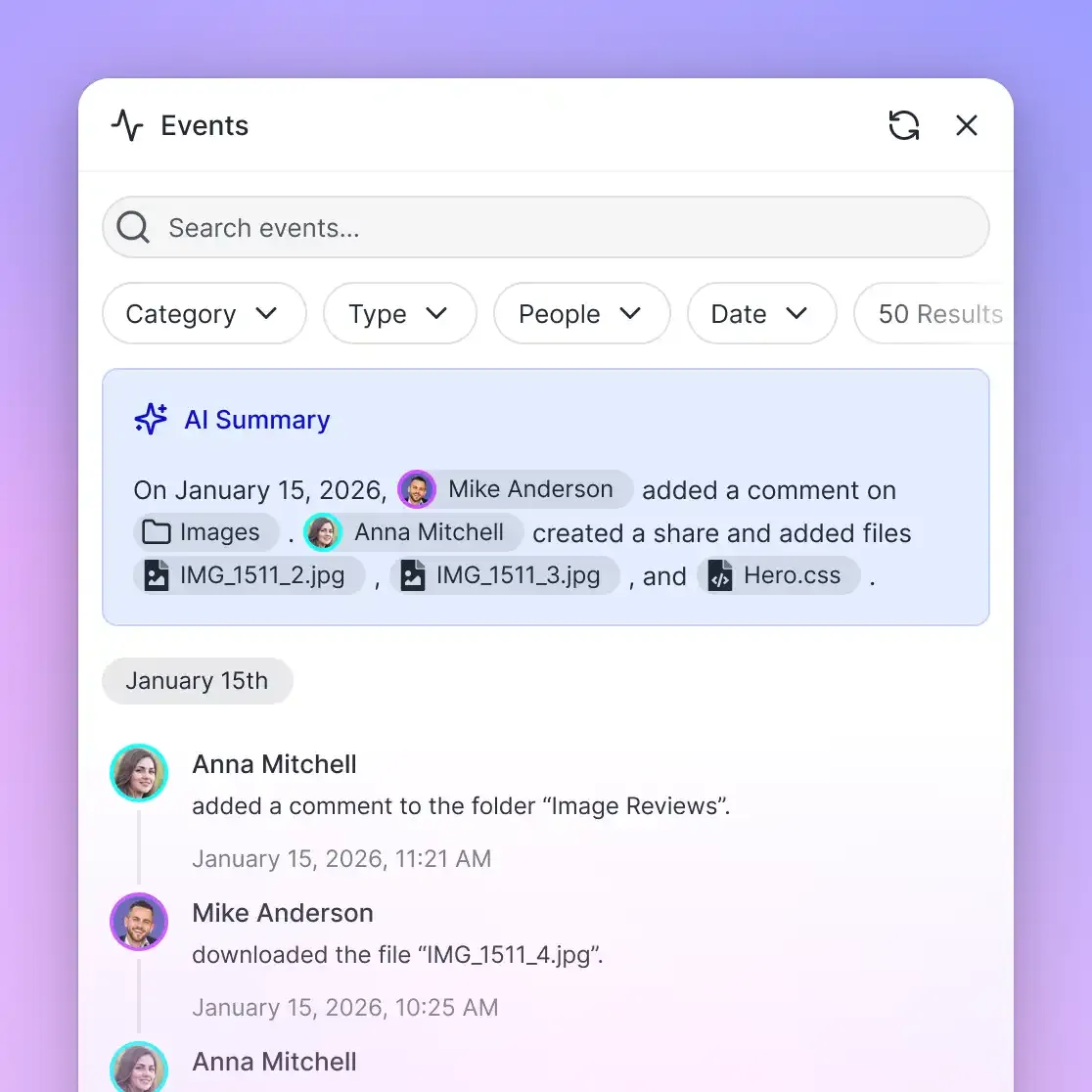


Connect Claude to Indexed Dropbox Workspaces
A shared workspace with a remote MCP server for Claude, indexing your Dropbox documents for hybrid search without tool call sprawl. Starts with a 14-day free trial.
How Indexed Workspaces Eliminate Tool Call Sprawl and Scanned File Errors
The core advantage of an intelligent workspace over raw cloud storage lies in how information is queried. In a standard storage connector, retrieval is client-driven: the agent must locate files, pull complete byte streams over the network, and parse the text locally. In an intelligent workspace, retrieval is index-driven: the workspace processes documents upon arrival, allowing agents to execute targeted search queries that return precise excerpts.
The efficiency gains were demonstrated in the 9 September 2026 multi-document audit benchmark. Auditing 211 files through direct Dropbox access required 115 calls and took 4 minutes and 24 seconds, with 4 documents failing to read due to scan and format limitations. In contrast, querying indexed files through Fastio took 2 minutes and 50 seconds compared to 4 minutes and 24 seconds for Dropbox, while requiring only 29 calls. Fastio completed the audit with zero unreadable document errors.
Hybrid Search Over File Contents
Fast.io eliminates tool call sprawl by combining exact keyword matching with semantic vector search across document text, titles, and metadata. When Claude needs information, it does not download forty files to find two paragraphs. It issues a single search query through the Fast.io MCP toolset.
The workspace evaluates the query against its vector and text index, returning the most relevant document passages along with exact file names and page numbers. Claude receives the factual context it needs in a single tool call, preserving prompt tokens and generating responses backed by verifiable citations.
Structured Extraction with Metadata Views
For teams dealing with repetitive business documents such as invoices, master service agreements, real estate deeds, or insurance claims, simple search is often insufficient. Organizations need structured tables. Fast.io provides Metadata Views, turning unstructured document collections into live, queryable databases.
Users define the fields they want extracted using natural language prompts. AI constructs a typed schema using seven supported data types: Text, Integer, Decimal, Boolean, URL, JSON, and Date & Time. Fast.io scans matching documents in the workspace, extracting structured values from PDFs, images, spreadsheets, and handwritten notes without manual templates or OCR configuration.
New columns can be added at any time without reprocessing existing files. Autonomous agents can query Metadata Views directly through the MCP interface, filtering files by structured attributes like counterparty, effective date, or renewal status before opening individual files.
Eliminating Scanned Document Failures
Scanned receipts, signed contract amendments, and legacy paper records often fail in raw API pipelines because storage connectors lack built-in document intelligence. Fast.io automatically processes scanned pages and images during ingestion. Text layers are extracted and indexed alongside digital documents, ensuring that historical records and scanned memos remain fully visible to Claude during compliance checks and audits.
Multi-Agent Coordination and Governance for Dropbox Data
Real-world AI implementations extend beyond a single developer chatting in a desktop window. Organizations deploy teams of specialized agents: Claude Code in terminal environments refactoring codebases, Cursor in code editors generating components, and autonomous agents executing research or auditing customer records.
When multiple agents interact with documents synced from Dropbox, uncoordinated access can cause version conflicts, unauthorized data exposure, and untracked changes. Fast.io provides a governance layer designed for multi-agent and human collaboration:
- Per-File Version History. Every file in a Fast.io workspace retains complete version history. If an automated agent updates a document or generates inaccurate text, previous versions remain intact. Team members can inspect diffs and restore earlier versions with a single click.
- Granular Permissions. Permissions can be configured across organizations, workspaces, folders, and individual files. Developers can scope an agent API key to a specific folder, ensuring the model cannot view confidential legal files or executive memos stored elsewhere in the directory.
- Collaborative Notes. Fast.io Notes provides real-time co-editing with live cursors for both human teammates and AI agents. Agents can draft research summaries, record audit findings, and outline next steps directly inside notes where human colleagues can observe and guide the work.
- Append-Only Audit Log. An immutable audit log records every file creation, read operation, edit, download, and permission update. Engineering leads and compliance teams maintain an exact record showing which agent accessed which Dropbox document and what changes were made.
- Ownership Transfer. Solutions consultants and internal developers can set up workspaces, configure metadata schemas, and sync Dropbox folders under an agent-created organization. Once testing is complete, the developer transfers organization ownership to the client or business lead via a secure claim link while retaining administrative access.
A Practical Audit Workflow
Consider a financial audit scenario. A finance department syncs an incoming invoices folder from Dropbox into Fast.io. An autonomous Claude Code agent running in a terminal queries the workspace via MCP. The agent uses Metadata Views to extract invoice numbers, vendor names, due dates, and line item totals into a structured table.
The agent checks the extracted numbers against payment records, writes a reconciliation summary into a Collaborative Note, and flags discrepancies. The department controller reviews the note, clicks citations to verify source PDF pages, and signs off on the disbursement. The original files remain organized in Dropbox, while the intelligent workspace provides the indexing, extraction, and audit trail required for safe agentic operation.
Sources
References used to verify factual claims in this guide.
-
The native Dropbox connector for Claude requires access to Claude Custom Connectors on select Claude plans.
Frequently Asked Questions
Can Claude read files from Dropbox?
Yes, Claude can read files from Dropbox through official connectors or through an indexed workspace. Dropbox provides a remote MCP server and Dash connectors for Claude Desktop and Claude Code. For larger repositories, syncing Dropbox folders into a Fast.io workspace enables Claude to query indexed documents via hybrid search, avoiding tool call timeouts and unreadable scanned file errors.
How do I connect Claude Code to my Dropbox folder?
To connect Claude Code to Dropbox via Fast.io, sync your Dropbox folders into a Fast.io workspace using Cloud Import, then enable Intelligence Mode. In your terminal, run `claude mcp add --transport http fastio https://mcp.fast.io/mcp`. Claude Code will automatically discover the consolidated Fast.io MCP tools, allowing you to search and read indexed Dropbox files directly from the command line.
Why does Claude struggle with large Dropbox folder scans?
Direct storage connectors force Claude to recursively walk folder trees and download entire files into memory. In a 211-file audit benchmark, this sequential approach required 115 calls and took 4 minutes and 24 seconds, while failing to read 4 scanned documents. Connecting through an indexed Fast.io workspace resolves this by returning exact text passages in 29 calls, finishing in 2 minutes and 50 seconds.
What is the difference between the Dropbox Dash MCP server and Fast.io MCP?
The Dropbox Dash MCP server connects Claude to company knowledge indexed within Dropbox Dash. The Fast.io MCP server connects Claude to persistent, org-owned workspaces with full-text and semantic search, Metadata Views for structured extraction from scanned documents, and multi-agent coordination tools like Collaborative Notes and append-only audit logs.
How does Fast.io handle scanned documents and credit memos from Dropbox?
Raw Dropbox API streams pass unparsed PDF and image files, which causes read failures when documents lack digital text layers. Fast.io automatically processes scanned pages and handwritten notes during ingestion. Text is extracted and indexed, and Metadata Views can parse structured fields into typed columns without manual templates.
Related Resources

Connect Claude to Indexed Dropbox Workspaces
A shared workspace with a remote MCP server for Claude, indexing your Dropbox documents for hybrid search without tool call sprawl. Starts with a 14-day free trial.