How to Connect Claude Desktop to Dropbox Files via MCP
Claude Dropbox MCP allows Anthropic Claude Desktop to query, search, and retrieve files stored in Dropbox accounts through Model Context Protocol tool interfaces. While local Stdio scripts and direct connectors often struggle with recursive directory walking, unreadable scanned PDFs, and context window limits, syncing Dropbox folders into an indexed Fast.io workspace enables fast hybrid search through a remote MCP endpoint without local process overhead.


How Claude Dropbox MCP Connects Desktop Agents to Cloud Files
In the 9 September 2026 multi-document audit benchmark across 211 files, an autonomous agent querying records directly through Dropbox required 115 calls and 4 minutes 24 seconds, failing on 4 scanned documents. In contrast, querying indexed files through a Fast.io workspace finished in 2 minutes 50 seconds with 29 calls and zero unreadable document errors. Multi-document audit, single run per provider, 9 September 2026. All five sessions fired within about fifteen seconds of each other.
Claude Dropbox MCP allows Anthropic Claude Desktop to query, search, and retrieve files stored in Dropbox accounts through Model Context Protocol tool interfaces. Engineering departments, legal practices, finance teams, and operations groups store critical institutional records across cloud storage providers including Dropbox, Google Drive, OneDrive, Box, and SharePoint. Giving desktop language models like Claude Opus and Claude Sonnet direct visibility into these folders allows knowledge workers to cross-reference contracts, audit financial ledgers, inspect technical specifications, and draft project briefings without manual file downloads.
Connecting Claude Desktop directly to raw cloud repositories introduces steep architectural hurdles. Standard advice often suggests dragging individual files into Claude Projects. This manual approach breaks down quickly: it duplicates sensitive records, hits strict file upload limits, and fails to capture ongoing updates made to the source folders in Dropbox. Another common recommendation involves building custom Python scripts against the Dropbox API. Maintaining custom scripts requires engineering teams to manage OAuth refresh token loops, write custom pagination routines, and build document parsing pipelines from scratch.
When an autonomous language model queries an enterprise storage repository through a naive connector, the retrieval pattern collapses under the weight of recursive directory walking. Business storage accounts hold deeply nested directory structures filled with subfolders, versioned drafts, scanned receipts, PDF agreements, and spreadsheets. To locate a single clause, an agent must discover folders, inspect file listings, download entire files over the network, and ingest raw text into its prompt. This client-driven retrieval pattern wastes execution time, inflates token costs, and risks hitting API rate limits. Teams need an architecture that leaves their core files in Dropbox while providing Claude Desktop with indexed, excerpt-level retrieval.
Why Local Stdio MCP Servers Fail on Production Dropbox Libraries
Connecting Claude Desktop to external storage systems relies on the Model Context Protocol, an open standard developed by Anthropic that allows AI applications to interact with external tools and data sources. When connecting to Dropbox, developers generally evaluate three distinct architectures: local Stdio servers running on the desktop, native hosted connectors like Dropbox Dash, and remote indexed workspace endpoints.
Understanding the structural differences between these patterns is essential for avoiding performance bottlenecks on large document collections.
How Local Stdio Dropbox MCP Operates
Most community guides recommend running a local node-based Dropbox MCP server directly on the host machine. In this pattern, the developer installs a package via npm, registers an application in the Dropbox App Console, generates an access token, and configures Claude Desktop by editing the local claude_desktop_config.json file.
Claude Desktop manages the server lifecycle by spawning a local Node.js child process using standard input and output (Stdio). When a user prompts Claude to inspect Dropbox files, Claude issues tool calls to the local Node process, which makes HTTP requests to the Dropbox API, downloads file payloads to temporary local storage, and pipes the contents back into Claude's active context window.
The Failure Modes of Local Stdio Connectors
While a local Stdio server functions adequately for listing a few files or reading small plain-text notes, it breaks down when exposed to production enterprise libraries:
- Memory and Process Crashes on Large PDF Libraries. Node-based Stdio servers struggle under the memory demands of parsing large, multi-megabyte PDF libraries. When an agent attempts to download and extract text from several fifty-page contracts simultaneously, the local Node process can exceed memory limits and crash, terminating the MCP session.
- Severe Tool Call Sprawl. Because Dropbox exposes files as raw binary objects rather than an indexed corpus, the agent must manually navigate folder trees. Locating three related documents across forty files can require dozens of recursive directory listings and download requests, consuming minutes of execution time.
- Context Window Exhaustion and Token Overhead. Downloading full documents forces Claude to ingest thousands of tokens of boilerplate text, legal disclaimers, and irrelevant appendices. This excessive token consumption consumes prompt budgets, increases inference latency, and degrades the model's recall accuracy.
- Scanned Document Failures. Cloud storage APIs return raw byte streams. When a folder contains scanned PDF agreements, image-based invoices, or signed forms without a digital text layer, the local connector passes raw binary data or empty text strings to Claude, resulting in silent audit gaps.
Remote Endpoints and Hosted Solutions
To bypass local runtime management, providers have developed hosted MCP endpoints. Dropbox Dash provides a remote MCP server accessible at https://mcp.dropbox.com/dash, though connecting it to Claude requires access to Claude Custom Connectors on select Claude plans.
A remote workspace architecture like Fast.io takes this approach further by pairing cloud-to-cloud synchronization with pre-indexing. Instead of forcing Claude to pull entire files over the wire, Fast.io syncs Dropbox folders into a persistent workspace on a schedule or on demand, indexes the text and semantics in the cloud, and exposes a remote MCP endpoint over Streamable HTTP and SSE. Claude queries the index rather than downloading raw folders.
How to Set Up Claude Desktop with Fast.io Remote MCP
Connecting Claude Desktop to your Dropbox files through an indexed workspace eliminates local process management while preserving Dropbox as your primary system of record. Teams keep their folder structures intact in Dropbox, sync the target directories into Fast.io, and point Claude Desktop to the remote endpoint.
Fast.io supports Cloud Sync for Dropbox, Box, and OneDrive folders. Synchronization can run one-way or two-way, on a recurring schedule or on demand. Google Drive imports files today with recurring sync coming soon. Because sync runs on scheduled intervals rather than real-time streams, it protects source storage limits while keeping the workspace index fresh.
Setting up the integration takes five steps:
Step 1: Create Your Workspace
Creating an account is free; running workspaces requires an organization on a paid subscription. Every organization starts with a 14-day free trial, which requires a credit card. Plans are Starter at $29/mo, Business at $99/mo, and Growth at $299/mo on Fast.io pricing. Create an organization and launch a dedicated workspace for your team or project documents.
Step 2: Connect Dropbox via Cloud Import
In the Fast.io administration console, navigate to Cloud Import and authenticate your Dropbox account using OAuth. Select the specific folders you want to sync, such as contracts, engineering specifications, or finance records. Fast.io mirrors the selected directory structure into your workspace and schedules synchronization according to your preference.
Step 3: Enable Intelligence Mode
Open your workspace settings and enable Intelligence Mode. Once enabled, Fast.io automatically processes incoming documents upon arrival. The platform extracts text from digital documents, runs optical character recognition on scanned PDFs and images, and builds a dual index containing full-text keyword indices and semantic vector embeddings.
Step 4: Configure Claude Desktop
The Fast.io MCP server operates as a remote service hosted at https://mcp.fast.io/mcp over Streamable HTTP, with a legacy Server-Sent Events transport available at /sse. Because it is hosted remotely, you do not need to install Node.js packages or run background terminal commands.
Open your claude_desktop_config.json file in your preferred text editor:
- On macOS:
~/Library/Application Support/Claude/claude_desktop_config.json - On Windows:
%APPDATA%\Claude\claude_desktop_config.json
Add the Fast.io server configuration inside the mcpServers object:
{
  "mcpServers": {
    "fastio": {
      "url": "https://mcp.fast.io/mcp"
    }
  }
}
If you prefer to authenticate using a scoped Fast.io API key, configure the /mcp/key endpoint with an Authorization Bearer header:
{
  "mcpServers": {
    "fastio": {
      "url": "https://mcp.fast.io/mcp/key",
      "headers": {
        "Authorization": "Bearer YOUR_FASTIO_API_KEY"
      }
    }
  }
}
For developers who also work in terminal environments using Claude Code CLI, add the remote endpoint with a single command:
claude mcp add --transport http fastio https://mcp.fast.io/mcp
Step 5: Query Your Indexed Dropbox Files
Restart Claude Desktop. When the application loads, Claude automatically detects the consolidated Fast.io MCP toolset. You can now prompt Claude to search, summarize, cross-reference, and analyze documents across your Dropbox folders. Claude queries the cloud index directly, retrieving exact text passages rather than transferring entire directory trees.


Connect Claude Desktop to Indexed Dropbox Files
Connect Claude Desktop to a persistent, indexed workspace that eliminates tool call sprawl across your Dropbox folders. Starts with a 14-day free trial.
How Indexed Workspaces Eliminate Tool Call Sprawl and Scanned File Errors
The primary performance difference between raw storage connectors and an intelligent workspace centers on where retrieval happens. In a direct storage connector, retrieval is client-driven: Claude must repeatedly poll the storage API, inspect folder manifests, download complete files over the network, and evaluate the text locally. In an intelligent workspace, retrieval is index-driven: the cloud platform parses documents at ingestion, allowing Claude to execute targeted queries that return precise, citation-backed excerpts.
The operational impact of this difference was recorded in the 9 September 2026 multi-document audit benchmark. Auditing 211 files through direct Dropbox access required 115 calls, took 4 minutes 24 seconds, and failed to read 4 documents due to format and scanning constraints. Fast.io completed the exact same audit in 2 minutes 50 seconds using 29 calls, opening only 18 relevant files and achieving zero read errors.
Hybrid Search Over File Contents
Fast.io replaces recursive directory walking with dedicated Hybrid Search. When Claude needs information to answer a prompt, it does not download forty separate documents. It issues a single search query through the consolidated MCP tools.
Fast.io evaluates the query against two complementary index layers:
- Exact Full-Text Matching. Finds specific entity names, alphanumeric contract identifiers, invoice numbers, or statutory clauses.
- Semantic Meaning-Based Retrieval. Discovers relevant sections even when the source documents use alternative terminology, synonyms, or conceptual paraphrasing.
Instead of flooding Claude's prompt with hundreds of pages of irrelevant contract language, the MCP tool returns the most relevant document passages, complete with the source file name, folder path, and page number. Claude receives the exact factual context needed to formulate an accurate answer in a single tool call, preserving prompt tokens and eliminating hallucination risks.
Structured Document Extraction with Metadata Views
When teams handle standardized business records such as vendor contracts, master service agreements, real estate deeds, or insurance claims, unstructured search is only the first step. Operations teams frequently need structured data tables. Fast.io provides Metadata Views, converting unstructured file collections into live, queryable relational tables.
Metadata Views operate without rigid templates or manual OCR configuration:
- Natural Language Schema Creation. Users describe the columns they need in plain English, such as counterparty name, effective date, governing jurisdiction, renewal notice period, and liability ceiling.
- AI-Designed Typed Schemas. The system creates a typed schema supporting 7 data types: Text, Integer, Decimal, Boolean, URL, JSON, and Date & Time.
- Automated Extraction Across File Types. The extraction engine processes PDFs, image-based scans, spreadsheets, presentations, Word documents, and handwritten notes.
- Incremental Field Addition. Teams can add new extraction columns at any time without reprocessing previously scanned documents.
Autonomous agents and Claude Desktop can interact with Metadata Views programmatically through the MCP interface. Claude can query the structured view directly, filtering files by structured attributes (such as identifying all agreements renewing within the next sixty days) before pulling specific document excerpts.
Resolving Scanned Document and Image Errors
Legacy paper records, signed counterparty addenda, and scanned billing receipts frequently cause failures in direct API pipelines because standard storage endpoints return unparsed binary streams. In the 9 September 2026 benchmark, direct Dropbox retrieval failed on 4 documents, including scanned credit memos, blinding the agent to critical financial adjustments.
Fast.io automatically extracts text layers and applies OCR during ingestion. Scanned invoices, handwritten notes, and image-based PDFs become fully searchable text within the workspace index. When Claude Desktop audits a folder, historical scanned records are queried alongside modern digital documents with equal fidelity.
Multi-Agent Governance and Shared Workspace Collaboration
Deploying Claude Desktop across corporate Dropbox files frequently expands into multi-agent workflows. A finance department might run Claude Desktop for executive queries, Claude Code in terminal environments for automated reconciliation scripts, Cursor for software engineering, and independent background agents generating compliance briefs.
When multiple agents and human staff access files synced from Dropbox, unmanaged connections risk version collisions, accidental overwrites, and unmonitored data exposure. Fast.io provides an organization-wide governance and collaboration layer designed specifically for human-agent teams.
Core Governance Capabilities
Fast.io equips teams with tools to maintain control, visibility, and data integrity:
- Per-File Version History. Every file in a Fast.io workspace maintains complete version history. If an agent script generates inaccurate text or overwrites a critical draft, previous versions remain intact. Team members can compare revisions and restore prior states with a single click.
- Granular Permission Controls. Access permissions can be scoped precisely across organizations, workspaces, folders, and individual files. Administrators can generate API keys restricted to a single subfolder, preventing an agent from accessing executive payroll files or sensitive board materials stored elsewhere in the directory.
- Collaborative Notes. Fast.io Notes provides real-time co-editing with live multiplayer cursors for human teammates and AI agents. Claude can write research findings, draft meeting summaries, and compile audit tables directly into a shared note where human colleagues observe the text appearing in real time. Notes are automatically indexed for AI grounding across the workspace.
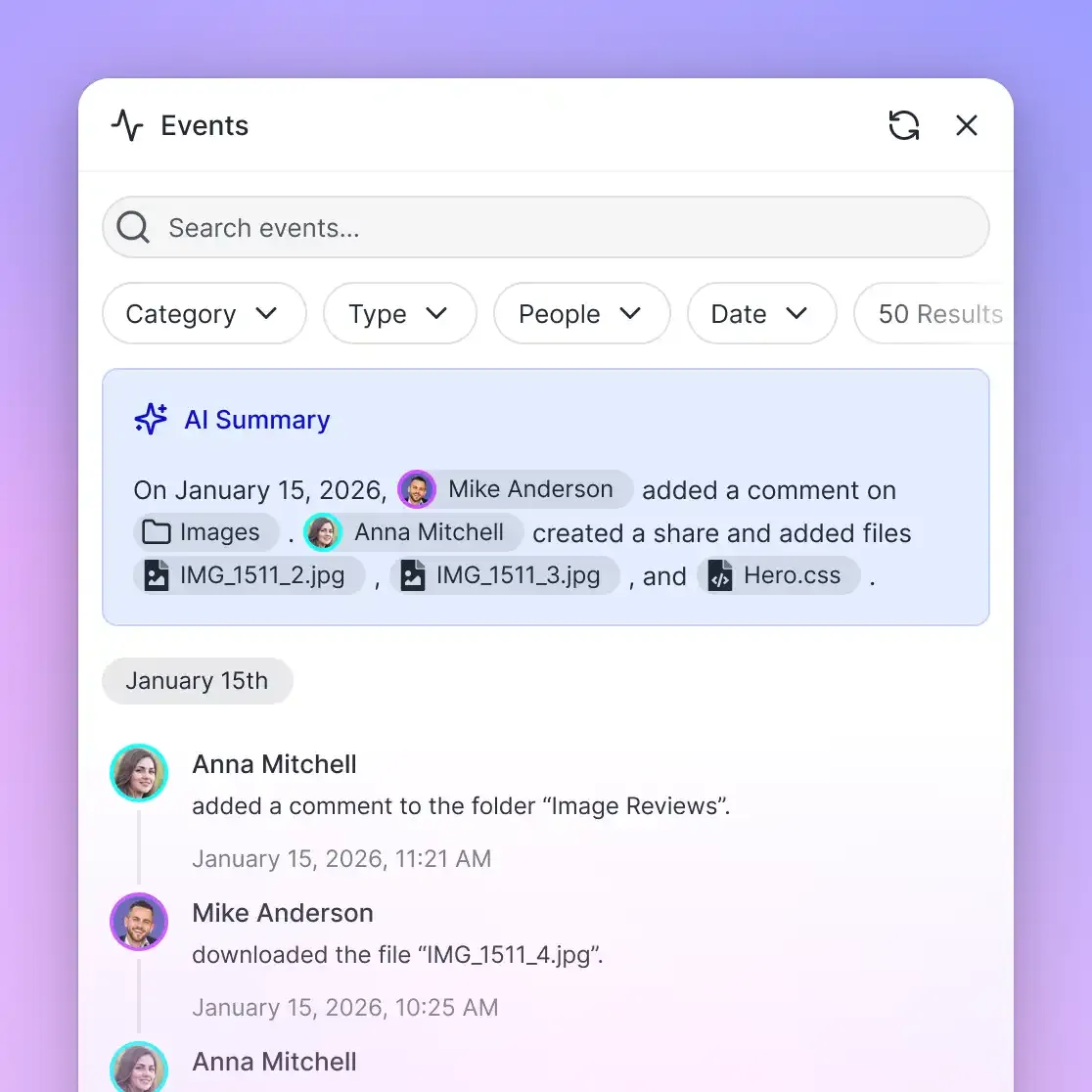
- Append-Only Audit Log. An immutable, append-only audit log records every file operation, read request, modification, link creation, and permission update. Compliance officers and engineering leads maintain a verifiable chain of custody showing which agent accessed which Dropbox document and what changes occurred.
- Ownership Transfer. Solutions architects and technical consultants can create organizations, configure workspace sync with Dropbox, build Metadata Views, and test agent queries. Once testing is complete, the creator transfers organization ownership to the client or business lead via a secure claim link while retaining administrative access.
End-to-End Enterprise Workflow Example
Consider an enterprise compliance audit. An operations team syncs a corporate vendor folder from Dropbox into a Fast.io workspace using Cloud Sync. Fast.io automatically processes incoming vendor contracts, non-disclosure agreements, and invoices, indexing text and running OCR on signed signature packets.
A compliance analyst opens Claude Desktop and queries the workspace through the Fast.io remote MCP endpoint. The analyst prompts Claude to verify whether all active vendor contracts contain standard data privacy clauses and required insurance limits. Claude queries the workspace index, retrieving relevant paragraphs and page citations across forty different agreements in seconds without downloading raw files to the desktop.
Simultaneously, a background agent uses Metadata Views via MCP to extract vendor names, expiration dates, and policy amounts into a structured grid. The analyst and the agent co-author an audit reconciliation report inside a Collaborative Note. The original repository remains organized in Dropbox, while the intelligent workspace provides the indexing, structured extraction, and audit governance required for reliable agentic work.
Sources
References used to verify factual claims in this guide.
-
Connecting Claude to the Dropbox Dash remote MCP server requires access to Claude Custom Connectors on select Claude plans.
Frequently Asked Questions
How do I connect Dropbox to Claude Desktop via MCP?
To connect Dropbox to Claude Desktop via Fast.io remote MCP, sync your Dropbox folders into a Fast.io workspace using Cloud Import, then enable Intelligence Mode to index your documents. Open your claude_desktop_config.json file and add the remote endpoint URL `https://mcp.fast.io/mcp` under the mcpServers configuration block. Restart Claude Desktop to start querying your indexed Dropbox files with hybrid search.
Is there a remote MCP server for Dropbox?
Yes, there are remote MCP options. Dropbox provides the Dropbox Dash remote MCP server at `https://mcp.dropbox.com/dash`, which requires Claude Custom Connectors on select plans. Alternatively, Fast.io provides a hosted remote MCP server at `https://mcp.fast.io/mcp` that pairs with scheduled Dropbox folder synchronization, allowing Claude to query indexed documents without local process management.
Why does Claude get slow when querying Dropbox folders?
Direct storage connectors force Claude to recursively walk directory trees and download entire files into memory sequentially. In a 211-file audit benchmark, this sequential approach required 115 calls and 4 minutes 24 seconds. Querying through an indexed Fast.io workspace resolves this by returning exact text passages in 29 calls taking 2 minutes 50 seconds.
How do I search Dropbox documents in Claude without uploading them?
You can search Dropbox documents without manual file uploads by syncing your Dropbox folders into a Fast.io workspace via Cloud Import. Once Intelligence Mode is enabled, files are automatically indexed for full-text and semantic search. Claude Desktop queries this index through the Fast.io remote MCP server, retrieving exact text excerpts and page citations on demand.
How does Fast.io handle scanned PDFs and image-based credit memos from Dropbox?
Direct Dropbox API connectors return raw file bytes, which fail when documents lack digital text layers. Fast.io automatically processes scanned pages, receipts, and image-based PDFs using optical character recognition during ingestion. Extracted text is added to the workspace index, ensuring scanned records remain fully visible to Claude queries.
Can multiple AI agents query the same synced Dropbox folder simultaneously?
Yes. Because Fast.io hosts the workspace index in the cloud, multiple agents, such as Claude Desktop, Claude Code CLI, and custom scripts, can query the same files simultaneously via MCP. Fast.io manages concurrent access through per-file version history, granular folder permissions, and an append-only audit log that tracks all operations.
Related Resources

Connect Claude Desktop to Indexed Dropbox Files
Connect Claude Desktop to a persistent, indexed workspace that eliminates tool call sprawl across your Dropbox folders. Starts with a 14-day free trial.